NGHM as Guest | “80 Years Later – Using History for Democracy”: Panel Discussion at Georgianum in Lingen.

This post was automatically translated from the German original at
NGHM zu Gast | „80 Jahre danach – mit Geschichte für Demokratie”: Podiumsdiskussion am Georgianum in Lingen..
On 21 May, Prof. Dr. Christoph Rass was a guest at the Georgianum in Lingen. There, students prepared a panel discussion on questions of historical and memorial culture in the context of Nazi rule, the Second World War and the Holocaust as part of their history seminar course and created a radio programme together with Ems-Vechte-Welle.
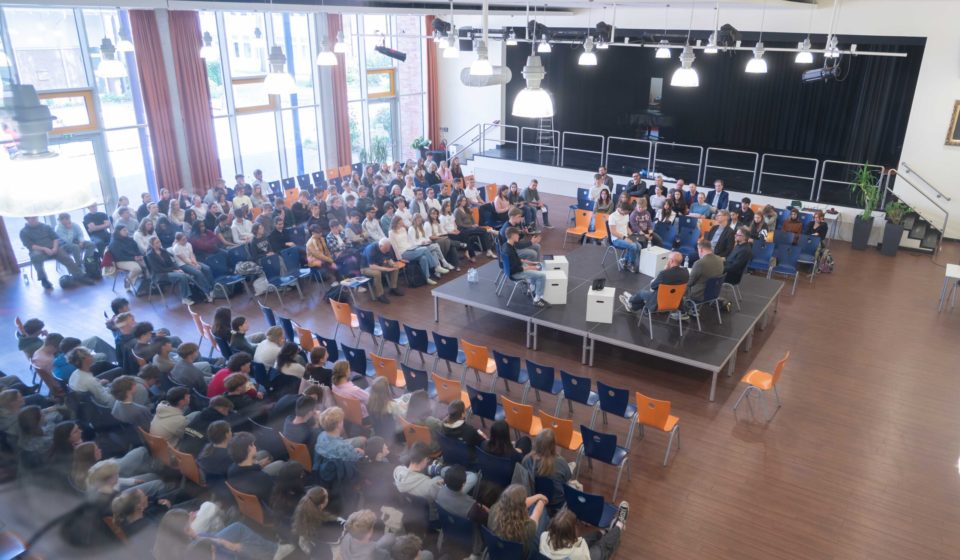
On 21 May 2025, an extraordinary panel discussion took place in the canteen of the Gymnasium Georgianum in Lingen. Upper school students had prepared an expert panel on society’s approach to the Nazi era. The intergenerational dialogue between academics and students produced fascinating perspectives on democratic opinion formation and historical education.
So what does the Nazi past mean for our society today? The students wanted to clarify this question through interdisciplinary dialogue and brought together scholarship, media, justice and memorial culture: Prof. Dr. Christoph Rass from the University of Osnabrück represented historical scholarship, Marko Schnittker contributed the media perspective as managing director of Ems-Vechte-Welle, Dr. Sebastian Weitkamp, director of the Esterwegen Memorial, participated from the perspective of practical memorial and educational work, and Markus Hardt, director of Lingen District Court, brought legal expertise to the debate.
After a brief introduction by headmaster Lucas Sieberg and history teacher Stefan Roters, the students confronted the experts with questions on four thematic areas:
(1) German self-understanding and the “question of guilt”. The first set of questions was devoted to the still virulent discussion about historical responsibility and distinguished this from the “question of guilt” repeatedly revived by political actors on the right. Both fundamental philosophical questions and current legal aspects were addressed. The representatives of historical scholarship differentiated how various generations since the end of the war have dealt with these phenomena and how this can also be demonstrated specifically in the Emsland region.
(2) Memory in the digital era. The second block focused on the future of memorial culture. The discussants explored how traditional memorial sites can further develop their communication and educational work in times of YouTube and TikTok and make their memorial work future-proof. For today’s students, who understand themselves as primarily digitally socialised, these questions proved particularly interesting.
(3) Democracy and its limits. The third set of questions addressed current challenges to democracy. From freedom of expression in social media to concrete cases such as the discussion about Bernd-Rosemeyer-Straße in Lingen, the students drew a wide arc between historical reappraisal, historical culture and their significance for contemporary social debates.
(4) Future perspectives. Finally, the focus turned forward: What lessons can be drawn from history and how can memory be preserved when the last witnesses leave us?
The result of the 90-minute session was not only a fascinating dialogue between representatives of media, scholarship and administration, but an extraordinary example of innovative educational work, in which students did not remain merely passive listeners, but actively shaped the discourse with their knowledge and critical perspective as moderators and questioners. Such forms of participatory educational work show how historical learning and democratic competence development can be linked together in everyday school life.
The Georgianum has impressively demonstrated what contemporary history teaching can look like. Through the combination of scholarly expertise, media presentation and intergenerational participation, a productive format has emerged that, 80 years after the end of Nazi rule, has provided an impressive sign of critical and reflective engagement with the Nazi past against all demands for drawing a “final line”.
The students of the Georgianum have shown how taking on historical responsibility can succeed in the best sense. The next generation is ready.