NGHM reads | Carlo Ginzburg: The Cheese and the Worms (1976)

This post was automatically translated from the German original at
NGHM liest | Carlo Ginzburg: Der Käse und die Würmer (1976).
What can we learn from the words of a Friulian miller about the world of the late sixteenth century, and why from his words in particular? Carlo Ginzburg’s The Cheese and the Worms, the next title on the NGHM reading list, is one of the classic texts of microhistory and pursues this question so consistently that the book has substantially shaped the profile of this research approach: the Microstoria.
In the early hours of 17 June 2026, Carlo Ginzburg died in Bologna, at the age of 87. With him, the historical discipline loses one of its most influential and internationally widely read representatives. This entry in our reading list now reads differently. What was intended as a reading recommendation for a methodological classic also becomes a retrospective on half a century of scholarship: from the first Friuli study (1966) to Il vincolo della vergogna, which Ginzburg presented in Bologna as recently as February 2026.
Let us begin with a scene from the archive. In the summer of 1962, a young historian working in the inquisitorial archive of the archiepiscopal curia in Udine comes across the name of a miller in an index compiled by a local inquisitor: Domenico Scandella, known as Menocchio, born in 1532 in Friuli, brought before the Holy Office twice, and ultimately executed as a heretic. The historian notes the case, sets it aside, and returns to other subjects. Only years later does he take up the files again. In 1976, a slim volume is published by Einaudi in Turin that changes the discipline of history. Carlo Ginzburg, born in 1939 in Turin, is at this point a lecturer in Bologna. There, in the years after 1970, he becomes drawn into debates about the relationship between popular culture and learned high culture: the immediate context of the study.
Ginzburg studied at the Scuola Normale Superiore in Pisa, where he graduated in 1961, and taught from the 1970s onwards at the University of Bologna, before moving in 1988 to UCLA as Franklin D. Murphy Professor of Italian Renaissance Studies and returning to Pisa in 2006. Teaching positions at American universities, including Harvard, Yale, and Princeton, complemented this trajectory.
His family biography also left its mark on his work: his father Leone Ginzburg, a key figure in the antifascist resistance against the German occupation of Italy, died in February 1944 in the hands of the Gestapo, as a result of torture in the Roman prison of Regina Coeli. Ginzburg’s mother, Natalia Ginzburg, became one of the most influential Italian writers of the postwar period. His first Friuli study, I benandanti of 1966, had already led Ginzburg into the field of early modern popular religiosity. In Menocchio he found a case that concentrated the open question of that field in a distinctive way: whether and how the cultural world of those without literacy or voice could be reconstructed when the only sources are the interrogation records of their persecutors.
The book takes an unusual approach. Rather than opening with a methodological manifesto, Ginzburg begins with Brecht’s poem about the ‘reading worker’ [“Fragen eines lesenden Arbeiters” / “Questions of a Reading Worker”], a signal that the study poses a political question before it becomes a methodological one: who has a voice in the surviving archives of power, and who does not?
At the center of the book are two inquisitorial proceedings of 1583/84 and 1599 against the literate miller. From the interrogation records, Ginzburg reconstructs a heretical cosmogony according to which the world, angels, and God had spontaneously emerged from a chaotic primordial matter, analogous to the formation of worms in cheese. This cosmogony is less Menocchio’s coherent doctrine than Ginzburg’s reading of fragmentary statements extracted under interrogation: in the record of 1584, the miller explains that everything had initially been a chaos of earth, air, water, and fire, from whose swirling motion a mass had formed, comparable to the curdling of cheese from milk, in which worms had then appeared — and these were the angels. Ginzburg systematically compares these and other statements with the books that Menocchio is known to have read, such as the Bible in the vernacular, Boccaccio’s Decameron, and the travels of Sir John Mandeville, and from the shifts, misreadings, and over-interpretations he reconstructs an independent peasant worldview. From this he develops what is perhaps his most far-reaching and at the same time most contested thesis: the assumption of a persistent peasant culture, largely independent of learned high culture and bearing materialist features, which found language and resonance through the printing press and the Reformation without being absorbed into learned heresies.
Methodologically, the book is intertwined with the program of the Microstoria: the reduction of the scale of observation and the attention to the individual case, which renders visible structures that remain invisible in the aggregate. The formula of the eccezionale normale, the ‘normal exception’, so frequently invoked in this context, does not originate with Ginzburg but with Edoardo Grendi (1977); it designates a figure of thought belonging to the entire microhistorical debate. This debate was a collective enterprise: it crystallized around the journal Quaderni storici and around the Einaudi series ‘Microstorie’ edited by Giovanni Levi and Ginzburg. The impact was international: the book was translated into numerous languages and discussed alongside Le Roy Ladurie’s Montaillou. Peter Burke, Natalie Zemon Davis, Roger Chartier, and Robert Darnton are among its most prominent recipients.
However, criticism also set in early. In two essays, Uno, due, tre, mille Menocchio (1979) and From Menocchio to Piero della Francesca (1985), Paola Zambelli accused Ginzburg of overgeneralizing from the individual case: can a representative worldview really be derived from an extremely fragmented universe of heretical and deviant teachings? Brigitta Bernet, in a re-reading for Geschichte der Gegenwart, has shown that the book can simultaneously be tied to the political horizons of left-wing intellectual Italy in the 1960s and 1970s, and is therefore less ‘innocent’ than its methodological self-description suggests. In 1990, Andrea del Col produced a critical edition of the underlying inquisitorial records, Domenico Scandella detto Menocchio. I processi dell’Inquisizione (1583–1599), published by Edizioni Biblioteca dell’Immagine in Pordenone. Since then, Ginzburg’s work with the sources has for the first time been broadly verifiable.
Those who, in the previous entries of this series, have followed Trouillot’s question about the points in historiographical production at which silences are created will find in Ginzburg a different answer to a related question: inquisitorial records are the archive of a machinery of persecution, but it is precisely their detective-like reading, against the grain, that can make audible voices which the apparatus was intended to silence. Methodologically, the book also connects with the research program of the Osnabrück Collaborative Research Centre 1604 ‘Production of Migration’ and our approach of ‘Negotiating Migration‘. Both treat process-generated sources such as administrative records, interrogation protocols, and registration documents as simultaneously distorting and indispensable means of access to the voices of subaltern actors.
This reading against the grain was not an isolated instance for Ginzburg, but a method. The Cheese and the Worms does not stand alone, but represents an epistemological procedure that Ginzburg conceptualized in 1979 as the ‘paradigma indiziario‘, the evidential paradigm, according to which historical reality is revealed less through general laws than through traces, symptoms, and inconspicuous details that the detective gaze learns to read. From the ‘benandanti‘ (1966) through Menocchio to Storia notturna (1989), his widely discussed ‘decipherment’ of the witches’ sabbath, this procedure remained the common thread: the small as a means of access to the large, the anomalous as a window into structure. In his later works, Ginzburg turned his attention increasingly to the conditions of historical knowledge itself: to distance and estrangement as instruments of cognition (Occhiacci di legno, 1998) and to the relationship between truth, falsehood, and fiction (Il filo e le tracce, 2006), which he defended to the last against a comfortable relativism and against the political instrumentalization of history. The international resonance of his work — whose books are available in translation in more than twenty languages and which was honored with awards ranging from the Aby Warburg Prize (1992) to the Balzan Prize (2010) — was always grounded in the same uncomfortable conviction: that truth exists, but that its reconstruction demands labor, especially at the margins of the historical record.
In the summer semester of 2026, Ginzburg’s miller will also be read as part of the foundational literature of historical scholarship in the Osnabrück reading seminar of Prof. Dr. Christoph Mauntel, which indicates that this book is regarded as a methodological foundational text well beyond social history. Later in this series, Joan Wallach Scott will follow as an author whose question about representation and analytical category shifts the problem of voice once again.
What remains is a shift in scale: for Ginzburg, the significance of a historical question is measured not by the scope of its subject matter, but by the precision with which an individual case renders the structures of its world legible.
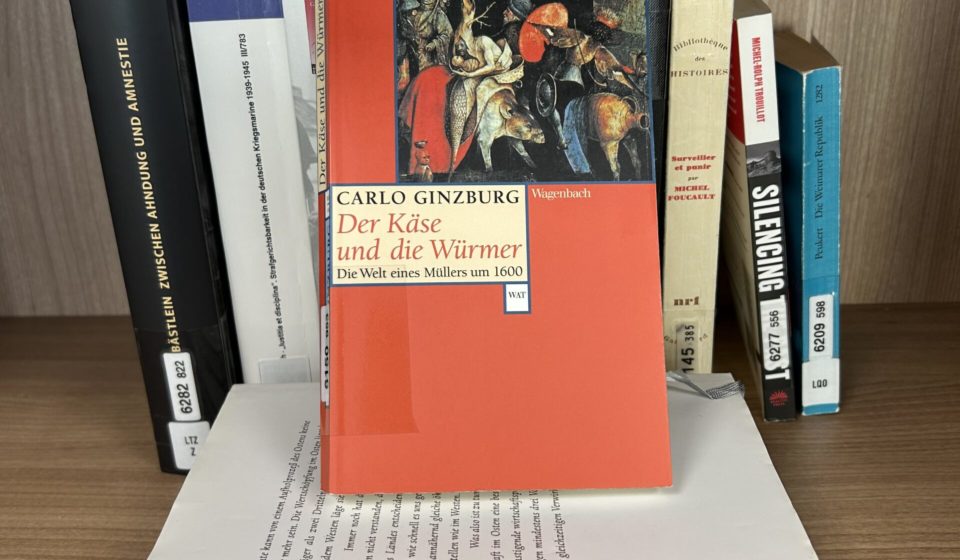
Osnabrück students will find Ginzburg’s Der Käse und die Würmer in the B open-stack collection under the shelf mark 6150-953 7 (OPAC).
Carlo Ginzburg (b. 1939), Der Käse und die Würmer. Die Welt eines Müllers um 1600, Frankfurt am Main: Syndikat 1979 (Italian first edition: Il formaggio e i vermi. Il cosmo di un mugnaio del ‘500, Turin: Einaudi 1976).
This entry is part of the series NGHM liest [NGHM Reads], in which the 65 titles of the NGHM reading list are presented. The list can be explored as a knowledge graph.