Osnabrücker Mitteilungen Vol. 130 published | NGHM team represented once again

This post was automatically translated from the German original at
Osnabrücker Mitteilungen Bd. 130 erschienen | Team NGHM erneut vertreten.
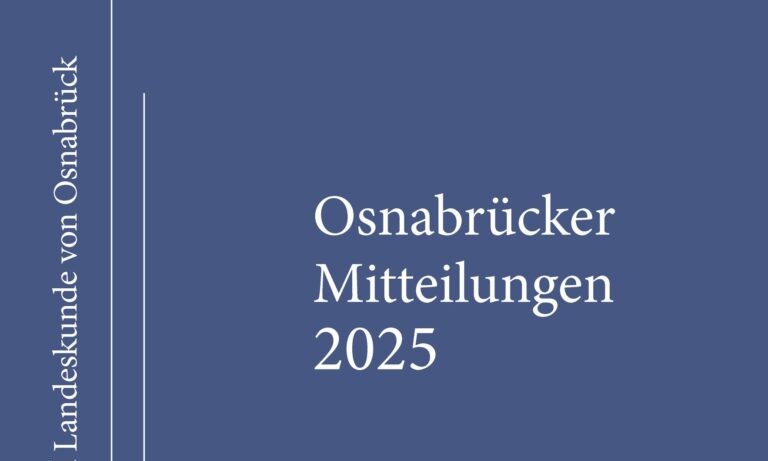
In December, the Association for History and Regional Studies of Osnabrück reported on its blog about the publication of the latest volume of the Osnabrücker Mitteilungen. In this year’s edition, the Research Group for Contemporary History and Historical Migration Research is represented twice. Both contributions address central questions of social exclusion, domination and counter-action in the 20th century and are simultaneously closely connected to current methodological debates in contemporary history research.
Simon Hellbaum (formerly NGHM team) examines in his contribution the Osnabrück homeless shelter ‘Papenhütte’ as a site of social marginalisation and municipal order policy in the 20th century. Based on extensive archival research, he shows how homelessness was negotiated in administration, public discourse and urban planning, and how categories such as ‘asociality’ and ‘worthiness’ of welfare became consolidated in the process. The spatial concentration of homeless people on the margins of the urban area appears as a deliberate strategy of social exclusion. For the period of National Socialism, Hellbaum demonstrates how existing practices of stigmatisation were radicalised and integrated into the system of racist persecution. The essay makes clear how strongly long-term continuities of municipal social policy can be traced across political caesuras. A detailed examination of the ‘Papenhütte’ in its complete history can be found in the NGHM online exhibition.
Valentin Loos addresses in his contribution the question of what can actually be understood as ‘resistance’ against National Socialism in the local context. Starting from the controversial debates about narrow and broad concepts of resistance, he analyses how resistant action is constructed in a source-dependent manner, using the Osnabrück Gestapo card index. The essay shows that different definitions of resistance lead to significantly divergent findings – both regarding the quantity and the social composition of the actors identified as resistant. Particularly convincing is the connection of theoretical reflection with a data-based evaluation of a central body of sources documenting National Socialist rule. Loos thus advocates for a self-reflective approach to concepts of resistance while simultaneously making an important contribution to research on NS rule and persecution at the local level.
On 15 January 2026, the official presentation of the volume will take place at 7 pm in the Museumsquartier Osnabrück. The event will be framed by short presentations from selected authors and concluded with a reception. Valentin Loos is among the speakers and will present highlights of his essay in a fifteen-minute contribution.