Production of ‘Volksgemeinschaft’. Notes on a Conference in Hameln

This post was automatically translated from the German original at
Produktion von ›Volksgemeinschaft‹. Notizen zu einer Tagung in Hameln.
The Conference
From 18 to 20 June 2026, the Dokumentations- und Lernort Bückeberg invited participants to Hameln, to the premises of the Zedita, in cooperation with the Stiftung niedersächsische Gedenkstätten and the Institut für Didaktik der Demokratie at Leibniz Universität Hannover. The title of the conference posed a question: »Die NS-Gesellschaft als ›Volksgemeinschaft‹? Inszenierungen, soziale Praxis und Handlungsspielräume« [»National Socialist Society as ›Volksgemeinschaft‹? Stagings, Social Practice, and Spaces of Agency«]. The question mark was programmatic.
At the center stood not the concept as a label, but the processes behind it: the propagandistic stagings, the local spaces of agency, the social practice through which a word became social reality. The conference was deliberately aimed at a broad audience: paid and voluntary staff of Lower Saxon memorial sites and places of remembrance, history initiatives, researchers, students, and school pupils. Historical scholarship and historical-political education sat at the same table for three days.
What came together over those three days can only be traced here in outline. The conference program records the lectures, the parallel workshops, the panel discussion, and the excursions in full, sustained by contributions from research and educational work in equal measure; the following notes draw out individual threads.
One distinctive feature of the conference lay in the manner in which our venue carried the theme: on the Bückeberg near Hameln, the National Socialists staged the ›Reichserntedankfeste‹ [Reich Harvest Thanksgiving Festivals] from 1933 to 1937, one of the regime’s largest mass events: a media-ready image of an ostensibly unified ›Volksgemeinschaft‹, manufactured in order to divide society and prepare it for war. Those wishing to discuss the production of community will find here its infrastructure made landscape.
Opening and Framing
Three lectures opened the conference and simultaneously marked out three axes. Felix Berge (Universität der Bundeswehr München) undertook a conceptual survey of the terrain under the title »Wozu ›Volksgemeinschaft‹? Eine historiographische Ortsbestimmung« [»What is ›Volksgemeinschaft‹ for? A Historiographical Positioning«]. Linda Conze (Kunstpalast Düsseldorf) turned to the visual staging of the festival with »Das Fest und die Fotografie« [»The Festival and Photography«]. And Bernhard Gelderblom (independent historian, Hameln) traced the local axis with »Der lange Weg zum Dokumentations- und Lernort Bückeberg« [»The Long Road to the Dokumentations- und Lernort Bückeberg«], the history of the memorial site itself.
The first lecture set the framework for our exchange. Berge traced the key concept back to its origins in the First World War and the Weimar Republic, and charted the research debates of the preceding decades, from early social history to the conjuncture that grasped ›Volksgemeinschaft‹ as social practice and crystallized in the edited volumes of around 2009 and 2013. In doing so, he weighed what the concept signifies and where it reaches its limits. His remarks delineated a coordinate system for the days to come.
A Workshop on the Osnabrück Gestapo Card Index
A workshop drawn from the author’s own research explored the same questions by a different route on the same Thursday afternoon: not through staging, but through administration. The subject was the central card index of the Staatspolizeistelle Osnabrück [Osnabrück State Police Office], held today at the Niedersächsisches Landesarchiv [Lower Saxon State Archive], one of only six substantially preserved card indexes of a regional Gestapo office in the German Reich.
The card index was, however, already established in 1928 by the Prussian Political Police as part of an administrative reform. It was not until 1933 that the Gestapo adopted the instrument and continued the card index until the end of the war. Within the DFG project »Überwachung. Macht. Ordnung.« [»Surveillance. Power. Order.«], we were able to fully digitize and index this card collection, so that a data model now enables granular analyses not only of the victims’ fates documented in this body of material, but above all of the perpetrators’ actions. The workshop drew on this potential, moving between the interpretation of individual cards and the contextualization of findings within the broader structures of the division-of-labor production of domination in the Regierungsbezirk Osnabrück [Osnabrück administrative district].
The findings direct attention to two fields of action situated upstream and downstream of the Gestapo apparatus. Upstream, actors become visible who provided supporting intelligence: the knowledge required for persecution did not originate primarily with the party or within the Gestapo apparatus itself, but came substantially from public administration and the economy — from the labor exchange, from firms, from district administrators and mayors; private denunciation, often remembered as the emblematic feature of the Gestapo, ranks behind these. The NS party likewise proves to be a comparatively secondary actor. Downstream, we were able to observe the execution of custodial sentences and the interlocking of institutions such as the police prison, the labor education camp, and the concentration camp. Between these poles, the Osnabrück Gestapo positioned itself as a hinge or switching point. It did not generate the knowledge; it collected it and made it the basis of its persecution activities, which were not infrequently triggered by the demands of third-party actors. The resulting picture also proved to be highly dynamic: during the wartime phase, almost two thirds of the recorded instances of detention concerned the persecution of forced laborers — the secret police force for the surveillance of political opponents had become the repression service provider of the National Socialist ›Arbeitseinsatz‹ [forced labor program].
This is what is meant by ›doing Volksgemeinschaft‹ (Bondzio 2021). Those persecuted were not channeled into the system by a single, unleashed actor, but through the interaction of an entire society: offices, firms, municipalities, neighbors. ›Volksgemeinschaft‹ here is neither a mood nor a declaration of allegiance, but a practice, and the card index records it transaction by transaction (Rass 2026). The format of the workshop followed this same logic: three groups each worked out one perspective — the supporting intelligence, the routes through detention, the language of the card index — and only in the plenary session did the full picture come together.
On the Bückeberg
On Friday afternoon, an excursion led to the site itself. What Bernhard Gelderblom had described in his opening lecture as the long road to the memorial site could now be walked: the grounds on which the ›Reichserntedankfeste‹ were staged from 1933 to 1937. Under the direction of Albert Speer, the hillside had been leveled over five years into a uniformly sloping surface in the approximate form of an amphitheater: at the bottom the speaker’s platform, at the top the grandstand of honor, and between them the central path, Hitler’s ›catwalk‹ through the masses. The site itself is the most important exhibit, as Jan Waitzmann and Aljoscha Napp made emphatically clear during the guided tour.
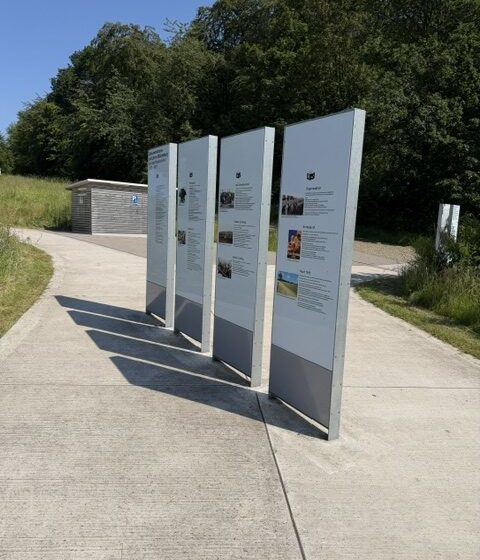
The Dokumentations- und Lernort, opened in 2022, makes this visible without reconstructing the historical site. The guiding principle of the memorial work is restraint: no buildings, no major interventions, no reconstruction. Mown grass paths lead across approximately 1.3 kilometers to six information stations; a planting of trees and shrubs marks the location of the former speaker’s platform, while a walkable bridge crosses the concrete foundations of the grandstand of honor. Where the regime monumentalized, the site documents; the restrained design received an award at the 2022 Niedersächsischer Staatspreis für Architektur [Lower Saxon State Prize for Architecture].
This is more than a design decision; it is a didactic argument. The site demonstrates what the workshop explored through the card index and the panel discussion through concepts: that ›Volksgemeinschaft‹ was manufactured — here through earthworks, grandstands, and a choreography of the masses. Those who wish to understand the production of community must have walked up this hillside at least once.
A Panel Discussion Takes Stock
The closing panel did not begin with a thesis, but with a clip from NDR. On the same weekend, on 19 June 2026, the AfD district association of Northeim had held its district party conference in the Stadthalle Moringen, just a few meters from the concentration camp memorial site there. Around 600 people protested, with a march leading up to the memorial. The district association is considered far-right and maintains close ties to Björn Höcke. The contemporary relevance of the debate was self-evident that afternoon.
Moderated by Aljoscha Napp, the pedagogical director of the Lernort Bückeberg, the panel was asked what the concept of Volksgemeinschaft [people’s community] is actually useful for in historical and political education. Three perspectives met, and they complemented rather than contradicted one another.
Elke Gryglewski, who heads the Stiftung niedersächsische Gedenkstätten [Lower Saxony Memorials Foundation] and the Bergen-Belsen Memorial, made a compelling case for the practical objection. Volksgemeinschaft, she argued, is both an anonymizing and a static concept: an amorphous mass behind which responsibility can be concealed, and a label that poorly captures change and room for agency. Educational work requires concreteness. Lower Saxony, she noted, is a fortunate case in this regard, because the radicalization of persecution policy can be shown here as a process at specific sites, rather than as a leap from 1933 to mass murder. Moreover, perpetration must be disaggregated, down to complicity through knowledge and the most mundane functions within the apparatus. Anyone who uses sources merely for illustration, without deconstructing them, ultimately reproduces the very images they set out to explain.
Wiebke Hiemesch, an educational scholar and pedagogical director of the ZeitZentrum Zivilcourage [Centre for Civil Courage] in Hanover, reported on an institution that deliberately avoids the term. The ZeitZentrum frames its life histories under the heading of ‘Hanover’s urban society’ rather than Volksgemeinschaft, and works with the guiding question “participation or resistance,” supplemented by the question of what was actually possible. Her reservations were twofold: the concept invites oversimplification, and it may reproduce precisely the myth that scholarship is currently in the process of deconstructing. At the same time, she reminded the panel that Volksgemeinschaft is not merely a historical source concept, but an idea that continues to exert influence in the present. She also identified a source-critical cost: those who work on the production of community often find it harder to access the perspective of those who were excluded.
The professorship, led by Imke Selle and Jessica Wehner, has already organized several excursions to the ZeitZentrum Zivilcourage. These included, among other things, extended visits to the exhibition and workshops on radicalization and right-wing extremism.
Aljoscha Napp contributed from the Bückeberg’s own practice an approach via the concept of community: discussing with young people what community promises, he observed, often first opens the path to the question of what was actually fascinating about the figure and system of National Socialism.
The third voice, that of the author of this contribution, came from the intersection of historiography and migration research, and put forward the proposal to examine Volksgemeinschaft not as a condition, but to read it as the outcome of a continuous process of production — as a product of categorization, administration, and violence. On the panel, this idea remained one offer among others. The essay that follows develops these reflections further as a contribution to theoretical framing.
From ‘Doing’ to ‘Production’: How is Volksgemeinschaft Made?
What research addresses with Volksgemeinschaft can be approached from yet another angle. The workshop’s keyword, ‘doing Volksgemeinschaft,’ points in this direction; taken further, it raises for us the question of how practices can be read through the lens of the production of social facts with real-world effects. At the Osnabrück Collaborative Research Centre 1604, we investigate the ‘production of migration’ — not migrants as pre-given groups, but the procedures, discourses, and institutions that bring such groups into being in the first place. Directed toward Volksgemeinschaft, this approach opens up a different perspective.
Such an approach begins with a process of denaturalization. Social categories are not given in advance; they are the outcome of discourses, procedures, and institutions. This shifts the central question. The older debate argued over whether Volksgemeinschaft had existed as a social reality or only as a myth. Both camps in that debate shared an assumption: they treated the community as an object whose degree of reality could be determined. Once we abandon this assumption, Volksgemeinschaft moves from being the explanatory framework to being what requires explanation. It is not a myth, but an ideologeme: an idea that was produced in a particular way in order to organize society, and that could be mobilized in very different ways.
Social order was thereby produced not least through figures that appear, implicitly or explicitly, always in pairs. The Volksgenosse and the Volksgenossin [male and female members of the people’s community] exist only paired with the Gemeinschaftsfremde [those alien to the community]; both emerge in the same act and require one another. Reinhart Koselleck described such asymmetric counter-concepts (Koselleck 1979): a ‘we’ that simultaneously produces and devalues its ‘non-we.’ Sometimes both figures appear explicitly in the sources. Often one is present only as the shadow of the other. Yet seeing it even where it is not named belongs to our research discipline. For Michel-Rolph Trouillot has shown that this absence is no accident of transmission, but is itself produced: silencing begins at the very point where events become sources (Trouillot 1995), and it is precisely for this reason that the unnamed figure belongs not at the margins, but within the findings themselves.
The approach of the production of social order can also help us sharpen our perspective elsewhere, when we read inclusion and exclusion not as two states that can be located in binary terms, but as always co-produced gradations along a continuum of belonging. The excluded person does not stand outside the order; they remain enclosed within it, precisely by virtue of being excluded from it. Giorgio Agamben calls this operation an inclusive exclusion (Agamben 1995). Migration research captures the same logic through Paul Mecheril’s concept of ‘natio-ethno-cultural belonging’ (Mecheril 2003), an order that sorts people into a ‘we’ and a ‘non-we’ and renders belonging precarious. Social order emerges through operations of inclusion and exclusion. The idea of community is, in this regard, a mobilizable operator.
The production of social order, in turn, requires apparatuses. The *Volksgemeinschaft* produced itself neither solely at party rallies nor solely on the Bückeberg, which was itself infrastructure and medium. It was manufactured in offices and on paper: in registration card files, hereditary files, and clan records, but equally in diaries, photographs, and monuments. What this looks like in practice can be illustrated by a simple procedure. An index card on which a box is ticked transforms, in a single administrative act, one person into a *Volksgenossin* [female member of the people’s community] and another into a *Gemeinschaftsfremde* [person alien to the community]. The card does not record who belongs: it first constitutes belonging, and this inscription of status retained its mobilizability, its capacity to be invoked. Whether someone became a *Volksgenosse* [member of the people’s community] was thus decided not solely through one’s own or a collective sense of belonging, but in a file. Ultimately, in 1933, a social group seized the state and with it its power of classification (Bourdieu 1982); in the National Socialist state, participation in this power—the sorting of others—became a means of staking one’s own claim to belonging. Being classified among the classifiers offered potential for the acquisition of social capital, and to classify was to stabilize one’s belonging.
This imagined community of National Socialist society thus made itself, ultimately through brutal violence: boycott, denunciation, pogrom, and murder were not consequences of an already existing community. They were the acts through which it first brought itself into being. When scholarship speaks of participation (*Mitmachen*), we mean a participatory event with a lethal outcome.
To take part in this process, or to be subjected to it, did not remain without consequence. It altered not only social position but also conduct. Ian Hacking called this the feedback loop of “making up people” (Hacking 1986): those who are named change, and the changed people in turn alter the category. This applies to the excluded just as much as to those who positioned themselves through acquiescence, spectatorship, and perpetration. They too were shaped, cast into roles and figures into which they themselves staked their claims.
Such reflections quickly yield implications for our use of language. Rogers Brubaker and Frederick Cooper distinguish between categories of practice and categories of analysis (Brubaker/Cooper 2000). *Volksgemeinschaft* is a category of practice, a source concept, not an analytical concept. The word belongs to the perpetrators. The task of scholarship is the analysis of its production, not its reproductive adoption. In Émile Durkheim’s terms, one might formulate it thus: the actual social fact (Durkheim 1895) is not the *Volksgemeinschaft*, but the process of its production in its full force.
Such reflections are not conceptual history for its own sake. The ideologemes of the National Socialist era still accompany us, even when they clothe themselves in different terms. In his correspondence with Götz Kubitschek (conducted in 2014, published in 2015), Armin Nassehi traced the core of right-wing thought to the premise that human existence becomes conceivable only as an inescapable group existence (Nassehi 2015). This finding can be sharpened: this group is defined ethnically, and barely concealed, also racially, and it operates according to the same logic of inclusive exclusion as the historical *Volksgemeinschaft*.
Research and public education thus face a shared challenge. A production-oriented perspective proves its worth only where it can be translated into a guided tour or a classroom lesson. The question of the apparatus is nothing other than source-based, concrete work of the kind that memorial sites carry out daily and that the workshop on the Osnabrück card file demonstrated; the paired figures demand that we ask after the excluded person where only the *Volksgenosse* is in the picture, just as much as where the victim is brought into view and the perpetrator appears absent. One difficulty remains: those who address the production of community risk giving more space to the producers than to the excluded, and paying more attention to the stabilization of social order than to its fracture points. A constant shift of perspective is the remedy. The *Volksgemeinschaft* is not the explanatory framework; the production of social order by means of this ideologeme is what must be explained.
Selected Bibliography
- Agamben, Giorgio: Homo sacer. Die souveräne Macht und das nackte Leben. Frankfurt am Main 2002 (it. 1995).
- Bondzio, Sebastian: Doing ›Volksgemeinschaft‹. In: Geschichte und Gesellschaft 47/3 (2021), pp. 343–379.
- Bourdieu, Pierre: Die feinen Unterschiede. Kritik der gesellschaftlichen Urteilskraft. Frankfurt am Main 1982 (fr. 1979).
- Brubaker, Rogers / Cooper, Frederick: Beyond “Identity”. In: Theory and Society 29 (2000), pp. 1–47.
- Durkheim, Émile: Die Regeln der soziologischen Methode (fr. Les règles de la méthode sociologique, 1895).
- Hacking, Ian: Making Up People. In: Thomas C. Heller et al. (eds.): Reconstructing Individualism. Stanford 1986.
- Koselleck, Reinhart: Zur historisch-politischen Semantik asymmetrischer Gegenbegriffe. In: idem: Vergangene Zukunft. Zur Semantik geschichtlicher Zeiten. Frankfurt am Main 1979.
- Mecheril, Paul: Prekäre Verhältnisse. Über natio-ethno-kulturelle (Mehrfach-)Zugehörigkeit. Münster/New York 2003.
- Nassehi, Armin: Die letzte Stunde der Wahrheit. Warum rechts und links keine Alternativen mehr sind und Gesellschaft ganz anders beschrieben werden muss. Murmann, Hamburg 2015.
- Rass, Christoph: Verfolgung als arbeitsteilige Praxis. Die Gestapo Osnabrück, das NS-Haftsystem und die ›Volksgemeinschaft‹ im Spiegel einer Karteiüberlieferung. In: Osnabrücker Mitteilungen (2026, submitted).
- Trouillot, Michel-Rolph: Silencing the Past. Power and the Production of History, Boston: Beacon Press 1995.