There and Back Again | Excursion to the Esterwegen Memorial

This post was automatically translated from the German original at
Hin und wieder zurück | Exkursion zur Gedenkstätte Esterwegen.
An excursion report by Leonie Schwiers and Greta Petersen
On 28 November, an excursion to the Esterwegen Memorial, which has existed since 2011, took place under the leadership of Imke Selle and with the support of Ilka Schwerdtfeger. In the preparatory session, participants received an initial overview of the history of the 15 former ‘Emsland camps’, which was further explored during the visit to the memorial site.
Our visit to the Esterwegen Memorial began with an introduction to the establishment of the memorial and the history of the ‘Emsland camps’. This was followed by a tour of the outdoor grounds, a visit to the permanent exhibition and two special exhibitions. The special exhibitions deal with the police in the Nazi state and with the federal state of Lower Saxony during National Socialism. Our visit concluded with a discussion on the topic of “Memory then and now”.
The Esterwegen Memorial commemorates a network of 15 concentration, penal and prisoner-of-war camps that existed between 1933 and 1945 in the Emsland and the County of Bentheim. At the other former camp sites today – apart from individual information boards – hardly any traces of the historical use are recognisable. Against this background, Esterwegen occupies a special position in the regional context.
The camp in Esterwegen was initially used as a concentration camp, later as a penal camp. Although Esterwegen was not an extermination camp, many people died due to the poor hygienic conditions, the inadequate food supply, the hard labour that the prisoners had to perform, and the massive violence to which they were exposed. Approximately 80,000 concentration camp prisoners and convicts suffered in the camps in the Emsland. During the war, far more than 100,000 prisoners of war were added. More than 20,000 people from various European countries died in these camps.
The first camps in the Emsland were already established in 1933 and received their first inmates in the summer of the same year. Esterwegen itself was used as a concentration camp until 1936, supervised by the SS. During this time, political opponents who had been taken into “protective custody” without due process were primarily imprisoned there. From 1937, it was placed under the supervision of the judicial administration and used as a penal camp until the end of the war, where alongside convicted criminals – it must be noted that during the Nazi period, acts were also criminalised that would no longer be punishable under today’s law, such as homosexuality – so-called “Night and Fog prisoners” from the occupied territories were detained. Both phases are characterised by the consistently poor living conditions in the camp and the forced labour that the prisoners had to perform. This includes, among other things, daily beatings on the camp street and the cultivation of the moors. The hard labour that the inmates had to perform is also the subject of the Peat Bog Soldiers song, which originated in the former ‘Emsland camp’ Börgermoor and quickly developed into a resistance song that spread rapidly despite being banned. A large part of the local population welcomed the establishment of the camps, as they thereby gained increased access to labour and hoped for economic growth in the Emsland.
After 1945, the Esterwegen camp continued to be used, initially housing Displaced Persons. Subsequently, the camp was used as a penal institution and finally for military purposes by the Bundeswehr.
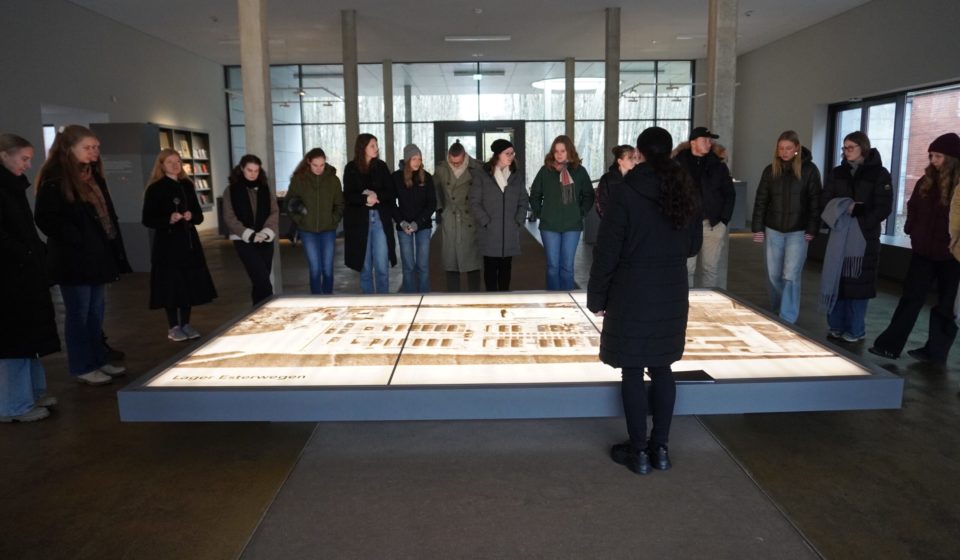
Following the theoretical introduction, we examined the historical layout of the camp grounds in the memorial’s foyer using an aerial photograph. Esterwegen was particularly distinguished by the white brick wall that surrounded the camp, which was considered especially beautiful by its builder. The division into guard and prisoner areas is also visually clear here. The park-like design of the guard area was striking, with plantings, a goldfish pond, and recreational areas with a sports field and outdoor swimming pool. In contrast, only the 10 x 40 metre barracks were visible in the prisoner area.
We then proceeded to the former camp grounds. In general, the main focus here should be on the prisoners, which is why the design in the former guard area is deliberately restrained. Walking along the former camp street, it is noticeable that its course can still be traced despite the changes to the terrain. At gaps in the ground – so-called time windows – the original gravel is still visible. The massively grown trees make visible how much time has passed since the events.
At the beginning of the tour, we visited the former guard area and the site of the former entrance gate. Instead of an exact reconstruction of the gate, a symbolic design was chosen here. The gap in the gate serves as a reminder that prisoners could look outside and that society saw the camp but did not intervene.
At this location are two memorial stones. One bears the inscription “Hell at the Forest’s Edge” and was erected by the Association of Peat Bog Soldiers; the second commemorates Nobel Peace Prize winner Carl von Ossietzky, who was imprisoned in Esterwegen.
At the edge of the former camp street are some of the few remaining structural remnants. The preserved steps led during the camp period to a monument for two guards who died under unclear circumstances. Today this monument lies hidden underground. The decision not to make it visible again was deliberately made and was part of a fundamental discussion about whom and what to remember. At this point, we considered how we would deal with such a relic. The different positions within the group illustrated how complex the question of appropriate remembrance is. It also became clear what challenges memorial sites face. What should be visible? How does one weigh memory? And which forms of commemoration appear responsible?
The transition to the former prisoner area is now marked by steel elements and a symbolic gate. This deliberately allows room for interpretation. Some associate its form, for example, with a funnel, as a metaphor for the increasingly hopeless fates of many prisoners. Particularly impressive here are the tree packages, which represent the dimensions of the former barracks and consist of exactly 100 trees, based on the number of people who were housed in one barrack. The decision about the design was made together with former prisoners. The trees are meant to commemorate the people in the building, not the architectural structure. The “living” medium of memory is intended to represent that the memory of the prisoners also remains alive. At the same time, our guide emphasised that particularly younger visitors often expect a reconstruction of the barracks, which again makes clear how different expectations of memorial sites can be.
Arriving at the end of the prisoner area, we were told that the memorial wants to focus not only on Esterwegen, but on all sites of the former ‘Emsland camps’. Since hardly any structural remains are preserved at many of these places and time has, in a sense, “moved on” there, a nominal listing on a Corten steel wall refers to their existence and history.
The permanent exhibition presents the chronological sequence of events from 1933 to 1945. Both central events that directly affected Germany and specific life stories of prisoners in Esterwegen and other camps are presented. Photos, texts and objects, such as uniforms, document the history of the ‘Emsland camps’. The focus of the exhibition is on the experiences of the inmates working in the moor as well as their life and suffering in the camps. A portrait wall shows some of the prisoners in the ‘Emsland camps’, including three women. These are women from the Polish Home Army who were imprisoned in the Oberlangen camp. A report on an excursion focusing on Polish post-war history in the Emsland can be found here.
The exhibition continued in another smaller room that illuminated the development of the camp after 1945. Great attention was given here to the camp model of the Aschendorfermoor camp. This was reconstructed by a prisoner from his own memory. The differences between the guard area and the prisoner area become recognisable here.
At the time of our visit, there were still two special exhibitions at the memorial. Under the title “Order and Annihilation – The Police in the Nazi State”, the Nazi past of the police was examined in cooperation with the Lower Saxony Police. The exhibition provides information, among other things, about one of the few convictions of a police officer in Lower Saxony. Friedrich Pradel contributed to the murder of several thousand people through the conversion of a truck on whose loading platform people were killed with exhaust fumes.
The second exhibition “On German Soil for the Whole World” shows the development of history from 1933 to 1945 in present-day Lower Saxony. Using world maps, among other things, the local and regional connections from Lower Saxony to global events become clear. Additionally, major construction projects such as military training grounds or the naval port in Lower Saxony are addressed.
Finally, we collectively gathered our impressions from the various exhibitions and watched a 1966 documentary that was filmed in the Emsland. In this, various people from the Emsland population were asked about their knowledge of the ‘Emsland camps’. This film showed that many people had not engaged with the past and knew little about the background of the ‘Emsland camps’. Using the documentary, we discussed together the memory of National Socialism then and now and talked about positive developments, but also setbacks. A major difficulty that repeatedly came up was the loss of contemporary witnesses.
Excursion Announcements
In January 2026, Team NGHM offers several more exciting excursions:
On 16 January, a day excursion to the Neuengamme Concentration Camp Memorial will take place. The excursion includes a thematic introduction and various stations on the grounds. In addition to the main exhibition and the former prisoner camp, other locations on the grounds (branch canal, brick works, clay pits, commandant’s house) will be explored or, depending on the group’s interest, another exhibition will be included. On 23 January, there is also the opportunity to participate in a digital day excursion, where we will explore the grounds of the Neuengamme Concentration Camp Memorial online.
On 19 and 27 January, a two-part day excursion to Ibbenbüren will also take place. On 19 January 2026, the film “Black Sugar – Red Blood” by Luigi Toscana will be shown in the morning (9 a.m. or 11:15 a.m.) at the Ibbenbüren Community Centre. The film addresses the fate of Anna Strishkowa, who as a small child stood at the ramp of Auschwitz on 4 December 1943. She knew neither her parents’ names nor where she was born – to this day. On 27 January 2026, a witness conversation with Dr. Boris Zarbarko (Holocaust survivor) will take place at 7:30 p.m. at the Ibbenbüren Cultural Centre. Prof. Dr. Christoph Rass will give the introductory remarks.