There and Back Again | Voice of History – Commemoration and Historical Scholarship in Ibbenbüren

This post was automatically translated from the German original at
Hin und wieder zurück | Stimme der Geschichte – Gedenken und Geschichtswissenschaft in Ibbenbüren.
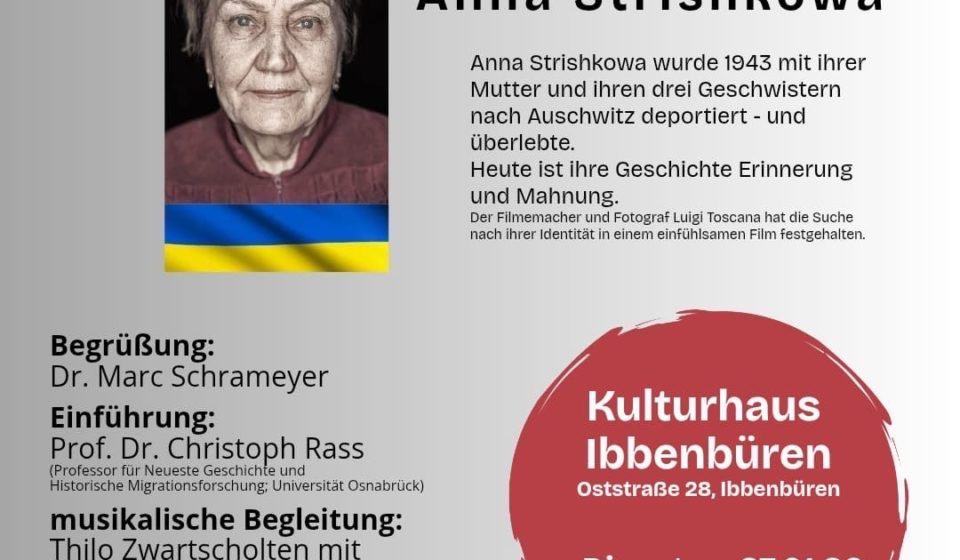
On 27 January 2026 – the 81st anniversary of the liberation of Auschwitz – the Catholic School Chaplaincy of Ibbenbüren invited guests to the commemorative event “Voice of History – Remembering for Our Future” at the Cultural Centre. At the centre of the event was an encounter with Anna Strishkowa, a survivor of the Auschwitz-Birkenau concentration camp, who was born in 1939 and registered at the Birkenau ramp as a nearly four-year-old child in December 1943. Christoph Rass (University of Osnabrück) provided the historical introduction – an occasion to reflect on the intersection between historical scholarship and memory work.
For students at the University of Osnabrück, attending the event was part of a two-part excursion examining school-related historical-cultural offerings using the Ibbenbüren project as an example.
A Project of Local Memory Culture
The event on 27 January took place within the context of a longer-term commitment that school chaplain Christoph Moormann has built up in Ibbenbüren. In autumn 2024, the exhibition “Against Forgetting” by photographer Luigi Toscano had been shown between the Erna-de-Vries Comprehensive School and the Johannes-Kepler Grammar School. Students from both schools had served as guides through the portraits of Holocaust survivors, reaching more than five thousand people.
From this exhibition work developed the idea of personally inviting one of the portrayed survivors. The originally announced Dr Boris Zabarko from Kyiv had unfortunately fallen ill; in his place came Anna Strishkowa, also from Ukraine, to Ibbenbüren. Mayor Dr Marc Schrameyer welcomed the guests on the evening of 27 January; Barbara Kurlemann and Christoph Moormann moderated the evening. The musical accompaniment was provided by Thilo Zwartscholten and students from the Graf-Stauffenberg Grammar School Osnabrück.
Anna Strishkowa: A Biography Between Trauma and Reconstruction
Anna Strishkowa belongs to those survivors whose life story embodies the consequences of the war of annihilation and the Holocaust with particular intensity. On 4 December 1943, she was registered in Auschwitz-Birkenau – barely four years old. She knows little that is certain about her family of origin to this day: one of her sisters was murdered in the camp, her one-year-old brother was already murdered during deportation. The circumstances of her mother’s death in Auschwitz cannot be clarified to this day despite intensive research.
After liberation, Anna came to a Ukrainian foster family, who had her tattooed prisoner number removed – an attempt to protect the child from the stigmatisation that survivors experienced for decades after the war’s end. With this, the only documentary reference to her identity also disappeared.
Only the work of filmmaker Luigi Toscano enabled research that could clarify Anna Strishkowa’s fate. In a Soviet documentary film from the post-war period, a prisoner number had been visible on little Anna’s arm – albeit with a digit transposition. The Baden-Württemberg State Criminal Police Office finally succeeded in reconstructing the correct number. On this basis, Luigi Toscano and his team were first able to verify the actual prisoner number and finally identify family members. In November 2024, Anna Strishkowa met her relatives for the first time, the daughters of her older sister.
After the Second World War, Anna Strishkowa completed her studies and worked as a microbiologist. Today she lives with her daughter Olga in Kyiv. When Russian rockets fell on the city in February 2022, she refused for a long time to flee.
Historical Scholarship and Witness Testimony
Christoph Rass placed the memorial day in historical context. On 27 January 1945, soldiers of the 322nd Rifle Division of the Red Army reached the Auschwitz main camp and liberated about seven thousand people. In the days before, the SS had driven around 56,000 prisoners on death marches westward; between nine and fifteen thousand of them died in the process. Auschwitz was the centre of a crime in which six million Jewish people were murdered.
Rass reflected on the relationship between historical reconstruction and witness testimony. Historiography relies largely on documents, process-generated data and archival records. Witness accounts supplement this source base with a dimension that eludes documentary capture: the subjective experience of persecution, violence and loss. The accounts of survivors like Anna Strishkowa make the abstract dimension of the crime concretely comprehensible.
At the same time, Rass addressed the question of historical continuity. National Socialism did not emerge suddenly and without preconditions, but in the context of a functioning – albeit crisis-ridden – parliamentary democracy. The transition from the Weimar Republic to totalitarian rule was the result of political decisions and social developments, not an inevitable process. This insight establishes the continuing relevance of engaging with the history of National Socialism and points to the necessity of constant vigilance to protect our democracy today.
With the foreseeable end of witness testimony, the question of the transformation of memory arises. What began as communicative memory – supported by the living narrative of survivors – must be transferred into other forms of transmission. The work in Ibbenbüren, where students function as mediators of survivors’ stories, is an example of this transformation.
Memory as Practice
Anna Strishkowa has now borne witness to the crimes of the National Socialists before thousands of people and spoken about her life in and after Auschwitz. Her message combines personal experience with a demand on the present: that the memory of the victims be kept alive – not as ritual, but as orientation for one’s own actions.
The event in Ibbenbüren shows that the transmission of this memory can succeed. Not as an abstract duty, but as concrete practice: through encounters with survivors, through working with their stories, through reflection on what these stories mean for the present. The voices of the witnesses will fall silent. The task of hearing them and carrying forward what was experienced remains.
Further information about the project “Against Forgetting” and the film “Black Sugar – Red Blood” by Luigi Toscano: schwarzerzucker-rotesblut.com