

By Christoph Rass · Originally published on nghm.hypotheses.org
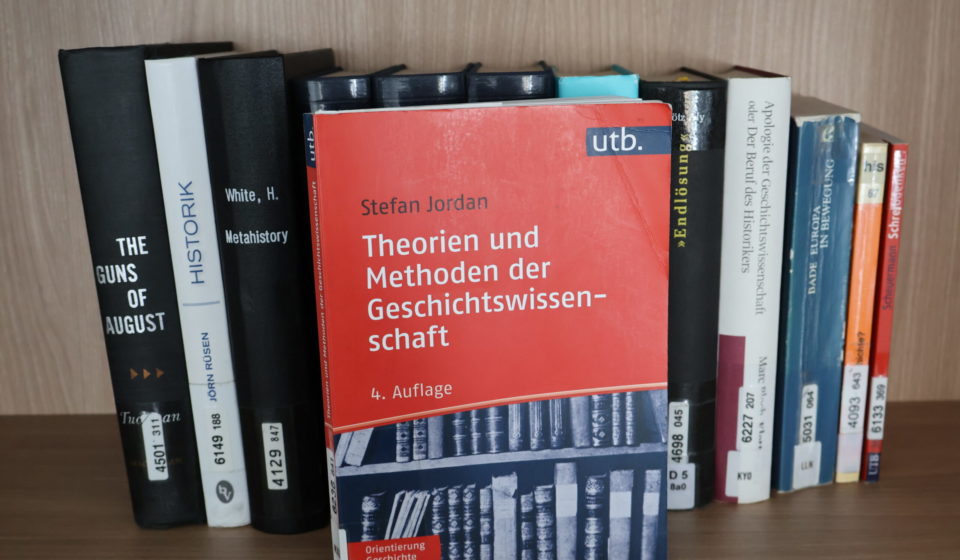
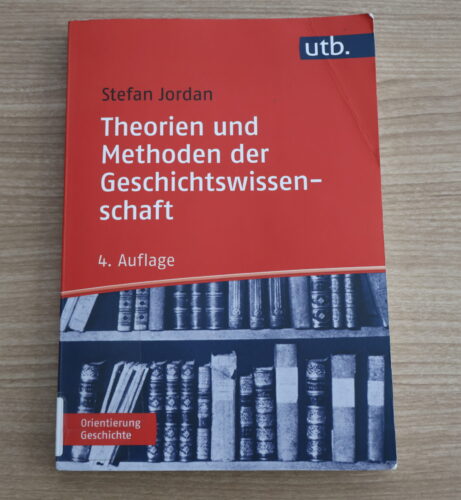
An introductory work that narrates its own discipline rather than organizing it: Theorien und Methoden der Geschichtswissenschaft by Stephan Jordan, reviewed here as the fourteenth title in our series, opens the NGHM reading list and stands at the top of the thematic field of Theory of History and Historiography. The volume has been available since 2021 in a fifth, updated edition; a book whose structure proves to be a successful didactic device.
What immediately stands out is the continuity. Twelve years separate the first from the fifth edition, a period during which the discipline has undergone considerable movement, from postcolonial perspectives and digital methods to debates about materiality, environment, and violence. The framework of the book is able to encompass this movement without requiring any alteration to its basic structure. This finding points to a successful introductory work whose foundations were able to absorb the updates that four new editions have demanded of it.
Stefan Jordan was already an established expert in the field at the time of the first edition. In 2002 he had edited the Lexikon Geschichtswissenschaft. Hundert Grundbegriffe and in 2005 presented the Einführung in das Geschichtsstudium, both published by Reclam. Both books were produced at the Historische Kommission bei der Bayerischen Akademie der Wissenschaften [Historical Commission at the Bavarian Academy of Sciences and Humanities], where Jordan has worked since 1999 and where he has served on the editorial board of the Neue Deutsche Biographie [New German Biography], which he has led as editor-in-chief of NDB-online since 2024. Lexicographical work, which distills a subject or a life to the scope of an article, demands the same capacity required to produce an introductory work: namely, a condensation that forgoes comprehensiveness while remaining precise. Authorship and working context are thus closely interrelated here.
The volume’s program is clearly defined. The theoretical knowledge base of the discipline is, as Benjamin Steiner notes in his review of the first edition, tacitly presupposed in many introductions, whereas Jordan counters this lack of reflection on the foundations of the discipline itself and guides students at the beginning of their studies into discussions of theory and method. The approach is historiographical rather than systematic. Theories and methods appear as a history of the debates from which they emerged.
Following introductory chapters on the function and definition of history and on how it is handled, Jordan dates the “beginning of modern historiography” to the nineteenth century, locating its roots in the processes of academicization and professionalization of the eighteenth century. This is followed by Historicism with its disciplinary matrix and Historical Materialism, whose conflict Jordan characterizes as a “second Sattelzeit [saddle period]” (c. 1870–1920), then the Annales school and Volksgeschichte [people’s history], before the final two major chapters are organized around the pivotal breaks of 1945 and 1989/90, leading from social and structural history through the history of everyday life and microhistory to the history of mentalities and the New Cultural History, within which Jordan situates the history of discourse. Max Weber is the only theorist to whom a dedicated chapter is devoted. In Jordan’s account, Weber emerges as a key figure because, in the reading offered by the social-historical new beginning of the 1960s, he “resolved” the conflict between historicist and materialist historiography and, on account of his cross-disciplinary interests, became “the personified embodiment of Historical Social Science, which sought to overcome disciplinary narrowness.”
The concluding chapter, entitled “Alles fließt – Warum Geschichtswissenschaft Demokratie benötigt und bedingt” [“Everything flows – Why historiography requires and conditions democracy”], foregrounds the inextricable connection between the research work of individuals, open discussion within the discipline, and engagement with society at large. Its title asserts a reciprocal relationship in which historiography presupposes democratic conditions just as it contributes to them. The text is accompanied by more than thirty graphically highlighted definition boxes, for which the book maintains its own index, explaining concepts such as Sattelzeit, Historicism, and Oral History, while chapter-by-chapter bibliographies open up avenues for further reading. The volume can therefore be consulted as a reference just as easily as it can be read in a linear fashion.
The reception of the first edition was predominantly positive and praised the didactic design in particular. Dirk Fleischer described the presentation in the Theologische Literaturzeitung as clear, accessible, and exemplary in its pedagogy, while Winfried Schulze characterized the volume in H-Soz-Kult as “on the whole cleverly conceived and written with expert knowledge.” Benjamin Steiner, however, articulated a reservation in sehepunkte that remains valid to this day: the synthetic clarity with which Jordan connects the lines of continuity in the nineteenth and early twentieth centuries and mediates the breaks in tradition within their broader context gives way, in the treatment of historiography in the “postmodern” era, to mere enumeration. Schulze arrived independently at the same conclusion, finding “the critical, contextualizing perspective” lacking in this chapter and expressing a wish for “stronger systematization and historical contextualization.” The fact that two reviewers identify the same passage transforms an individual judgment into a finding that points to a structural problem inherent in historiographical introductions: the closer the account draws to the present, the more difficult canonical condensation becomes, as long as it remains open what will attain canonical status.
What Jordan articulates toward the end of the book nonetheless deserves attention. His ethical understanding of history finds expression in a “threefold responsibility of the historian,” namely “towards the subject matter of the discipline, towards the representatives and institutions of one’s own scholarly community, and towards a public whose education and well-being is the entire purpose of the endeavor”; Steiner has called this commitment the ever-recurring pattern in Jordan’s argument. The triad identifies precisely what tends to recede into the background in theoretical introductions: that historiography is always also a public practice. Because on the NGHM reading list Carr’s question about what history is stands directly alongside Jordan, both can be read in conjunction — the question and an institutional response to it.
The lasting contribution of the volume lies less in any single argument than in its form. Historiographical chronology, definition boxes, and chapter-by-chapter bibliographies have proven their durability across five editions. Those wishing to introduce a discipline can either organize its concepts or narrate its history. Jordan has chosen narration. The self-historicization of historiography is itself a methodological approach, one that shows students their discipline as a grown and contingent practice whose next turn cannot yet be found in this book.
Students in Osnabrück can access Theorien und Methoden der Geschichtswissenschaft as an online resource via the University Library Osnabrück in the OPAC.
Stefan Jordan, Theorien und Methoden der Geschichtswissenschaft (Orientierung Geschichte, UTB 3104), Stuttgart: UTB / Paderborn: Brill Schöningh, 5th updated edition 2021, 230 pp. The first edition was published in 2009 by Schöningh, 228 pp.
This post is part of the series NGHM liest [NGHM Reads], in which the 65 titles on the NGHM reading list are presented. The list can be explored as a knowledge graph.
Find the original post at NGHM liest | 14 | Jordan: Theorien und Methoden der Geschichtswissenschaft (2021) on nghm.hypotheses.org.
This post was automatically translated from the German original.