OUT NOW | The Holocaust and Varieties of Migration

By Sebastian Musch · Originally published on nghm.hypotheses.org
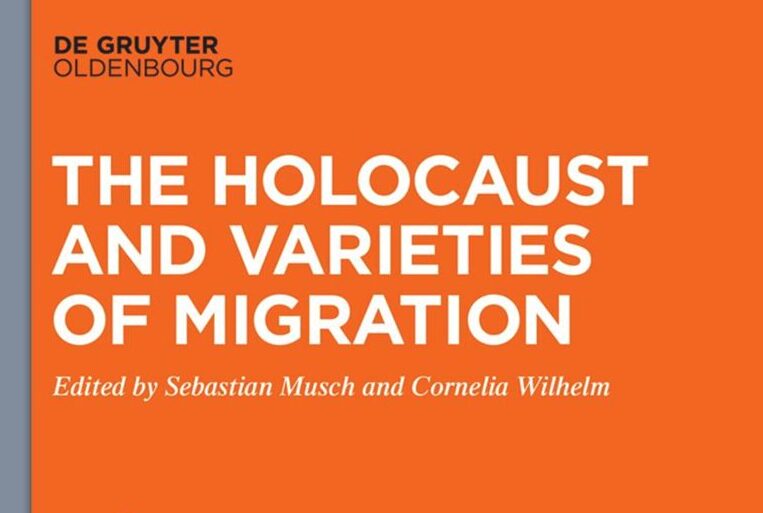
The edited volume The Holocaust and Varieties of Migration, edited by Sebastian Musch and Cornelia Wilhelm, has just been published by De Gruyter and is available in Open Access here. The volume originates from an international conference held in 2023 at the Georg-von-Vollmar-Akademie in Kochel am See. In addition to Sebastian Musch and Cornelia Wilhelm, the volume includes contributions by Zofia Trebacz, Susanne Heim, Wendy Lower, Ayelet Eva Herbst, Hana G. Green, Edith Raim, Iris Helbing, Annika Heyen, Peter Gatrell, and Tony Kushner.
The volume’s starting point is the observation that the various forms of flight, expulsion, deportation, resettlement, internment, and postwar migration during the Second World War and the Holocaust were not merely consequences of violence, but in manifold ways formed part of its preparation, organization, and execution. At the same time, the volume turns its attention to the period after 1945 and examines how expulsion, flight, and resettlement shaped international orders, political categories, and forms of memory. In this respect, the edited volume directly engages with the research questions of the Collaborative Research Centre (SFB) 1604 “Production of Migration” at the University of Osnabrück. From this perspective, The Holocaust and Varieties of Migration can be read as a historically focused contribution to a reflexive migration studies. The volume makes visible that, even in the context of the Holocaust, categories such as “refugee,” “foreigner,” “enemy alien,” or “resettler” were not simply found ready-made, but were produced and rendered effective through political, administrative, and institutional practices. At the same time, it demonstrates that Holocaust research must also reflect critically on its own categories. It is precisely the conjunction of Holocaust history and migration history that opens up a shift in perspective: not only does migration become useful for understanding the Holocaust; conversely, the Holocaust itself becomes a historical key for understanding the “production” — that is, the emergence, transformation, and lasting effects — of migration regimes. Furthermore, the volume exemplifies, through the case of the Second World War, the interconnection between mass violence, wartime events, and forced migration, whose intrinsic entanglement goes beyond a simple causal relationship.
From NGHM, in addition to co-editor Sebastian Musch, Annika Heyen is also represented in the volume with her contribution “‘Conceived Reluctantly, Brought to Birth Grudgingly, Straitjacketed from Birth.’ The Bermuda Conference, the World Jewish Congress, and the Emergence of the Postwar Migration Regime.” Annika Heyen examines the conference not merely as a rescue initiative, but as a site at which power relations, political room for maneuver, and the institutional logics of the emerging international migration regime can be observed. The conference is analyzed as a political negotiation process in which possibilities for action were opened up, constrained, and ultimately blocked.
The volume thus brings together approaches at the intersection of Holocaust research and migration history that have long been advanced within NGHM, and which in recent years have been systematically investigated, among other projects, in the research project The Holocaust Migration Regime, led by Sebastian Musch and funded by the Alfred Landecker Foundation, as well as in the project Die Bermuda-Konferenz 1943, worked on by Sebastian Musch and Annika Heyen and funded by the Gerda Henkel Stiftung.
The volume is dedicated to the historian Edith Raim, who contributed a chapter on forced labor and forced migration and passed away in 2025 while the volume was in its final stages of completion.
Find the original post at OUT NOW | The Holocaust and Varieties of Migration on nghm.hypotheses.org.
This post was automatically translated from the German original.