Out Now | Conflict Landscapes Volume 3: The Hürtgenwald in Context.

By TEAM NGHM · Originally published on nghm.hypotheses.org
No one fought in the ‘Battle of Hürtgen Forest’ under that name in 1944/45. Neither the units of the U.S. Army nor those of the Wehrmacht knew the designation when they faced each other between September 1944 and February 1945; it emerged ex post and consolidated a series of military operations into a coherent major event in retrospective narrative. Since then, historiography and memory culture have treated the ‘Battle of Hürtgen Forest’ as a fixed reference point, and as a slogan it has emotionally charged a place that has been marketed as the ‘Verdun of the Eifel’. Volume 3 of the series “Konfliktlandschaften” takes this process of history production as its subject: the contributions in the volume are concerned less with the history of events than with the translation of acts of violence into history.
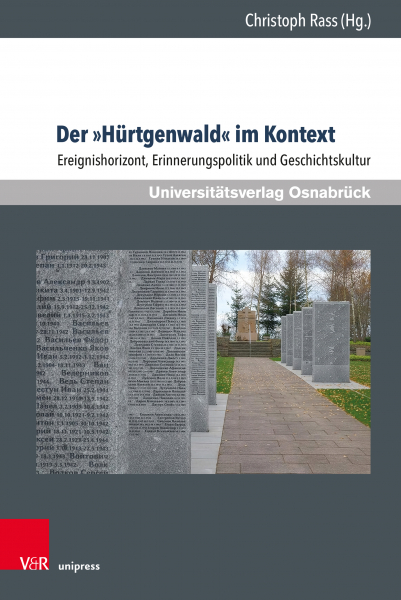
With “Der ›Hürtgenwald‹ im Kontext. Ereignishorizont, Erinnerungspolitik und Geschichtskultur” [“The ‘Hürtgen Forest’ in Context. Event Horizon, Memory Politics and Historical Culture”], the third volume of the series “Konfliktlandschaften” is now available, edited by Christoph Rass. From this volume onwards, the series is overseen by Christiane Kunst, Christoph Mauntel, Christoph Rass, Lale Yildirim and Marcus Zagermann on behalf of the Interdisciplinary Research Group Conflict Landscapes. The volume comprises 334 pages with 35 illustrations, has been published by V&R unipress / Universitätsverlag Osnabrück, and is fully available Open Access in the V&R eLibrary, with individual DOIs for each contribution.
From Conference to Project Completion
The volume originates from an international conference held in October 2019 in Cologne under the title “Konfliktlandschaft Hürtgenwald” [“Conflict Landscape Hürtgen Forest”], organized jointly by the Landschaftsverband Rheinland and the University of Osnabrück. It also documents the research project “Lernort ›Schlachtfeld‹? – Neue Didaktik einer Konfliktlandschaft Hürtgenwald” [“Learning Site ‘Battlefield’? – New Didactics of a Conflict Landscape Hürtgen Forest”], which was carried out at the University of Osnabrück from 2020 to 2024. Historical analysis, geophysical prospection, archaeological field research and digital communication formats were intertwined throughout; with this book, the project concludes its work.
This work was supported throughout its entire duration by the Landschaftsverband Rheinland, which funded the conference, the project, and the publication. A funder that accompanies an endeavor of this kind over a period of years enables more than a publication: it creates the conditions under which rigorous scholarly work can be carried out at all in a region where the interpretation of its own past remains contested. For this, we extend our sincere thanks to the LVR.
The course of the project is itself part of the findings. The pandemic forced the cancellation of field research activities and networking workshops, shifting the focus toward digital documentation and dissemination — a reorientation that proved productive. More significant were the local forms of resistance: denied access to areas under investigation, the absence of cooperation, and at times open hostility. These forms of resistance have themselves become a subject of the volume, as they demonstrate the tenacity with which regional historical culture responds to being called into question.
Conflict Landscape as an Analytical Concept
Conflict landscapes are, according to the conceptual foundation, socioculturally definable spaces that have been transformed by violent confrontations and in which the traces of these conflicts persist — materially and immaterially — without ever coming to rest. What is decisive is the underlying conceptual figure: ‘landscape’ and in particular the ‘battlefield’ do not exist as given entities, but are discursively co-produced through narrative constructions, naming practices, commemorative performance, and the interpretation of material traces. This production in turn acts upon the materiality of the place. Looting by ‘battlefield tourists’, reenactments, tourism development, and not least scholarly prospection itself all alter the very site they claim to read.
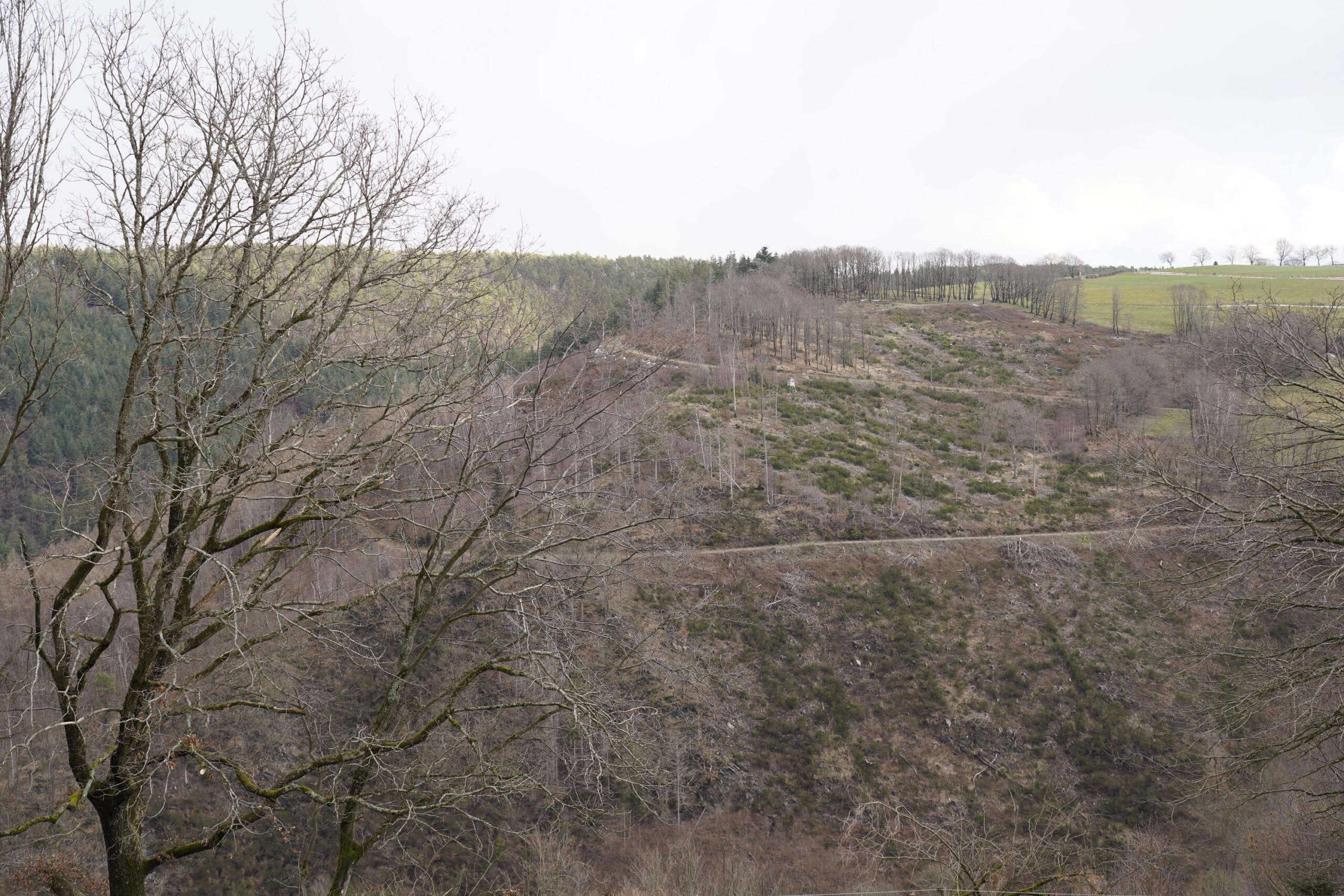
The northern Eifel can thus be read as a palimpsest in which the pre-war cultural landscape, the militarization through the construction of the ‘Westwall’ from 1936 onwards using forced labor on a massive scale, the destruction of 1944/45, the forest fires of the late 1940s, the clearances and reforestation of the 1950s and 1960s, the development of tourism since the 1980s, and finally the current forest damage caused by climate change and bark beetle infestation are layered upon one another. Each of these layers was discursively framed, integrated into or excluded from the dominant narrative of the ‘battle’. From this perspective, the volume seeks to advance three thematic fields: the musealization of war and violence, engagement with the history of events and memory culture in the case of the ‘Hürtgen Forest’, and the development of a critical historical culture with regard to the National Socialist past of the region.
In memoriam:
G. Stephen Lauer and Frank Möller
The volume is dedicated to the memory of two authors who did not live to see its completion.
G. Stephen Lauer (1952–2020) died unexpectedly on 27 May 2020. After 26 years as an infantry officer in the United States Marine Corps, he completed his doctorate in military history at Florida State University in 2010 and most recently served as Associate Professor of Military Theory and History at the U.S. Army School of Advanced Military Studies at Fort Leavenworth. His analysis of American operational command, published here, is among his final scholarly works. It approaches military decisions not from an armchair perspective, but from the viewpoint of those who had to make decisions under the same conditions.
Frank Möller (1954–2025) died on 23 March 2025 after a long and serious illness. As a historian, journalist, and newspaper publisher, he combined foundational research with civic and political engagement. The volume “Hürtgenwald – Perspektiven der Erinnerung” [“Hürtgen Forest – Perspectives of Remembrance”] (2016), co-edited with Karola Fings, marked a turning point in the critical examination of regional history; with Volume 2 of this series in 2022, he set standards for the deconstruction of revisionist history production. The shift in the way the ‘Hürtgenwaldmarsch’ [“Hürtgen Forest March”] is treated is a result of his persistent work and demonstrates how contingent such processes of negotiation remain. We have said our farewell to him.
Both — the American military historian with his expertise in operational history and the German journalist and scholar with his focus on local historical politics — embodied the multi-perspectivity on which conflict landscape research depends.
A Narrative in Fourteen Contributions
The first part of the volume addresses the musealization of war and violence. **Heidrun Derks** traces the journey from the archaeological site to the Museum and Park Kalkriese, and considers the question—still open after thirty years—of whether Kalkriese is the site of the Battle of the Teutoburg Forest a fortunate circumstance from a curatorial perspective. **Christopher Sommer** examines military-historical dioramas situated between an “aesthetics of the beautiful” and an “aesthetics of the ugly,” finding in their very artificiality a reflexive potential that is rarely fully exploited. **Sebastian Weitkamp** traces how subsequent uses as a penal camp, refugee accommodation, and Bundeswehr depot physically and discursively overlaid the Esterwegen camp site until it became nearly unrecognizable as a place of National Socialist violence. **Ralf Raths** develops four “acts of balancing” in relation to the Deutsches Panzermuseum Munster and argues that “killing and being killed as the core of war” must not be allowed to disappear behind technical fascination. **Martin Weber** demonstrates, using the example of the Seelow Heights, that findings from conflict archaeology extend far beyond the battlefield in the narrower sense, encompassing forest camps of the Red Army, supply structures, and postwar memorial sites.
The second part is devoted to event history and the politics of memory. **Stefan Wunsch** describes the NS-Ordensburg Vogelsang on its path to becoming the International Place Vogelsang IP, and the challenge of conducting critical educational work at a perpetrators’ site without reproducing the fascination of its monumental architecture. **Frank Möller** has, in the case of the grave of Walter Model in Vossenack, worked against an interpretation—drawing on the records of the Volksbund and the Düren municipal and district archive—that proved remarkably resistant to the archival evidence over the course of decades. **G. Stephen Lauer** has reconstructed how woodland terrain and the low mountain landscape neutralized the superiority of the US Army, and identifies in the narrative of the “unnecessary battle” a critical perspective that is absent from German memory culture. **Robert Sterling Rush** demonstrates in a micro-study based on personnel statistics concerning A Company of the 22nd Infantry Regiment how unevenly the burden of casualties was distributed between experienced soldiers and newly assigned replacements, thereby calling into question common assumptions about the superiority of the Wehrmacht. **Ian Spurgeon** presents the Hürtgen Forest project of the Defense POW/MIA Accounting Agency, which combines archival research, GIS, archaeological fieldwork, and forensic anthropology in order to recover and identify approximately 200 missing US soldiers.
Voices from the Region
The third part owes its existence to an editorial decision. Alongside the international and interdisciplinary discussion initiated in Cologne, the aim was to provide a forum specifically for those actors who have been working on the ground for years against the dominant revisionist narratives, often in isolation, and to connect them with one another. **Franz Albert Heinen** brings into focus the violence perpetrated against Polish and Soviet forced laborers in the northern Eifel, as well as the suppressive work with which regional postwar society responded to it. **Dieter Lenzen** shows, using the example of the cemetery in Simmerath-Rurberg, how misleading designations, a lack of contextualization, and the spatial separation from the original sites of violence serve to obscure National Socialist crimes. **Benedikt and Konrad Schöller** trace over several decades the handling of a memorial stone and a burial site in Nideggen-Schmidt. **Katharina Isabel Franke** examines Roetgen, the first municipality on German soil to be reached by Allied troops in September 1944, and demonstrates how local history associations there speak of an “occupation” rather than a “liberation.”
In this way the character of the volume shifts. External academic critique gives way to a dialogue that takes seriously the regional contests over historical interpretation and brings them into print. It also demonstrates that, in this case too, a problematic culture of memory is not without alternatives.
The Two Preceding Volumes
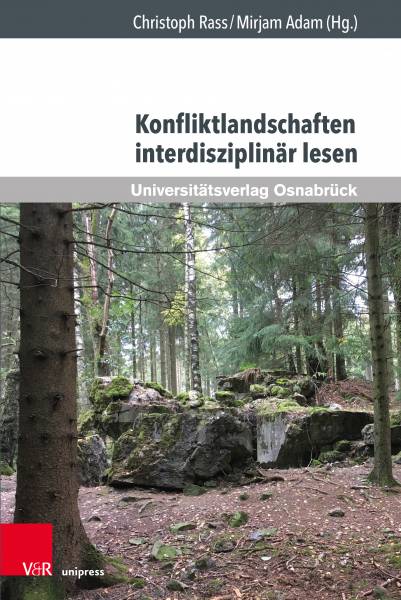
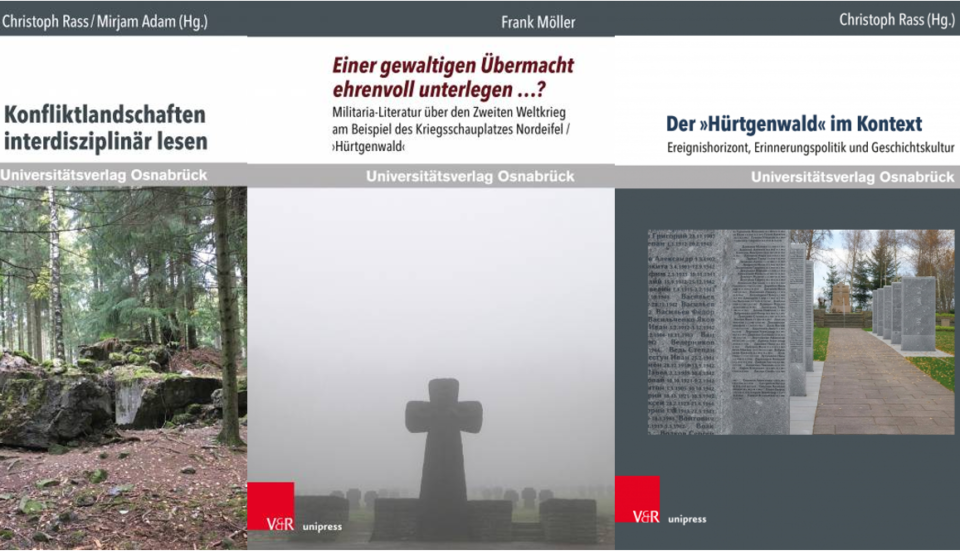
**Volume 1**, [»Konfliktlandschaften interdisziplinär lesen«](https://www.vandenhoeck-ruprecht-verlage.com/reihe-konfliktlandschaften) [“Reading Conflict Landscapes Interdisciplinarily”], develops the theoretical and methodological foundation of the concept. The contributions draw on case studies ranging from antiquity through the Middle Ages to the modern period to demonstrate how violence materially transforms its sites, and how the narratives, discourses, events, and actors associated with those sites relate to one another. Topics covered include military battlefields as well as militarized borders, and sites of National Socialist violence and extermination connected to the Shoah. The integration of approaches from the natural sciences and the social and cultural sciences—which is characteristic of the IAK—renders the interactions between the material and discursive levels in a process of ongoing transformation tangible.
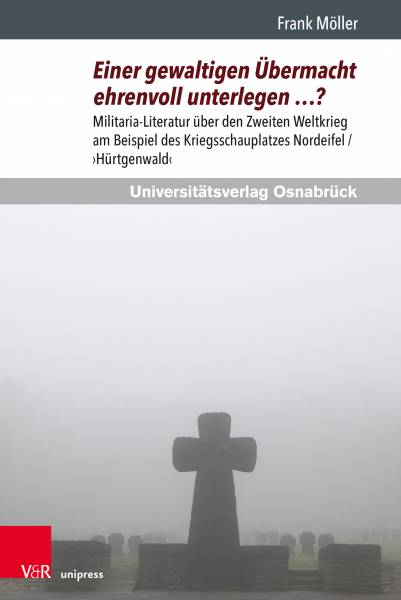
**Volume 2**, Frank Möller’s study [»Einer gewaltigen Übermacht ehrenvoll unterlegen …?«](https://www.vandenhoeck-ruprecht-verlage.com/reihe-konfliktlandschaften) [“Honorably Defeated by an Overwhelming Superiority …?”], analyzes ten titles from the German Militaria literature on the combat operations of the final phase of the Second World War in the northern Eifel and the ‘Hürtgen Forest.’ Möller examines the sources, intentions, target audiences, and networks of supporters behind these works, and lays bare how they pave the way for a revisionist conception of history and exert their influence into local and regional historical politics. From this analysis he derives ten theses that invite further discussion. Anyone wishing to understand how a right-wing historical narrative is constructed will find the workshop laid open here.
Volume 3 brings both lines of inquiry together—the conceptual program of the first and the ideological-critical precision of the second—and supplements them with the contemporary challenges of critical memory work.
Conflict Landscape Research at UOS
The completion of the Hürtgen Forest project coincides with a phase in which conflict landscape research at the professorship is continuing in two directions.
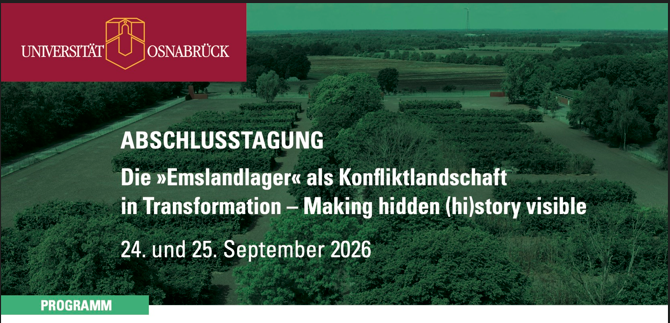
On 24 and 25 September 2026, the [closing conference of the project “The ‘Emsland Camps’ as a Conflict Landscape in Transformation”](https://nghm.hypotheses.org/49673) will take place in Osnabrück. The project has been carried out by the [NGHM](https://www.uni-osnabrueck.de/fb1/geschichte/nghm) in collaboration with the [Professorship for the Didactics of History at Kiel University](https://www.histsem.uni-kiel.de/de/das-institut-1/abteilungen/didaktik-der-geschichte). Whereas the Hürtgen Forest volume asks how a space is made into a “battlefield,” this project asks how widely dispersed camp sites—with very varying degrees of visibility and invisibility—can be digitally documented, represented, and communicated. The conference will present the digital resources that have been developed, as well as the dissertation by [Imke Sofie Selle](https://www.uni-osnabrueck.de/fb1/geschichte/nghm/alle-personen/imke-sofie-selle-med) on “Practices of the Digital Production of Historical Culture Using the Example of the ‘Emsland Camps'”; on the second day, it will include a visit to the memorial site at Camp Dalum.
In October 2026, the newly approved cooperative project “Moorlandschaften als Interventionsräume” [“Moorland Landscapes as Spaces of Intervention”] will commence with the Emsland Moormuseum in Geeste, funded through the Pro*Niedersachsen programme. It examines the socio-ecological transformation of the Bourtanger Moor between 1945 and 2025, applying the analytical framework to a case in which the reshaping of a landscape arose not from war but from planning. The connection to the Emsland complex is not merely geographical: because the cultivation of the moorlands between 1933 and 1945 was bound up with the Emsland camps, in which forced labour in the moor was used as a means of punishment, this landscape, too, carries a history of violence.
From these two projects, volumes four and five of our series will emerge.
All three endeavours share a question that the Hürtgenwald volume poses with particular sharpness: under what conditions does a society revise an interpretation in which it has settled for decades. The case of the Northern Eifel offers an uncomfortable answer to this question. It is instructive not because an especially large number of people died there or because the battles were of exceptional significance, but because it allows us to observe how difficult it is to engage critically with one’s own past and how much persistent effort is required before anything changes.
Christoph Rass (ed.): Der ›Hürtgenwald‹ im Kontext. Ereignishorizont, Erinnerungspolitik und Geschichtskultur (= Konfliktlandschaften, vol. 3). Göttingen: V&R unipress / Universitätsverlag Osnabrück 2026. 334 pp., 35 figs. ISBN 978-3-8471-1990-6 (Print), ISBN 978-3-7370-1990-3 (PDF). Open Access: https://doi.org/10.14220/9783737019903
Find the original post at Out Now | Konfliktlandschaften Band 3: Der Hürtgenwald im Kontext. on nghm.hypotheses.org.
This post was automatically translated from the German original.