
Gaps in the Culture of Remembrance | Between Commemoration and Repression. Panel Discussion on 1 October at the vhs Osnabrück.

By TEAM NGHM · Originally published on nghm.hypotheses.org
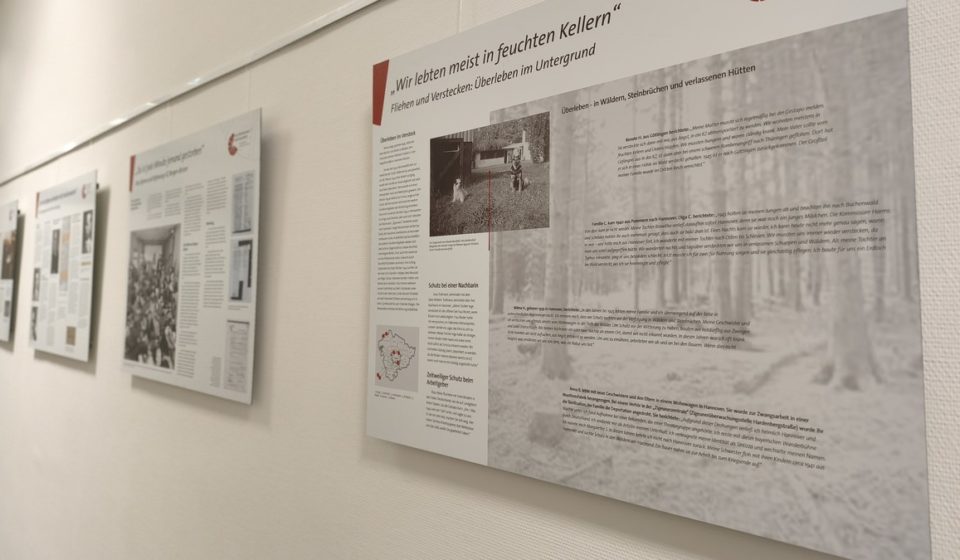
On Thursday, 1 October 2026, at 6:00 p.m., the panel discussion »Leerstellen der Erinnerungskultur. Zwischen Gedenken und Verdrängung« [»Gaps in the Culture of Remembrance. Between Commemoration and Repression«] will take place in the lecture hall of the vhs|os at Bergstraße 8 in Osnabrück. The Volkshochschule Osnabrück is organizing the event jointly with the Niedersächsischer Verband Deutscher Sinti [Lower Saxony Association of German Sinti], the Kunsthalle Osnabrück, and the Institute for Migration Research and Intercultural Studies (IMIS) at the University of Osnabrück. The discussion is part of the accompanying program for the exhibition »Aus Niedersachsen nach Auschwitz« [»From Lower Saxony to Auschwitz«]; guests include Mario Franz and Kutlu Yurtseven.
Mario Franz is President of the Niedersächsischer Verband Deutscher Sinti [Lower Saxony Association of German Sinti] and Director of the Niedersächsische Beratungsstelle für Sinti und Roma [Lower Saxony Advisory Center for Sinti and Roma]. He serves on the advisory board of the Stiftung niedersächsische Gedenkstätten [Foundation for Lower Saxon Memorial Sites] and developed the concept of Z-Projektion, an analytical instrument for identifying the mechanisms of anti-Romani discrimination. As a composer, he wrote the piece »Unku« in memory of Erna Lauenburger, who was murdered in Auschwitz-Birkenau in 1944.
After he contacted the Auschwitz survivor Esther Bejarano in 2007, the group performed more than 900 concerts with her over thirteen years. Since 2021, Microphone Mafia has continued this work together with Esther Bejarano’s son, Joram Bejarano. Kutlu Yurtseven is also active in Herkesin Meydanı (A Place for Everyone), an initiative advocating for a memorial site commemorating the NSU nail bomb attack on Cologne’s Keupstraße on 9 June 2004.
Moderated by Christoph Rass, the evening follows a line of inquiry developed by the anthropologist and historian Michel-Rolph Trouillot. In »Silencing the Past« (1995), he demonstrated that history consists not only of what happened, but also of what was recorded, preserved, and narrated about it, and that between these layers lie decisions made by people with varying degrees of power. According to his analysis, history as silence is produced at four points: when sources come into being, when archives are established, when archives are transformed into narratives, and when those narratives are subsequently assigned meaning. His illustrative example is the Haitian Revolution, which was unthinkable for European contemporaries and therefore went largely untold for a long time.
Against this backdrop, the discussion addresses the genocide of Sinti and Roma as well as racist violence after 1945 — two subjects that each have their own history while also sharing certain similarities. The conversation centers on who decided, when, how, and why at each of these four points, and what can be changed about the consequences of those decisions in pursuit of an inclusive culture of remembrance. The guiding question is: what is the memory of those worth in a society who do not count among the privileged actors of historical politics and the culture of remembrance?
The discussion moves through three areas. In the first, we ask which memories of the genocide of Sinti and Roma and of racist violence after 1945 are visible in the public sphere, which are absent, and who is involved in shaping them. In the second, the panel discusses whose knowledge counts as a source, who decides about archives and access to them, and which media and forms of expression — from monuments and street names to music, art, and digital forms — are recognized as legitimate forms of remembrance. In the third, we examine the relationship between institutions and grassroots work, asking what resources, what shared decision-making power, and what conditions must be in place for genuine collaborative participation. The guiding principle throughout is the maxim: »Nothing about us without us«.
The panel guests will discuss for approximately 60 minutes. Afterwards, members of the audience are invited to contribute questions and comments for a further 20 minutes.
At a Glance
| Date | Thursday, 1 October 2026, 6:00 p.m. |
|---|---|
| Venue | vhs|os, Bergstraße 8, 49076 Osnabrück, lecture hall |
| Guests | Mario Franz (Niedersächsischer Verband Deutscher Sinti), Kutlu Yurtseven (Microphone Mafia, Herkesin Meydanı) |
| Moderator | Christoph Rass (IMIS) |
| Organizers | Volkshochschule Osnabrück, in cooperation with the Niedersächsischer Verband Deutscher Sinti, the Kunsthalle Osnabrück, and the Institute for Migration Research and Intercultural Studies (IMIS), University of Osnabrück |
| Course number | 26B7820 |
| Admission and registration | [free] |
| Information | Dr. Tobias Pischel de Ascensão, telephone 0541 323-21 97; Leon Nicolaysen, telephone 0541 323-41 73 |
Find the original post at Leerstellen der Erinnerungskultur | Zwischen Gedenken und Verdrängung. Podiumsgespräch am 1. Oktober in der vhs Osnabrück. on nghm.hypotheses.org.
This post was automatically translated from the German original.