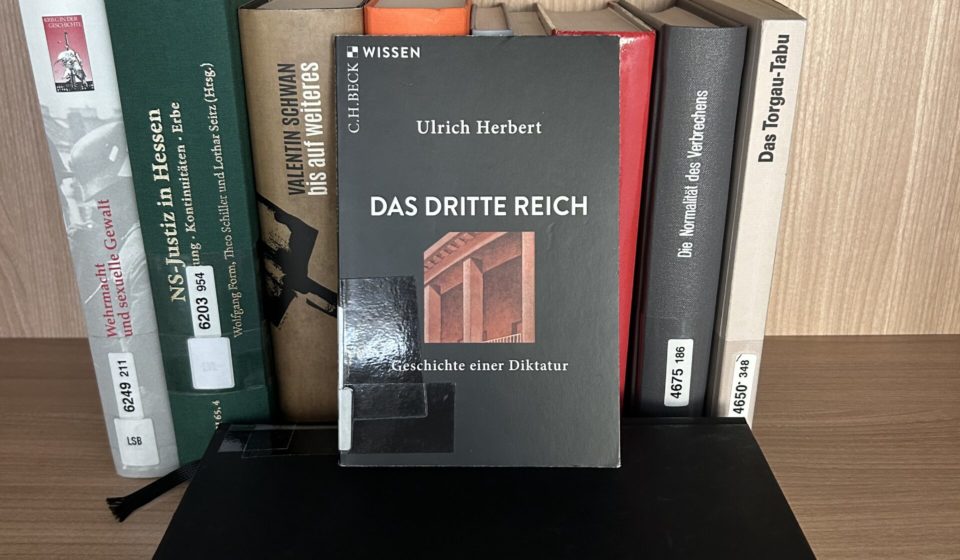
NGHM reads | 16 | Ulrich Herbert: Das Dritte Reich. Geschichte einer Diktatur (2016)

By Christoph Rass · Originally published on nghm.hypotheses.org
Can the history of the ‘Third Reich’ be told in just over 120 pages without oversimplification? In the preface to his 2016 volume published by C.H. Beck, Ulrich Herbert himself describes the undertaking as “a venture.” With this title from the field of National Socialist history and Holocaust research, the series NGHM liest continues its presentation of the NGHM reading list. The volume demonstrates what a survey can achieve when written by a historian who has helped shape the field over decades.
When the volume appeared, Herbert could look back on a long scholarly career. Born in Düsseldorf in 1951, he completed his doctorate in 1985 at the University of Essen under Lutz Niethammer, on the deployment of ‘foreign workers’ in the wartime economy of the National Socialist state. From 1992 to 1995 he directed the Research Centre for the History of National Socialism in Hamburg. He subsequently held the Chair in Modern and Contemporary History at Freiburg until 2019. In 2014 he published his Geschichte Deutschlands im 20. Jahrhundert [History of Germany in the Twentieth Century], which in the same year received the Bavarian Book Prize in the non-fiction category. According to Herbert’s own indication, the slender volume draws on this work “in many parts,” even if it sets “partly different emphases and priorities.”
This genesis explains the approach. A scholar who has researched forced labor, illuminated the ideological elite of the Reich Security Main Office through the biography of Werner Best (1996), and most recently written a panorama of the entire century, distills his own knowledge in such a volume into an analytical sketch. Herbert justifies this form by reference to the state of research, whose findings yield an “extraordinarily diverse and complex overall picture” that differs markedly from the earlier tendency to reduce the subject to a few individuals and central events. Robert Probst accordingly noted in the Süddeutsche Zeitung that Herbert dispenses with personalization and with quotations that interrupt the flow of reading.
The proportions of the volume also reflect a substantive decision. Because only the years from 1933 to 1939 constitute specifically German history, whereas the war years form “part of European and world history,” the period up to 1939 accounts for only about two-fifths of the presentation. A first part traces the long-term preconditions from the Wilhelmine Empire through the postwar years to the right wing in the Weimar Republic, before the second part leads from the ‘seizure of power’ through persecution, economy and society, expansion, and the November pogroms to the path toward war. The third part forms the core. Its chapters range from the “explosion of violence” through “Barbarossa,” “extermination policy,” and “war and occupation” to the “Volksgemeinschaft [people’s community] at war” and resistance.
Herbert encapsulates his program in a precise formulation: the aim is to “elucidate contexts and explain connections, so as not to dissolve the history of the Third Reich into unrelated individual details.” In this way he responds to a subject that, beneath the abundance of research material, easily fragments into isolated islands of detail, and answers with selection according to coherence. He names the price himself. The presentation dispenses “almost entirely with consideration of developments in research and scholarly controversies,” which are set out in detail elsewhere, and therefore only the quotations are referenced. Those seeking the debates of the field will therefore need to turn to the individual studies on our reading list.
The initial reception largely accepted this decision. Gregor Schöllgen wrote in the Frankfurter Allgemeine Zeitung of “a major achievement in a small space,” while Matthias Arning recommended the volume in the Frankfurter Rundschau as “essential reading.” Probst, initially skeptical by his own admission, credited Herbert with precision and emphasized that what lay before the reader was no mere introduction to the subject. He identified the relationship between the German people and the National Socialist leadership as the central focus of Herbert’s presentation.
Read from this focal point, the decision to forgo controversies shifts the emphasis onto a question that has accompanied Herbert’s work for decades. The relationship between the population and the regime appears less as a moral question of guilt than as an analytical question about the forces of cohesion, about consent, toleration, and complicity, and about their limits. Behind the seemingly neutral chronology there thus stands a thesis about the social reach of a dictatorship.
The preface also points to the volume’s origins in teaching and conversation. Herbert thanks Sybille Steinbacher and Susanne Heim for their critical reading. The concise sketch is above all the result of discussions with students, doctoral researchers, and colleagues, in which one found oneself confronted “with ever new and challenging questions.”
LQP 6259-645 5.
The volume’s place on the reading list is as a framework that situates the individual studies of the field within a broader context. A counterpart is offered by Ian Kershaw’s Hitler, which will be presented in this series in a few weeks. Kershaw links the person of the dictator to the structure of charismatic rule, while Herbert steps back from personalization. Read side by side, both approaches illuminate a system of domination that can be reduced neither to its ‘Führer’ nor to its structures.
In Herbert’s work, conciseness becomes the condition for an approach that makes connections visible precisely because it must leave out details. It is fitting, therefore, that he explicitly regards his own book merely as an “interim result,” since, contrary to the widespread conviction that the ‘Third Reich’ has been researched or even “come to terms with,” scholarship on many points is “only at the beginning.”
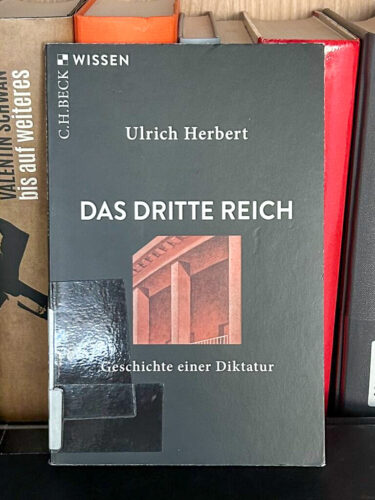
Students at Osnabrück can access Das Dritte Reich as an online resource or as a physical copy through the University Library (OPAC).
Ulrich Herbert, Das Dritte Reich. Geschichte einer Diktatur, München: C.H. Beck 2016 (C.H. Beck Wissen).
This post is part of the series NGHM liest, in which the 65 titles of the NGHM reading list are presented. The list can be explored as a knowledge graph.
Find the original post at NGHM liest | 16 | Ulrich Herbert: Das Dritte Reich. Geschichte einer Diktatur (2016) on nghm.hypotheses.org.
This post was automatically translated from the German original.