
By Christoph Rass · Originally published on nghm.hypotheses.org
“I am seeking to rescue the poor stockinger, the Luddite cropper, the ›obsolete‹ hand-loom weaver, the ›utopian‹ artisan, and even the deluded follower of Joanna Southcott, from the enormous condescension of posterity.” With this sentence from the preface, which he completed in August 1963 in Halifax, Edward Palmer Thompson sets out the program of a book that became a founding text of ›history from below‹. In the NGHM reading list, his book ranks at number 17 and offers us a key text of social history.
Thompson wrote the book out of adult education. From 1948 to 1965 he taught as an Extra-Mural Lecturer at the University of Leeds in the West Riding, where he led Tutorial Classes whose participants were partly recruited through the Workers’ Educational Association. The preface itself records this connection: Thompson thanks the university and S. G. Raybould for enabling him to undertake the research for this book, and writes that he learned a great deal about the subjects discussed from the members of his courses. This origin is one of the methodological preconditions of the book, for one who writes about the constitution of a class and has those he writes about sitting before him in the classroom reflects upon his own work differently.
The first edition comprises 848 pages and is divided into three parts, the program of which Thompson himself outlines in the preface. The first part, The Liberty Tree, traces the continuing popular traditions of the eighteenth century that shaped the Jacobin agitation of the 1790s. The second part, The Curse of Adam, moves from subjective to objective influences: to the experiences of individual groups of workers in the Industrial Revolution, to the character of the new industrial work discipline, and to the question of what Methodism meant for this discipline. The third part, The Working-Class Presence, takes up plebeian radicalism, follows it through Luddism into the ›heroic age‹ at the end of the Napoleonic Wars, and closes with aspects of political theory and class consciousness in the 1820s and 1830s. Thompson describes the structure in the preface as “a group of studies, on related themes, rather than a consecutive narrative”; this arrangement is itself part of the argument.
Thompson’s argument is itself processual. In his work, class constitutes a historical event rather than a sociological category into which people are sorted — this is what ›making‹ stands for. The preface formulates it as an occurrence: class ›happens‹ when people, as a result of inherited or shared experiences, sense and articulate the identity of their interests among themselves and in relation to others whose interests differ from, and are usually opposed to, their own. With this, Thompson shifts the analytical approach. The working class produces itself — through engagement with economic, cultural, and religious conditions and as an acting subject — rather than being produced by the economy. For the years between 1780 and 1832, Thompson describes this process as it occurred among the majority of English working people; by 1832, in his judgment, the presence of the working class constituted the most significant factor in British political life.
The book received praise early on, and sharp criticism only later. In 1964, Ben B. Seligman called it unreservedly in Commentary the most important study of the Regency and early Victorian period since the Hammonds’ classic work. An informal poll by History Today on the most important historian of the preceding sixty years placed Thompson second in 2011, behind Fernand Braudel and ahead of Eric Hobsbawm, both of whom are also represented on our reading list. From the 1980s onward, however, historians began to advance a discourse-analytical critique of the book. Gareth Stedman Jones, in Languages of Class (1983), read the political language of radicalism as the instance that determined the form of the democratic movement, rather than as an expression of social experience; he interpreted Chartism accordingly as a movement for parliamentary reform. Joan Wallach Scott, whom we discussed in the thirteenth installment of this series, showed in Gender and the Politics of History (1988) that Thompson constructs class in its origins and expression as a masculine identity, and that the coding of labor and politics as masculine excludes women from the narrative.
These debates attest to the work’s stature: more recent approaches define themselves against it, including those that regard it as superseded.
Further blind spots were identified in the anniversary issue of Historical Reflections/Réflexions Historiques (41/1, 2015), marking the book’s fiftieth anniversary: Zach Sell examined English workers’ conceptions of American slavery and colonial India, and charged Thompson with overlooking the worldwide movement of capital and global racial hierarchies. In the same issue, Caroline Bressey recovered the multiethnic and Black geographies of Britain and showed how the narrative constructs a working class presumed to be white. Carolyn Steedman had already set domestic service against the narrative of the ›making‹ of the English working class in Labours Lost (2009). The counter-critique was sharpened by Marc W. Steinberg in Theory and Society in 1991: Stedman Jones, he argued, turns discourse into a deterministic motor and Scott turns experience into mere signification, with both thereby losing sight of precisely the human agency that Thompson works to bring to light. His conclusion: ›it is people that do the making‹.
The debate over ›agency‹ and ›discourse‹ continues to accompany our series. When, in a few weeks’ time, following installment 11, Frantz Fanon’s The Wretched of the Earth is discussed on this list, the question will arise again in a postcolonial register: how do collective subjects become historically capable of action, and who writes their history? For the English case, Thompson formulated an answer that exerted methodological influence far beyond Britain, extending to the South Asian Subaltern Studies, whose relationship to British Marxist social history has been examined by Sumit Sarkar in Writing Social History (1997). Thompson’s understanding of class as a lived, culturally mediated process remains the reference point of the debate, even as its vocabulary has shifted.
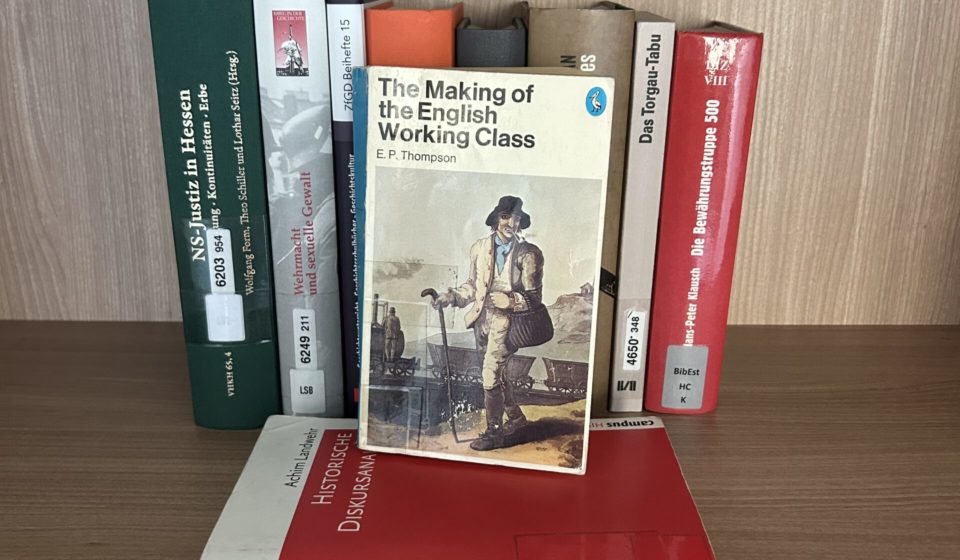
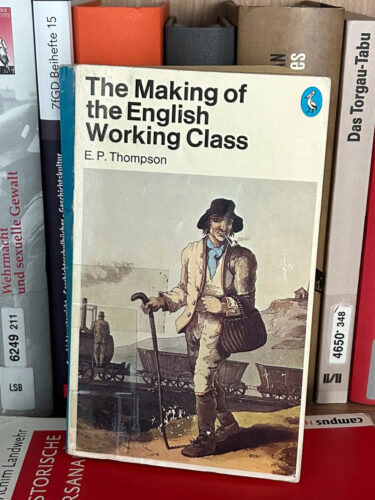
Students in Osnabrück will find the book in the Penguin edition in the B-Magazin of the University Library (OPAC).
Edward Palmer Thompson (1924–1993), The Making of the English Working Class, London: Victor Gollancz 1963.
This post is part of the series NGHM liest [NGHM Reads], which presents the 65 titles on the NGHM reading list. The list can be explored as a knowledge graph.
Find the original post at NGHM liest | 17 | Thompson: The Making of the English Working Class (1963) on nghm.hypotheses.org.
This post was automatically translated from the German original.