

By Christoph Rass · Originally published on nghm.hypotheses.org
With the new academic year, a Footnote Society is being established in Osnabrück. During the winter semester 26/27, this new reading circle will meet on three Tuesday evenings to read one text in full and debate it. The Footnote Society is open to students of all years as well as to academic staff. What this group practises has a history that can be traced on a single book page from 1697.
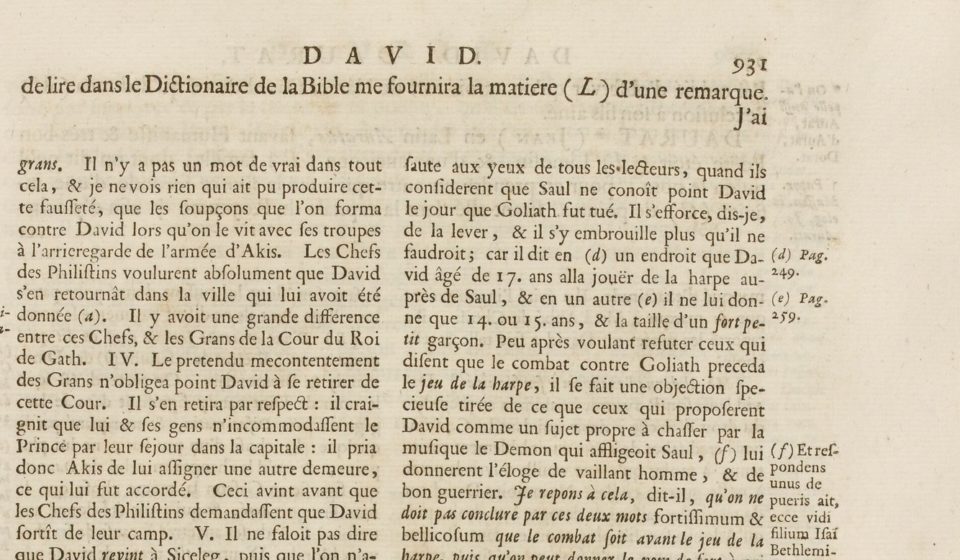
In 1697, Pierre Bayle published a book in which the footnotes crowd the main text off the page. On page 930 of the first volume of his »Dictionnaire historique et critique«, eight lines still hold their ground at the top; on the following page, only a single line remains, completing the unfinished sentence. Everything else belongs to the apparatus: two closely typeset columns of annotations, flanked on both margins by narrow columns referring to the passages where the claims made can be verified.
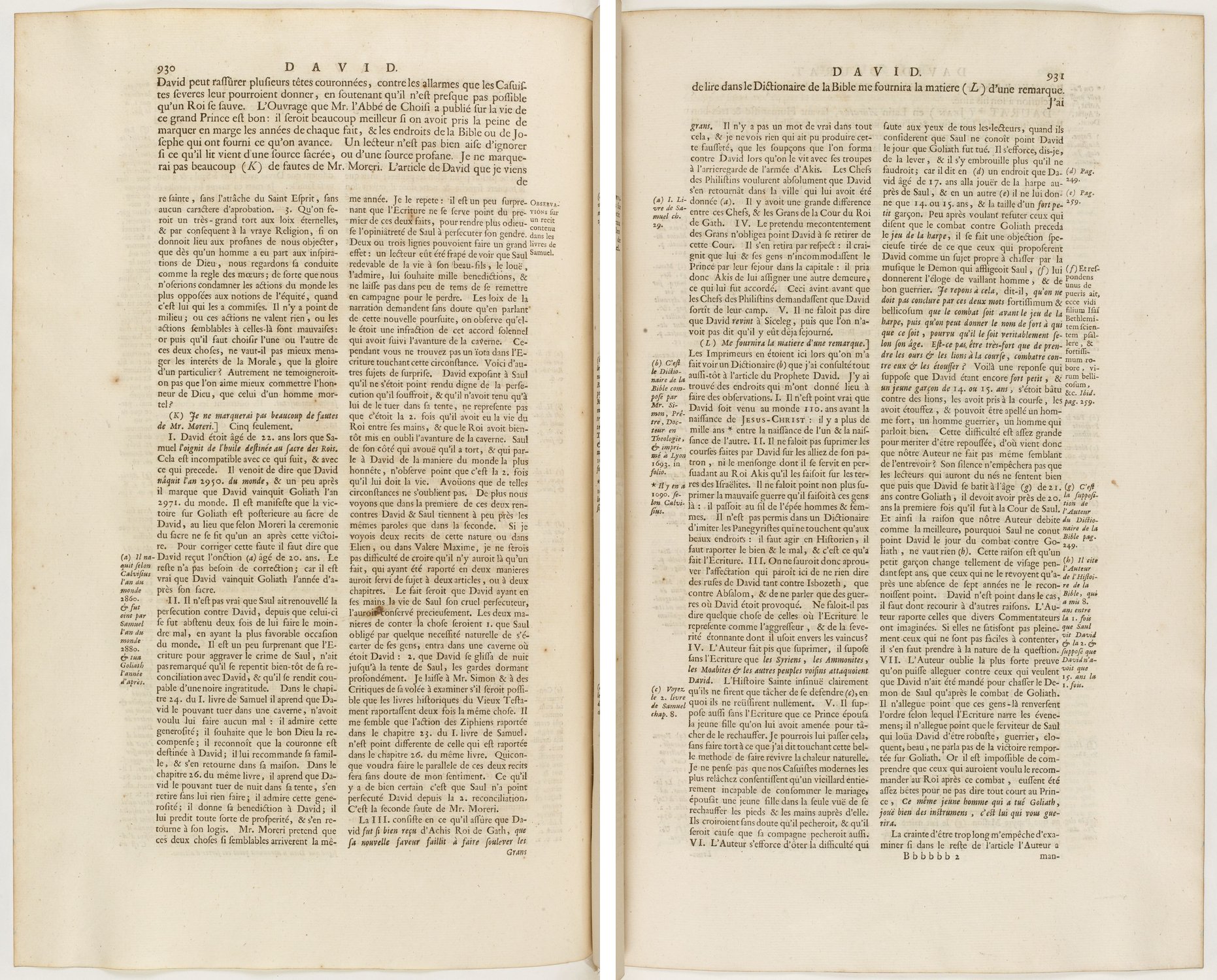
Pierre Bayle, »Dictionnaire historique et critique«, vol. 1,2, Rotterdam: Reinier Leers 1697, pp. 930 and 931, from the article »David«. Bibliothèque nationale de France, département Arsenal, FOL-H-5119 (2) (Source: gallica.bnf.fr / Bibliothèque nationale de France).
This arrangement is no accident of typesetting. In the eight lines on page 930, Bayle praises a biography of King David written by the Abbé de Choisy and adds that the book would be considerably better had someone taken the trouble to note in the margin the dates of individual events, along with the passages from the Bible or from Josephus on which the author drew. A reader, he argues, is understandably reluctant to remain uncertain whether what he is reading derives from a sacred or a profane source. What Bayle demands there, the marginal columns of the following page demonstrate in practice.
Anthony Grafton cites precisely this passage in the first history of the historiographical footnote, which appeared in German in 1995 under the title »Die tragischen Ursprünge der deutschen Fußnote« [»The Tragic Origins of the German Footnote«] and two years later in an expanded English edition published by Harvard University Press. Grafton traces the origins of the historical citation to around 1700 and locates it in Bayle, whose work was conceived from the outset as a catalogue of the errors of other reference works, directed first against Louis Moréri’s »Grand dictionnaire historique« of 1674. Anyone wishing to correct an error must disclose the source of their superior knowledge. Bayle’s pages, Grafton writes, are covered by only a thin and brittle crust of text, beneath which the swamp of commentary opens up.
This manner of writing had its price, incidentally. From September 1697, six commissioners of the Consistory of the Walloon Church in Rotterdam examined the »Dictionnaire« article by article, reaching the article on David on 17 November 1697, from which they derived a shocking portrayal of the conduct and governance of this king and prophet. The articles thus censured were ones whose substance resided overwhelmingly in the annotations. Bayle promised corrections, bided his time, and responded in the second edition of 1702 with the »Éclaircissements« and a revised version of his text.
Reading that begins at the bottom of the page takes time and rarely rewards solitary effort. This is precisely where the Footnote Society begins, which is being established at the University of Osnabrück in the winter semester 2026/27 and founded by Christoph Mauntel and Christoph Rass. As an academic reading club, the Footnote Society proceeds from the assumption that the annotations frequently contain more than the main text, and that it is worthwhile to follow a reference even when nobody knows in advance where it leads.
The Footnote Society is affiliated with no faculty, subordinate to no examinations office, and the acquisition of credit points within it is impossible. A meeting of the Society lasts sixty minutes and has nine seats. Those who take a seat speak; those who arrive later listen and are welcome as guests.
What is read is an essay, a book chapter, or a piece of writing. During the session, all devices remain switched off. This rule is not hostile to technology but protects a scarce resource: one hour of uninterrupted attention for a line of argument and a conversation. Three of the nine places are determined in advance, because each carries a specific responsibility. The remaining six are taken by whoever comes having read the text.
A session lasts sixty minutes and follows a fixed format. At the outset, one person has five minutes to present the central argument of the text, identify a key concept, and explicitly invite disagreement. This is followed by a discussion of just over half an hour, without an agenda and without a formal presentation, during which no one speaks for more than three minutes at a stretch.
The final quarter of an hour belongs to the part that gives the Society its name. A second person has selected in advance a single footnote from the text, has pursued it, and reports on what was found there: a reference, a forgotten title, a surprise, occasionally an entire field of research contained within a single annotation. The group then collectively decides what will be read next time. If the footnote under discussion points toward another text, the Society follows it there, and over the course of a semester it traces in this way a reading path that no seminar syllabus has mapped out in advance.
The texts for the first round are drawn, for example, from the NGHM reading list, which is presented on this blog in the series »NGHM liest« [»NGHM Reads«] and can already be explored in full as a knowledge graph. What was actually read, which concept was at the centre of discussion, and which footnote the group pursued is recorded by the Society in its own register.
In the discipline of history, the footnote is the point at which a claim passes into its evidence, and simultaneously the point at which a text acknowledges its own origins. Reading footnotes is among the skills that the Footnote Society sets out to cultivate. Whether the format proves its worth depends on a very simple condition: a session takes place as soon as three readers appear who have genuinely read the text.
Dates in the winter semester 2026/27: Tuesday, 3 November 2026 · Tuesday, 8 December 2026 · Tuesday, 19 January 2027, each from 7 to 8 p.m.
Further information is available in StudIP course no. 2280.
The access password can be found in the newsletter of the Historisches Seminar.
Those present on 3 November will be recorded in the Society’s register as a founder (Fundatorin or Fundator).
Find the original post at Die Fußnotengesellschaft | oder | Dem Verweis folgen, wohin er auch führt. on nghm.hypotheses.org.
This post was automatically translated from the German original.