Work on the Production of Categories | Impressions from a Conference in Cambridge

By Christoph Rass · Originally published on nghm.hypotheses.org
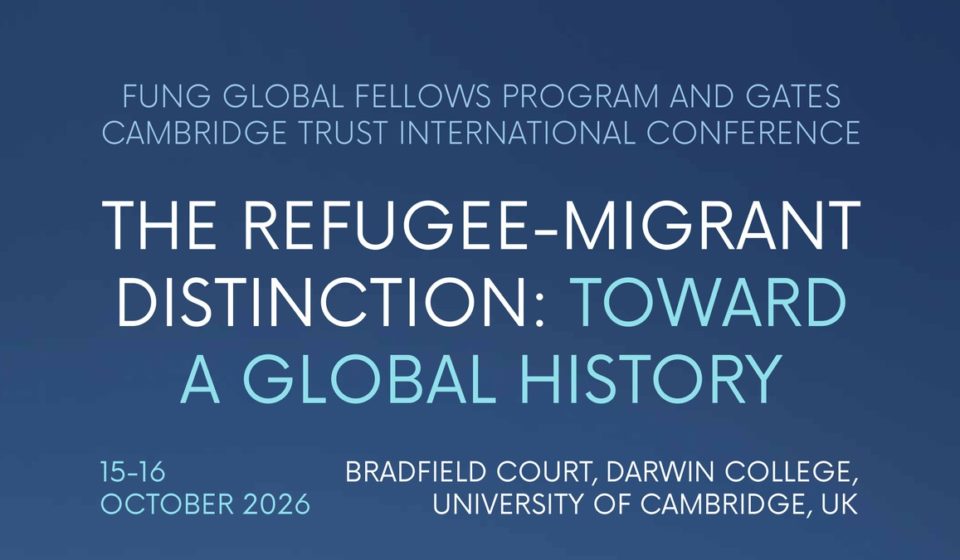
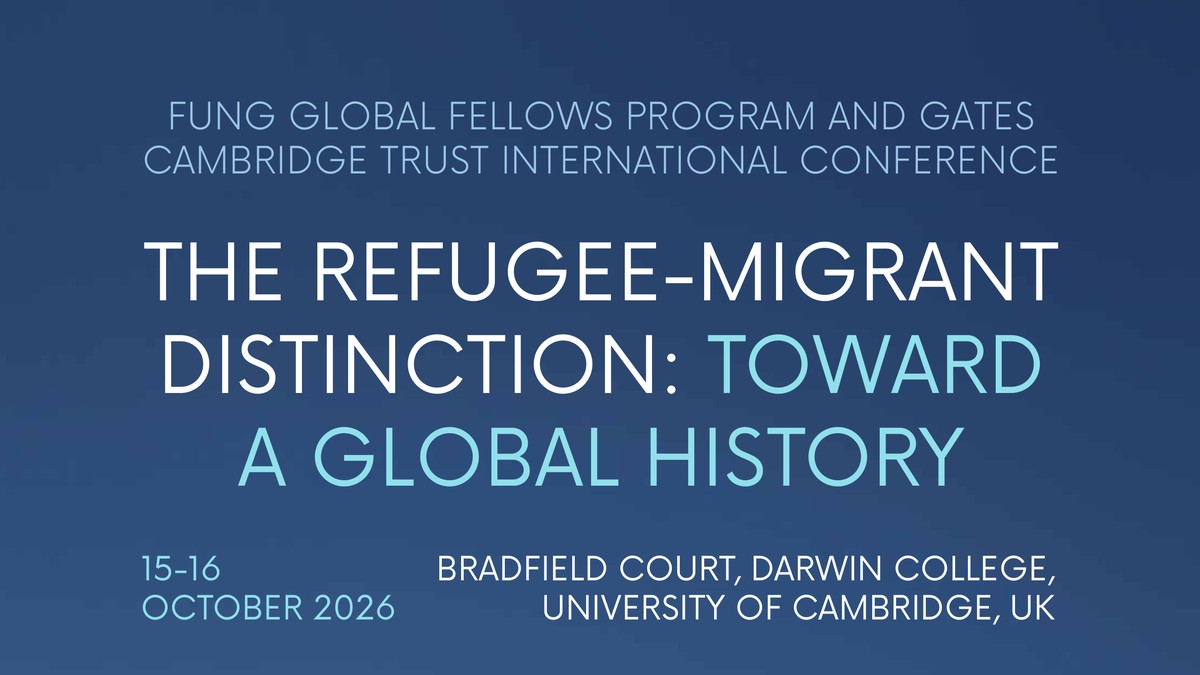
»The Refugee-Migrant Distinction: Toward a Global History«, Darwin College, Cambridge, 15 and 16 October 2026
Who draws the line between ‘refugee’ and ‘migrant’? How did the distinction come about? What consequences has the production of such categories or figures had—and continues to have—for the people they name? For two days, experts from the fields of history, law, and other disciplines gathered in Cambridge to explore these questions. This post reflects the impressions of one participant at a stimulating and productive conference and does not claim to be a comprehensive conference report. The text introduces the six panels of the conference and discusses in greater detail the third panel on labor, security, and precarity, which the author chaired and commented on.
The distinction between ‘refugees’ and ‘migrants’ carries within it a hierarchy of worthiness of protection that continues to this day to justify political decisions and legal boundary-drawing.
With this observation, Bastiaan Bouwman (Utrecht University), Fabrice Langrognet (CNRS France), and Jeremy Adelman (University of Cambridge) opened the conference, made possible by the Fung Global Fellows Program at Princeton and the Gates Cambridge Trust; the widespread assumption of a clear and ontologically given separation was therefore to be examined.
The organizers also sought to challenge the top-down perspective that proceeds from the state and from global governance, for the distinction between ‘refugees’ and ‘migrants’ has never been technical or neutral.
In their opening remarks, the organizers simultaneously proposed understanding the conference as a form of “provincializing the international refugee regime.” Discussion also touched on the fact that restrictive immigration policies now shape not only the histories that historians investigate, but sometimes their own work as well.
Most contributions had been circulated in advance as papers. In order to preserve time for discussion, presentations were limited to twenty minutes each and comments to fifteen minutes.
A Conference in Six Panels
The papers traced the production of the distinction between ‘refugees’ and ‘migrants’ across more than a century and a half and four continents, from the American Civil War to the Rohingya camps in Bangladesh, drawing on treaties and conference minutes, court decisions and newspapers, petitions, records of relief organizations, and interviews.
At many points, the discussion spoke productively to the thinking of the Osnabrück Collaborative Research Centre 1604 “Production of Migration” on the making, assignment, and transformation of formations addressed to us as “figures of migration.”
Panel 1: Refugees, Migrants, or Alternative Categories? Categories beyond the Binary
The first panel asked what terms were in use alongside ‘refugee’ and ‘migrant’ in a wide variety of historical contexts, and who used them. In all three cases—in Turkey after the end of the Ottoman Empire, in the American Civil War, and in southern Mexico—the focus was on designations that people gave themselves or that others gave them, and on the restrictions and possibilities that arose from these categorizations.
The panel opened with the Greek-Turkish population exchange stipulated by the Convention of Lausanne on 30 January 1923, which was organized primarily along religious lines. For those displaced, the Turkish text of the Convention drew on ‘muhacir’, the common word for immigrant, which carried connotations of neediness and competition for state assistance. Aytek Soner Alpan (British Institute at Ankara) traced, in From Treaty Category to Identity Claim: Mübadil and the Uneven Making of the Refugee-Migrant Divide, how those exchanged countered this attribution with a category of their own: ‘mübadil’, a word from which they derived rights to resettlement, property, and compensation, on the grounds that an international treaty had sent them away. In January 1925, a woman at a guesthouse in Constantinople/Istanbul insisted to a journalist from the Istanbul newspaper Vatan that she should not be counted among the alms-seeking ‘muhacir’: “we are demanding our rights.” Under single-party rule, the word disappeared as a category of political mobilization. Within families, however, it endured, and from the late 1990s onwards it returned as an identity of origin for the third generation. Alpan discussed the prestige now attached to descent from the exchange by way of a cartoon from 2011. At a party, everyone traces their family back to Crete, Thessaloniki, or the Balkans, until the protagonist discovers to his horror that his own family comes from Yozgat in central Anatolia. For Alpan, ‘mübadil’ was a third term beyond the binary, one that initially denoted a claim and only later an identity. The line between ‘refugee’ and ‘migrant’ was also drawn from below.
Mae Ngai (Columbia University) approached the question from a different angle. Against the humanitarian discourse that portrays refugees as victims, her essay Refugees, History, and the Human framed them as historical actors with a past and a future. As her example she chose—by her own account, perhaps counterintuitively—the ‘colored refugee camps’ of the American Civil War, when more than half a million enslaved people fled behind Union lines. The abolitionist newspaper The Liberator had already called for escaped enslaved people to be designated ‘Colored Refugees’, thereby distinguishing them from a second stream of war refugees—namely, the families of white slaveholders fleeing the Union Army. Slaveholders, meanwhile, used ‘refugee’ as a verb for the removal of enslaved people to Texas. The chair, Mia Bay (University of Cambridge), countered that contemporary scholarship and maps almost invariably call these camps ‘contraband camps’, after the term Union officers had used for those arriving. Ngai conceded that the freedpeople likely would have understood themselves as free.
Catherine Nolan-Ferrell (University of Texas at San Antonio) considered the distinction between ‘refugee’ and ‘migrant’ to be misguided in certain respects. She opened her presentation »Unrecognized Refugees« and Alternate Citizenships in Chiapas, Mexico with a question posed by one of her oral history interlocutors: what difference does it make whether one flees because one’s child is at risk of starvation or because the army is moving in—in either case, the child dies. Her case study examined approximately 200,000 people, predominantly impoverished Maya campesinos, who fled to Chiapas between 1979 and 1983 to escape the genocidal violence of the Guatemalan army, in a region where Mexican law made no provision for refugees. Only 46,000 of them registered as refugees with the Mexican government or the UNHCR. COMAR, the Mexican refugee agency established in 1980, and the UNHCR, with which COMAR had been coordinating since August 1981, imposed restrictions on camp life after roughly a year: residents were not permitted to leave the camps in search of work. The vast majority therefore avoided the camps and lived as desarraigadas (the uprooted)—referred to by authorities and aid organizations as ‘dispersed refugees’—on coffee fincas or with Mexican families to whom they were connected through kinship, previous labor migrations, pilgrimages, or village festivals. These ‘alternate citizenships,’ as Nolan-Ferrell termed the substitute forms of belonging thereby acquired, allowed them to work and move freely; yet they remained without political voice and without recognition by the Mexican state.
Between the first and second panels, Jeremy Adelman moderated a conversation with Heather Faulkner, Senior Archivist at the UNHCR, on Archival Access in Uncertain Times.
Panel 2: Repatriation and the End of Refugee Status. Vom Ende des Flüchtlingsstatus
Chaired by Irial Glynn (University College Dublin), the second panel approached the subject from the endpoint, asking who decides when someone ceases to be a refugee. The answers led to Indian courts, Japanese immigration detention, and a closed camp in Nigeria.
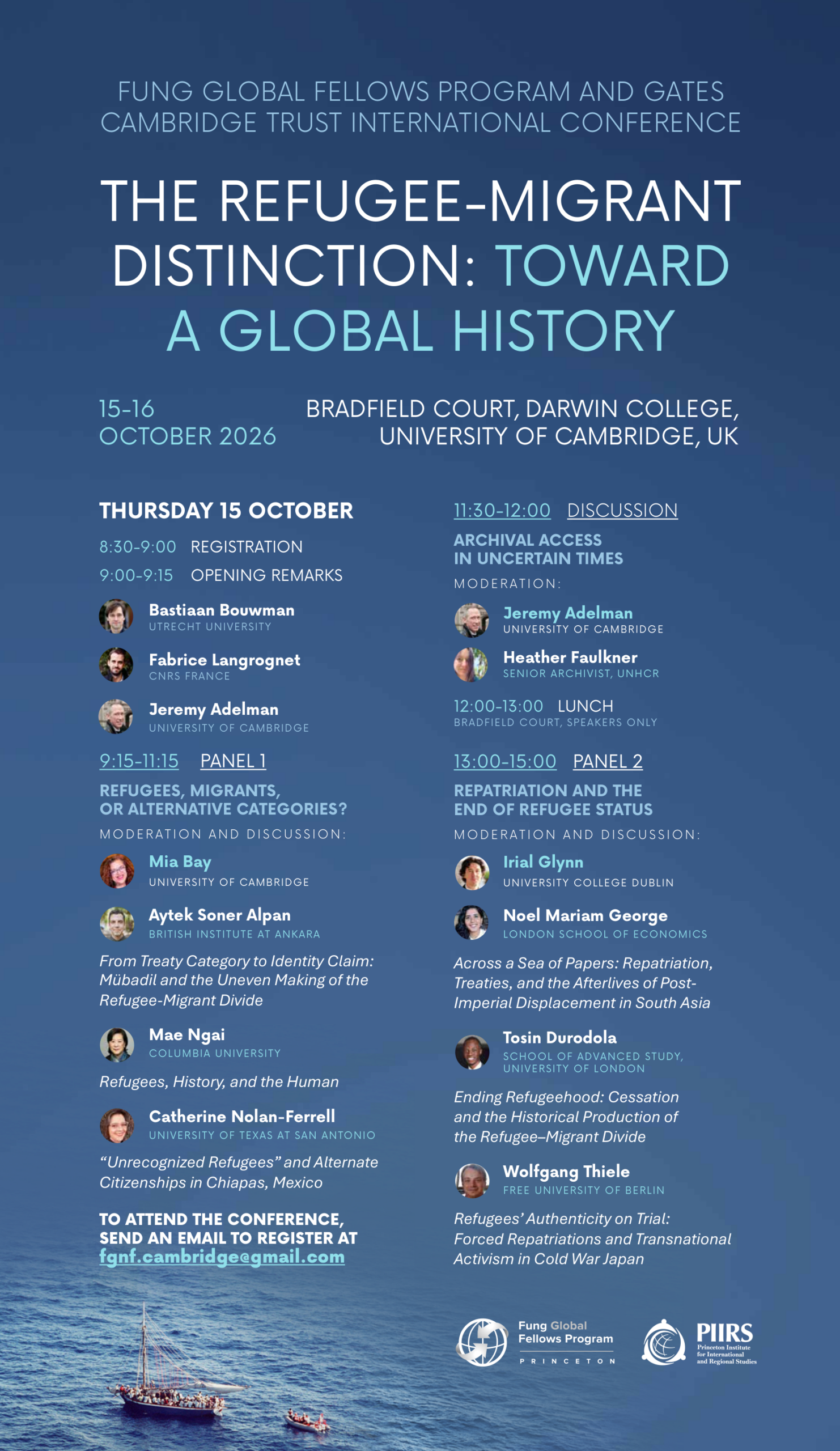
Noel Mariam George (London School of Economics) joined remotely and spoke on Across a Sea of Papers: Repatriation, Treaties, and the Afterlives of Post-Imperial Displacement in South Asia. Her pre-circulated paper, Fragmented Borrowing: Refugee Law, Executive Power, and Judicial Evasion in India (1996–2021), took the audience to India, which has neither signed the 1951 Refugee Convention nor enacted refugee legislation, with the result that asylum seekers are classified as ‘foreigners’ under the Foreigners Act of 1946. Within this legal lacuna, courts adjudicate on a case-by-case basis, selectively drawing on concepts from international law—as did the Manipur High Court in 2021, which classified seven individuals from Myanmar as refugees rather than as persons who had entered the country illegally in the ordinary sense, thereby enabling them to access the UNHCR in Delhi. George described this pattern as ‘borrowing without institutionalisation,’ since courts were able to prevent individual deportations but did not diminish executive primacy. In India, the legal force of the distinction between ‘refugee’ and ‘migrant’ is sustained through judicial practice, even where refugee protection is not secured by statute.
Japan equally lacked any asylum law when, in the late 1960s, it forcibly repatriated activists from the Taiwanese independence movement. In Refugees’ Authenticity on Trial: Forced Repatriations and Transnational Activism in Cold War Japan, Wolfgang Thiele (FU Berlin) reconstructed the covert agreement with the Republic of China (Taiwan) upon which these repatriations were based, as well as the authorities’ justification that those affected were economic migrants posing as activists. Those arrested challenged this characterization in court, arguing that they were refugees under customary international law because their lives would be in danger in Taiwan. After Liu Wenqing was deported one morning in March 1968 despite a lawsuit whose acceptance his lawyer had obtained by telephone during the night, the court declared that it would henceforth accept legal challenges against deportations at any time. Thiele attributed the movement’s success to the breadth of its coalition. He described as nebulous the line drawn by the Japanese Foreign Ministry between ‘genuine’ and ‘false’ activists.
But when does refugee status end, and what follows? Under refugee law, it ceases (the so-called ‘cessation’ clause) when the circumstances that gave rise to flight no longer obtain. Tosin Durodola (King’s College London) reversed the conventional perspective in Ending Refugeehood: Cessation and the Historical Production of the Refugee-Migrant Divide, examining this transition in the case of Liberians at the Oru camp in Nigeria’s Ogun State, for whom the cessation clause took effect on 30 June 2012. Because the envisaged registration of residence permits under the framework of the Economic Community of West African States (ECOWAS) did not take place, approximately 500 former refugees remained after the camp’s closure in 2012 in a self-built settlement, some continuing to use their old UNHCR cards as identification. Durodola termed this condition ‘residual refugeehood’—a persistence of the refugee condition beyond the withdrawal of formal recognition. In this reading, ‘refugee’ and ‘migrant’ appear as successive positions occupied by the same person who has not moved; the distinction is produced by the revocation of status just as much as by its conferral.
Panel 3: Labour, Security, and Precarity. Arbeit, Sicherheit, Prekarität
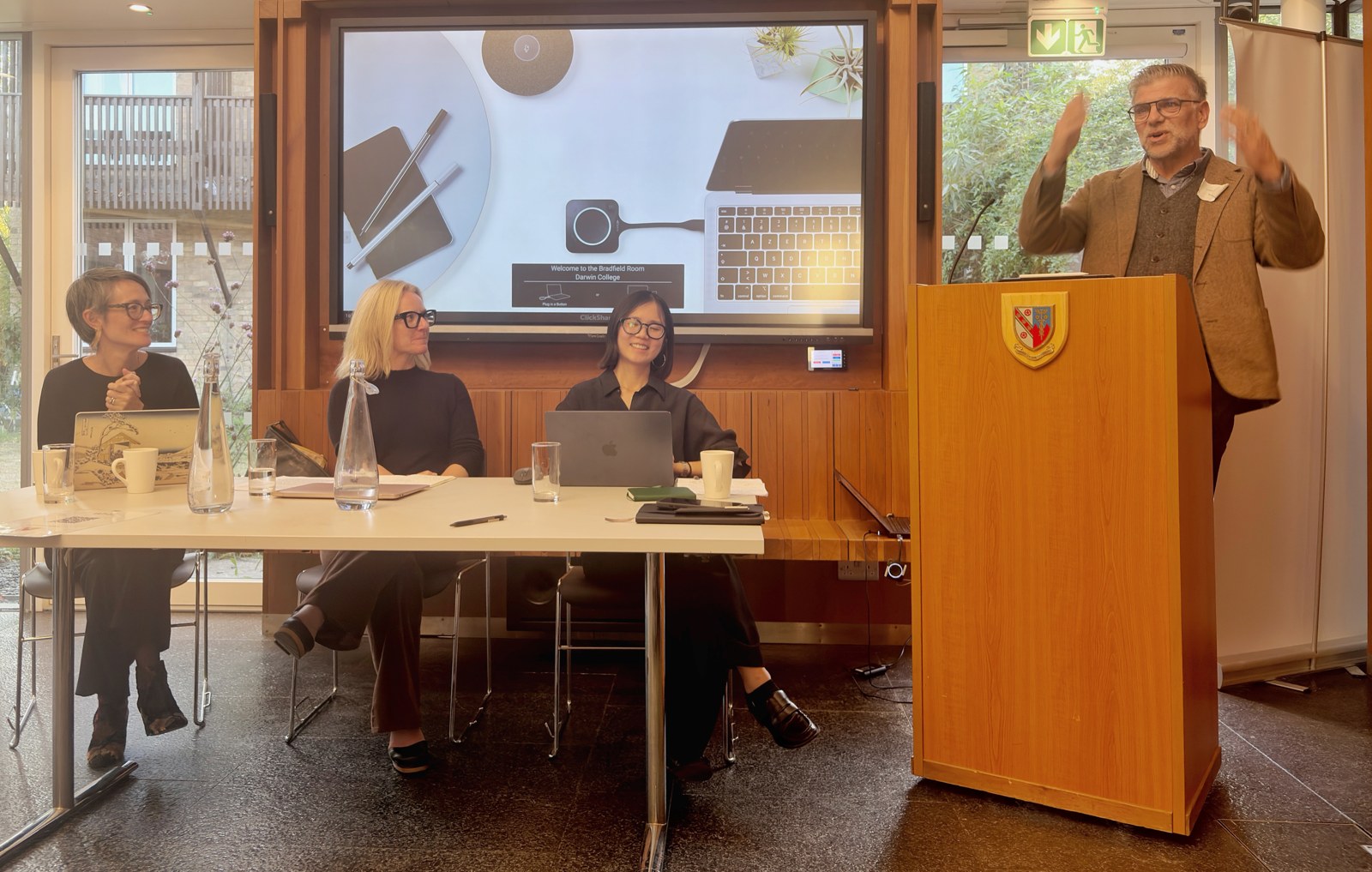
The third panel brought the first day to a close. Under the title ‘Labour, Security, and Precarity,’ it placed work at the center and brought together three widely separated cases: Constantinople/Istanbul after the First World War, a prison in Pennsylvania in the 1990s, and the prairies of North America in the 1930s.
In November 1920, following the collapse of the White forces in Crimea, approximately 150,000 soldiers and civilians were evacuated to Allied-occupied Constantinople/Istanbul, where they were gradually registered as refugees and, as Allied policy toward Turkey shifted, increasingly perceived as a burden. Laura Robson (Yale University), in The »Nansen Passport« and the Birth of the Modern Guest Worker, challenged the widespread interpretation that the Nansen Passport of 1922 represented the first step toward an international refugee law. Her analysis argues that the document served primarily to remove unwanted Russian migrants by stripping them of the special rights that foreigners had enjoyed in the Ottoman Empire under the Capitulations, granting neither permanent residence nor the right of return. From 1925 onward, the bulk of the work of the League of Nations High Commission for Refugees fell to the International Labour Organization (ILO), whose refugee services focused almost exclusively on labor placement. From this emerged the principle of admitting or expelling refugees according to the conditions of the labor market. Robson interpreted this as a construction through which “migrants” became “refugees” and refugees in turn became temporary workers — a genealogy of what would later be termed the “guest worker” model.
On the night of June 6, 1993, the freighter Golden Venture ran aground off Queens with 286 undocumented passengers from China. Ten of them drowned attempting to swim ashore. Jiajia Duan (University of California, Irvine), in Walk the Line: The Golden Venture and the Making of Chinese Asylum in the Post-Cold War United States, traced how these men were transformed from the status of “illegal aliens” to “refugees” who appeared politically legible and morally deserving of protection. The authorities detained 118 of them in the York County Prison in Pennsylvania, where hearings held behind closed doors through mid-August 1993 resulted in asylum being granted to only one of more than one hundred applicants. Following a hunger strike and a lawsuit brought by regional newspapers, public proceedings in Baltimore resulted in three of seven applicants receiving asylum.
Advocates found a bipartisan language around the issue of forced abortion, which a 1990 executive order had already given particular significance in the context of China’s one-child policy. Congressional hearings in 1995 contributed to the passage of Section 601 of the 1996 immigration law IIRIRA, which recognizes forced abortion as persecution on account of political opinion — while the same legislation, as Duan noted, simultaneously introduced harsher border controls and detention measures. The last 53 detainees were released in February 1997 through “humanitarian parole,” that is, without asylum and without permanent status. Duan’s assessment: the campaign rendered the men legible as deserving “refugees” without necessarily challenging the underlying assumptions of American policy.
Laura Madokoro (Carleton University), in »Dust Bowl« Refugees: Citizenship, Mobility and the Hardening of Rhetorical Strategies, examined how people who left the prairies of North America during the drought and depression years of the 1930s were designated — as “refugees,” “migrants,” or “settlers.” Her proposal to incorporate citizenship and settler colonialism into the history of this distinction serves as a reminder that the governments of the United States and Canada had dispossessed and displaced Indigenous societies in order to open the prairies for settlement. In her Canadian examples, the primary determinant of whether people faced deportation or received assistance was the distinction between citizens and non-citizens: non-citizens in need could be expelled as a burden on public funds, while settlers with citizenship rights received support.
Commentary on Panel 3: The Production of Categories
In July 1922, Fridtjof Nansen, the League of Nations High Commissioner for Refugees, brought sixteen governments together to deliberate on a new identity document for Russian refugees — in particular for those in the camps around Constantinople/Istanbul, which the Allied occupiers maintained while simultaneously perceiving them as a threat. Most delegations insisted that the document should not confer a right of return to the issuing state. Nansen reassured them with a statement that Robson quoted from the conference minutes: if refugees were assisted in departing, there was every reason to believe they would not return to the country they had left. In this scene, the three terms of the panel title appear as decisions about who paid, who was regarded as a danger, and where a person was permitted to remain.
Such decisions produced precisely the line with which the conference was concerned — not between two types of people, but running through the individual person, layer by layer and across time. The premise of this argument is already encoded in the name of the Collaborative Research Centre 1604 “Production of Migration” (University of Osnabrück), in which the author conducts his research: its research program investigates how migration is produced as a social fact when authorities, courts, employers, newspapers, and the individuals concerned themselves categorize certain life trajectories as migration and certain people who move as “refugees.” The traces of these practices are the sources of historical scholarship. They do not simply record a given state of affairs; they participate in the often consequential production of meaning.
How this production operates is captured by an approach the author has developed together with Hajo Holst, building on what Mae Ngai had called “subject formation” during the morning session. A figure of migration is an image of people that has become a category. Three vectors jointly bring it into being. Institutionalization acts upon rules by turning the figure into an administrative, political, or cultural category with attributes, rights, obligations, and procedures — just as the legal definition of the “refugee” (in the 1951 Geneva Refugee Convention) names the forms of persecution that count and excludes those fleeing economic ruin, the consequences of climate change, or generalized violence. Subjectivation acts upon the person, assigning them a position within the figure and shaping their self-understanding. Transformation acts upon the figure itself, when those named by it and their allies rework it in their own terms, turn it against its original purpose, or demand a different figure — one that must then in turn undergo institutionalization and subjectivation. All three vectors are always operative, with shifting weight. In each of the three papers, the commentary identified one of them as predominant.
In Robson’s work, which draws primarily on League of Nations and ILO records, it was institutionalization. The High Commission declared in 1922 that it was not for the refugees to decide whether they accepted a position; they were to be informed that a suitable post had been found, and those who refused it would bear the consequences. The people concerned had as little part in shaping the category that became their identifying marker as they did in determining where that category would lead them — even though many of them had wished to remain in Constantinople.
The commentary concurred with this analysis. Two objections drawn from the author’s own research, however, concerned the paper’s title, which announces the birth of the modern “guest worker” — a term that Robson herself places in quotation marks within the text.
The first objection concerned the history of the word. Max Weber coined “Gastarbeiter” during the First World War to describe groups whose labor was exploited while membership in the community was denied to them, before NS propaganda appropriated the term from 1941 onward primarily as a euphemism for forced labor. In June 1961, the management consultant Ludwig Kroeber-Keneth and the journalist Werner Höfer — both of whom had been familiar with the labor mobilization policies of the NS regime during the war — reintroduced the word in the Frankfurter Allgemeine Zeitung and the Neue Illustrierte; Kroeber-Keneth presented it as a new coinage and as a break with the NS past. It was neither, yet it was long read as such. Only in the late 1970s did “Gastarbeiter,” through its translation into English, become a policy term in the United States, one that subsequently achieved global currency and was retrospectively applied, for instance, to the Bracero Program of 1942. Temporary labor migration as a state-regulated migration channel had, however, already been taking shape in Europe from 1919 onward through the activities of the ILO and various nation-states — with its own distinct colonial roots — whereas Robson’s paper traces this project back to Nansen.
The commentary read “Gastarbeiter” as a category of practice that repeatedly infiltrates scholarly analysis and is reproduced within it. It is, accordingly, more productive to critically trace the effects of this category within the sociohistorical process and its reproduction therein, rather than to grant “guest labor” the status of an analytical concept.
The second objection concerned the model through which Robson defines a stay granted by the receiving state and revocable by it. The production of the modern ‘guest worker’, however, entails a second characteristic: a country of origin that readmits him once his stay ends. The Nansen passport, by contrast, constructed the ‘refugee’ as stateless—that is, as having no state to which he could return. Even to the issuing state, holders were not permitted to return until the arrangement was supplemented by a return visa in 1926; as late as 1928, the governing body of the ILO reported that it was considering settling refugees as permanent colonists, above all in South America. Has the paper, then, relocated the birth of the ‘guest worker’, or has it uncovered the making of a worker whom no state wished to readmit? Does such a worker not stand closer to the ‘Displaced Persons’ of the postwar period—perhaps even as their forerunner—given that resettlement in a receiving country was determined not least by their capacity for work?
In Laura Madokoro’s paper, subjectification came to the fore. In the newspapers from Alberta and Saskatchewan on which she primarily drew, one author wrote about farming families receiving welfare: those who wished to remain did so ‘at their own risk’. The farmers themselves are given no voice on these pages. Many of them nonetheless decided for themselves whether to stay or go, thereby displaying an agency that is quite capable of transforming categories. At the same time, the sources spoke a language of spatialization and placement, in which, alongside ‘refugee’ and ‘migrant’, ‘settlement, re-settlement, and even re-colonization’ predominated, as Madokoro noted. The commentary identified in this a claim to a place earned through labor—a notion that Madokoro herself pursued as a thread running through material and economic contributions. A farmer without citizenship could thus appear in the press as a ‘settler’ and in law as a burden on public funds. Had he lost his place because he was no longer productive, or because he had moved away? A second question concerned the word ‘displaced’. Sebastian Huhn and the author had encountered a related vocabulary, for instance in a 1934 article in which planners of the Tennessee Valley Authority recommended resettling ‘displaced families’. In the early 1940s, this language converged with the ‘European refugee problem’ and was deployed in the construction of the category ‘displaced person’. To what extent, then, was the path toward the postwar distinction between ‘Displaced Persons’ and ‘refugees’—produced by refugee institutions in Geneva, from Nansen’s High Commission at the League of Nations to the definitions of the IRO—connected to the older discourse of ‘displacement’, in which, since industrialization, through economic crises, in the course of rapid urbanization, and in settler colonialism, the question of who was entitled to welfare as a victim of force majeure had been negotiated?
In Jiajia Duan’s paper, transformation came to the fore. Through the newsletters of the support coalition in York County, the letters of the detainees printed therein, and their paper sculptures, she showed how the men and their supporters reworked the category of ‘refugee’ from within their own terms of reference—from the eagle in the paper cage to Section 601. Yet humanitarian sympathy did not displace criminalization. In Duan’s sources, the men are called ‘illegal aliens’, ‘bogus refugees’, and ‘freedom fighters’; in the representations she analyzes, they are rendered as human cargo, then as folk artists, and finally as industrious immigrants. One word, as far as can be determined, never names them: workers. And yet, as Duan showed, journalists and US authorities foregrounded the debts that could bind the passengers to years of exploitative labor and implied that indebtedness would draw them into criminality. Unlike resistance to forced population policies, the debts never became the basis of a claim. To speak as workers would have pushed the men across the line—to the ‘economic migrant’, whom the asylum system does not hear. Had the men or the coalition ever spoken in such terms—in hearings, in letters, in the newsletters? Or was the silence about labor the price of being heard as refugees, a silence that kept them within that entanglement of criminal and immigration law that Juliet Stumpf has called ‘crimmigration’?
The call for papers had asked about the ‘relational nature’ of categories. Every figure is defined against others: the worker, the immigrant, and the settler on one side, the refugee on the other. The papers demonstrated the purposes of such distinctions: to push people onward, to pay them less, to keep a presumed danger at bay. Decisions were made about people who had already made decisions of their own. Three themes connect the cases. The first is labor, around which the central question was inverted from case to case: what was ultimately at stake was whether a worker could be a refugee, rather than whether a refugee was obliged to work. Under the 1922 regulations, a refugee could not refuse offered work; under a clause of the International Refugee Organization (IRO) dating from 1946, cited by Madokoro, no one who was unwilling to return home because they preferred idleness to the toil of rebuilding their country was to benefit from its assistance. The men in York could, reading Duan’s sources in this light, qualify as refugees in the mid-1990s as long as labor appeared as a virtue and never as a motive. The second theme is the line itself. Katy Long has asked when refugees ceased to be migrants. With each shift of the line, the commentary suggested, the same people change sides: the ‘Displaced Persons’ of the postwar period—a category deliberately distinguished from ‘refugee’—became ‘immigrants’ as soon as resettlement transferred them from the jurisdiction of the international refugee regime to national immigration policy, as Ismee Tames and the author have shown. The third theme is the archive, which charges scholarship with reading each case for what its sources keep silent.
The call for papers had also raised Alexander Aleinikoff’s question of whether refugee studies could sustain the line between refugees and migrants—a question that Aleinikoff himself had concluded with the counter-question of whether researchers should continue to draw such a line at all. Drawing on Rogers Brubaker, ‘refugee’ and ‘migrant’ can be read as categories of practice, to be kept distinct from the analytical categories that research must construct for itself. If research, however, simply cites its documents or absorbs historical and contemporary political categories into its own narrative—often without attending to language and translation—it risks perpetuating the very language it seeks to dismantle.
In closing, the author placed his position as a citizen committed to refugee protection alongside his question as a scholar regarding how the line is produced. The two condition each other: those who wish to maintain the line must know which actors draw it, in which negotiations, time and again, at whose expense, and to whose benefit. From the perspective of the production of migration, migration research itself forms part of the very process it studies. As an actor in the production of knowledge, it contributes—through its own concepts and categories—to the making of the very figures whose history it writes, and thereby to the line it investigates. A reflexive migration studies makes this complicity its own subject matter.
Panel 4: The Evolution of International Norms and Concepts? Normen und Begriffe im Wandel
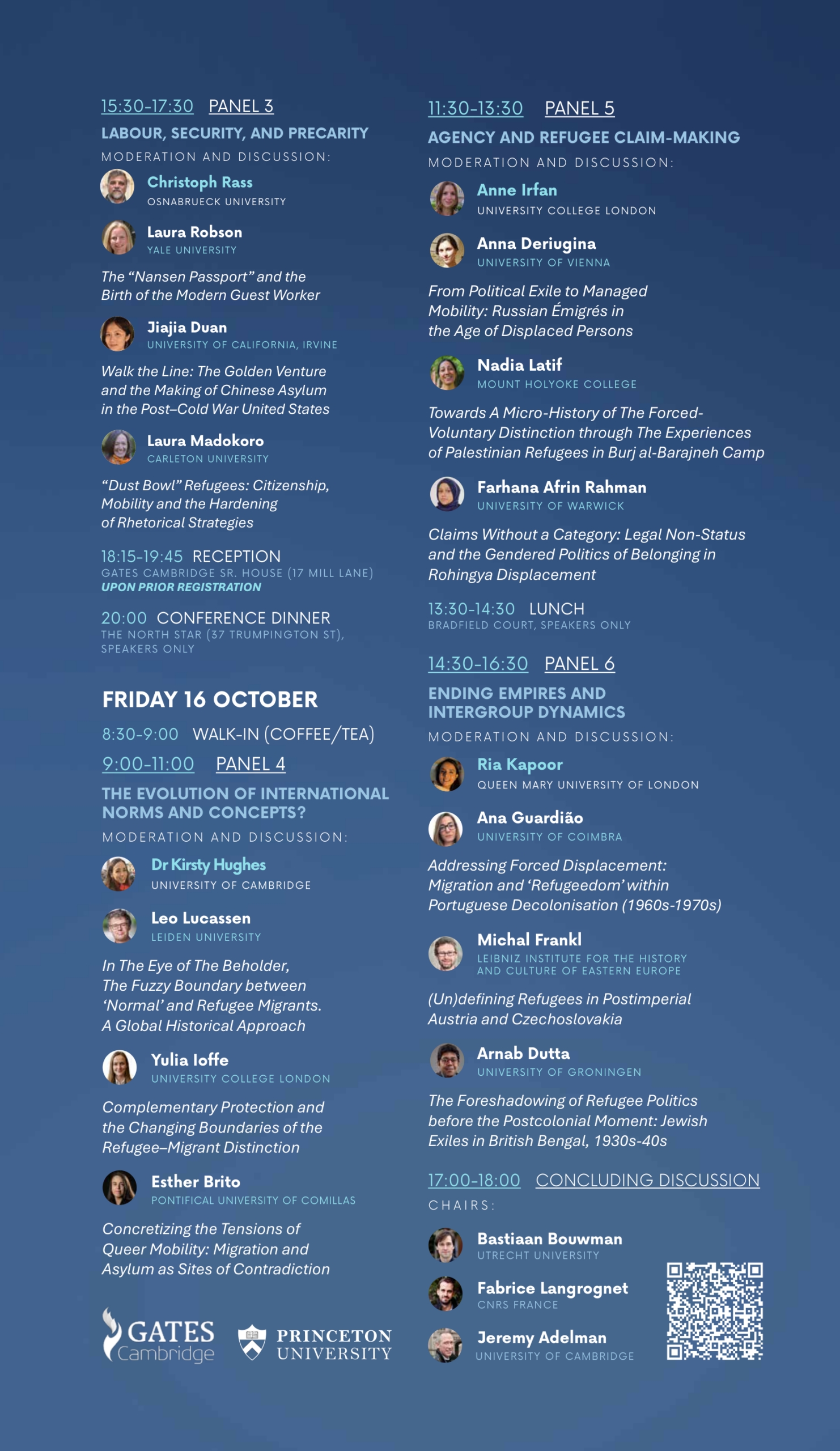
On the second day, the fourth panel, chaired by Kirsty Hughes (University of Cambridge), turned attention to the norms and concepts with which law and administration draw the line.
Leo Lucassen (Leiden University) opened with a stocktaking of the first day. The case studies had shown how politically charged the question of who holds the power to name people is, and how much the historical and political context matters: Why did the United States readily classify people from Cuba as refugees, but not people from Guatemala with potentially even stronger grounds for flight? The contributions had also highlighted how those affected deployed labels for their own purposes, such as the ›mübadil‹ in Alpan’s paper. “I’m preaching to the converted,” Lucassen acknowledged.
His paper In the Eye of the Beholder, the Fuzzy Boundary between ›Normal‹ and Refugee Migrants: A Global Historical Tour d’Horizon took a step back from state definitions and replaced the opposition between ›refugees‹ and other ›migrants‹ with a continuum ranging from flight from open persecution, through escape from exploitation, forced labor, and slavery, to the retreat of communities into remote areas where they sought to minimize the reach of the state. Even in the case of the Huguenots, supposedly a classic example, only around 150,000 left France following the revocation of the Edict of Nantes in 1685 — according to Lucassen, ten to fifteen percent; the great majority stayed and converted, at least formally. Those who left chose destinations where their skills as printers, booksellers, soldiers, vintners, or craftspeople could be put to use. Almost all migrants, Lucassen argued, have mixed motives; moreover, they always represent only a small selection of those facing the same problems. Sending and receiving societies, however, typically acknowledged only one motive and labeled the migrants accordingly — a framing that scholarship, too, often adopts uncritically. Lucassen therefore proposed treating ›refugees‹ primarily as migrants, thereby incorporating them into comparative long-term research on human mobility.
The legal perspective was brought by Yulia Ioffe (University College London). In Complementary Protection and the Changing Boundaries of the Refugee-Migrant Distinction, she described complementary protection as an intermediate category in international law between Convention refugees and ordinary ›migrants‹. Those fleeing disasters or war were explicitly intended, in the preparatory work for the 1951 Refugee Convention, to fall outside the definition. The human rights prohibition on return (›non-refoulement‹), by contrast, extends further than Article 33 of the Convention; international adjudicatory bodies have moreover progressively expanded it — the European Court of Human Rights, for instance, now also takes into account social and economic hardship and lack of medical care. Those whom states may not return must be granted certain rights, often in the form of a distinct status such as the European Union’s subsidiary protection. Ioffe did not consider the growing alignment of these rights with those of Convention refugees to be justified in every case. Her argument: the Convention was designed as a substitute for the protection that a person’s own state no longer provides, whereas human rights belong to every person regardless of nationality or residence status. Her question also addressed the consequences of this alignment for the distribution of responsibility among states.
The visibility that the asylum process demands of queer refugees was examined by Esther Brito (Pontifical University of Comillas) in Concretizing the Tensions of Queer Mobility: Migration and Asylum as Sites of Contradiction. In transit, it is often precisely concealment that ensures survival. In asylum proceedings, by contrast, visibility functions as evidence of credibility, measured against a simplified notion of coming out in stages; a late disclosure frequently raises doubts. Many of these standards thus paradoxically penalize, as Brito observed, the very concealment that had previously secured survival. Heteronormative standards determine which forms of queerness are considered legitimate. The procedure brings into being, on its own terms, the identities it recognizes.
Panel 5: Agency and Refugee Claim-Making. Ansprüche erheben
The fifth panel, chaired by Anne Irfan (University College London), shifted the perspective to refugees themselves: it asked how they made claims and how they used, circumvented, or rejected the categories assigned to them.
Nadia Latif (Mount Holyoke College) turned to the Burj al-Barajneh camp on the southern outskirts of Beirut, established by the League of Red Cross Societies in 1948 for Palestinian refugees. Her micro-history Towards a Micro-History of the Forced-Voluntary Distinction through the Experiences of Palestinian Refugees in Burj al-Barajneh Camp drew on interviews with residents spanning several generations, conducted in 2006 and 2024, as well as on records from the International Committee of the Red Cross and the League of Red Cross Societies. During registration, officials from the host state and staff of the League of Red Cross Societies recorded refugees who had lived in rural areas and worked in agriculture as unskilled rural inhabitants, ›fellahin‹, even though they possessed varying degrees of transferable capital — such as cross-border trading relations or a few years of schooling. Eligibility for assistance was determined by a definition that the League of Red Cross Societies proposed to the United Nations: a refugee was anyone who had lost their home and means of livelihood in Palestine and lacked sufficient resources to support themselves. Since many Lebanese had previously worked in Palestine as seasonal laborers, it was difficult to distinguish residents from itinerant workers. The distinction between ›refugee‹ and ›migrant‹ was drawn in this case by local and international bodies as they attempted to determine who qualified as a ›national‹ entitled to poverty relief. Refugee status, Latif concluded, was primarily sought and obtained by those who lacked transferable capital, while Palestinians from the middle and upper classes acquired Lebanese citizenship.
After Myanmar’s military burned villages in Rakhine in August 2017, killed people, and committed mass sexual violence, more than 650,000 Rohingya fled to Bangladesh by the end of that year. Bangladesh denies them refugee status and registers them as ›forcibly displaced Myanmar nationals‹ — a category that, according to Farhana Afrin Rahman (University of Warwick), was created not least to avoid the word ›refugee‹. In Claims Without a Category: Legal Non-Status and the Gendered Politics of Belonging in Rohingya Displacement, Rahman asked how women make claims under these conditions, and described two pathways from her fieldwork. One runs through the ›majhi‹, male intermediaries whom the Bangladeshi army deployed as a makeshift measure in 2017 and who control access to aid organizations and distributions. The other runs through the ›taleem‹, a women-led weekly religious study circle that, without funding and invisible to camp administration, mediates disputes among neighbors and supports women in crisis. The absence of legal status, Rahman argued, redirected claims onto such pathways. A history of the distinction between ›refugee‹ and ›migrant‹ must also treat categories that states create specifically for a given case (›bespoke categories‹) as political decisions with their own consequences, Rahman concluded.
“Do not be refugees!” [“Seid keine Flüchtlinge!”] With this appeal, the Buenos Aires-based journal Rodina addressed its readers in August 1952. The journal spoke for the Vlasov movement, which the Soviet general Andrei Vlasov — captured by German forces — had built up, with the support of German agencies, primarily among Soviet prisoners of war, and whose Russian Liberation Army fought alongside the Wehrmacht in the final months of the war in 1945. The readers, the appeal declared, were first and foremost political emigrants, an honorable title that imposed obligations. The word “refugee,” on the obvious reading, carried connotations of dependency, humanitarian supervision, and passivity that ill suited the self-image of anti-communist exiles. Yet many of them had endured captivity, forced labor, and the legal limbo of the DP camps; it was, in large part, precisely that international machinery managing refugees and “Displaced Persons” that had brought them to Argentina. Anna Deriugina (University of Vienna) took this appeal as the starting point of From Political Exile to Managed Mobility: Russian Émigrés in the Age of Displaced Persons, in order to examine how the meaning and practical value of refugee status changed over decades. After 1945, the status opened the path to resettlement; however, Argentina itself decided on admission according to professional, political, physical, and social suitability. Deriugina read the appeal as drawing a distinction between a status one may need and an identity one wishes to claim. Like Alpan’s “mübadil,” the emigrants set against the category offered to them from outside a designation of their own.
Panel 6: Ending Empires and Intergroup Dynamics. The End of Empires
With Ria Kapoor (Queen Mary University of London) as chair, the final panel of the strand traced the end of empires, when successor states redefined who counted as a “refugee,” “citizen,” or “foreigner.”
At the end of June 1961, the jurist John D. R. Kelly wrote a report for the United Nations refugee agency on the more than 100,000 people who had fled the war in Angola to the Congo-Léopoldville since April. Kelly saw them as persecuted persons, but feared they might fall under an exclusion clause, since the large majority, as Bakongo, had been received by members of the same group on the other side of the border; an African refugee, Kelly argued, was generally content with the law of his “tribe.” Taking this report as her starting point, Ana Guardião (University of Coimbra) examined in Addressing Forced Displacement: Migration and ‘Refugeedom’ within Portuguese Decolonisation (1960s–1970s) how international and state protection and assistance regimes during the decolonization of the Portuguese empire categorized people as “refugees,” “migrants,” citizens, or exiles — in Africa as well as in Portugal itself. In Africa, aid organizations and host states made recognition decisions on a blanket (“prima facie”) and improvised basis, guided by colonial assumptions about African societies, and soon redirected assistance toward the settlement and employment of displaced persons in development projects. After the Carnation Revolution, between 700,000 and 800,000 people arrived in Portugal from the former colonies between 1975 and 1981, predominantly settlers and their children, but also former African subjects. From 1975 onwards, people from the colonies generally retained Portuguese nationality only if they had lived in Portugal for more than five years prior to 25 April 1974, or if a parent, grandparent, or great-grandparent had been born there. Whether someone was classified as a “refugee,” “migrant,” or returnee now determined their social rights. Cape Verdeans, for instance, were typically categorized by the authorities as “migrants,” since displacement not caused by war received little recognition; they accordingly found it more difficult to access immediate social benefits. Comparing both contexts, Guardião concluded that the contest over who counted as a “refugee” was no less central in Europe than in Africa.
How rapidly such classifications could shift was demonstrated by Michal Frankl (Leibniz Institute for the History and Culture of Eastern Europe) in (Un)defining Refugees in Postimperial Austria and Czechoslovakia, through the case of Jewish war refugees, primarily from Galicia and Bukovina. Hundreds of thousands of people had been displaced within the Habsburg Monarchy since 1914. They received assistance as displaced citizens. After the collapse of the Monarchy, the Czechoslovak government terminated this support in mid-December 1918, and Austria did so by 15 March 1919. Although the people continued to be registered as “refugees,” the status now meant only control and the state’s power to deport them. In their petitions, they initially invoked employment, regular income, taxes paid, and stable family circumstances. This no longer worked: newspapers and police cast every form of Jewish economic activity under the antisemitic suspicion of speculation and black-marketeering. The argument of health proved more successful: of 55 families whose residence permits in Bohemia were renewed at the end of 1919, 42 owed this to illness, pregnancy, or a newborn child. Officials at the Czechoslovak Ministry of the Interior long resisted — contrary to the advice of aid organizations and the Foreign Ministry — classifying the remaining Jews from Galicia as “foreigners,” because the refugee status allowed them to be deported without administrative and diplomatic obstacles. Only after years, and under pressure from the consulates, were they reclassified as “foreigners.” This status, which Frankl placed alongside today’s category of “migrant,” paradoxically offered greater security — at least situational consular protection and better prospects for employment.
Arnab Dutta (University of Groningen) drew in The Foreshadowing of Refugee Politics before the Postcolonial Moment: Jewish Exiles in British Bengal, 1930s–40s a connection from approximately one thousand Jewish exiles who sought refuge in British Bengal between 1933 and 1947, to the more than 2.5 million people who fled from East Bengal to India between 1946 and 1950. Conservative Bengali Hindu elites denied the Jewish exiles any prospect of permanence by invoking the antisemitic trope of the “Wandering Jew” and the argument of lacking indigeneity. East Bengali Hindu refugees called themselves “natun ihudi” — new Jews — after 1947; conservative intellectuals such as the historian Jadunath Sarkar and the linguist Suniti Kumar Chatterji drew on the idea of a Jewish homeland to ground claims on behalf of Hindu refugees. Dutta interpreted the distinction between “refugee” and “migrant” as a question of scale: movement beyond South Asia could be regarded as migration, whereas crossing the new border within Bengal became flight when it was bound up with the promise or loss of a secure home.
A Takeaway
Across six panels, it became possible to trace how many actors worked at the boundary between “refugee” and “migrant”: League of Nations conferences and aid organizations, interior ministries, asylum authorities and courts, newspapers and intellectuals, and finally the people themselves, who adopted a label, reinterpreted it, or rejected it. For our work within the Collaborative Research Centre 1604, the conference thus confirms a core premise: the production of categories and their reproduction are the outcome of negotiation processes in which scholarship, through its own practices, also takes part. This entails a task that reaches beyond the history of the conceptual pair at the center of our inquiry — namely to reconstruct comparatively the division of labor among these actors from the camps around Constantinople in 1922 to the Rohingya camps in Bangladesh, and to show how that division of labor produced figures of migration to which rights, obligations, and life chances were attached through processes of inclusion and exclusion.
Further Reading
The program and profiles of the participants are available on the conference website.
Publications and profiles of the speakers
- Aytek Soner Alpan: But the Memory Remains: History, Memory and the 1923 Greco-Turkish Population Exchange, in: The Historical Review / La Revue Historique 9 (2013), doi.org/10.12681/hr.295.
- Mae M. Ngai: Impossible Subjects: Illegal Aliens and the Making of Modern America, Princeton 2014, doi.org/10.1515/9781400850235.
- Catherine Nolan-Ferrell: Pedimos Posada: Local Mediators and Guatemalan Refugees in Mexico, 1978–1984, in: Historia Crítica 80 (2021), pp. 153–178, doi.org/10.7440/histcrit80.2021.08.
- Noel Mariam George: Refuge by ‘technical’ means: humanitarianism, bureaucratic asylum, and the politics of refracted mandates in postcolonial India (1947–1981), in: Journal of Refugee Studies 39 (2026), no. 2, pp. 355–374, doi.org/10.1093/jrs/feag004.
- Tosin Durodola: When does a refugee stop being a ‘refugee’? The social construction of refugeehood after cessation, in: Journal of Refugee Studies 38 (2025), no. 4, pp. 1140–1157, doi.org/10.1093/jrs/feaf047.
- Wolfgang Gerhard Thiele: Decolonization and the Question of Exclusion in Taiwanese Nationalism since 1945, in: Global Histories: A Student Journal 3 (2017), no. 1, doi.org/10.17169/GHSJ.2017.106.
- Laura Robson: Human Capital: A History of Putting Refugees to Work, London/New York 2023.
- Jiajia Duan: Profile, University of California, Irvine.
- Laura Madokoro: “From Citizens to Refugees”: Japanese Canadians and the Search for Wartime Sanctuary, in: Journal of American Ethnic History 39 (2020), no. 3, pp. 17–48, doi.org/10.5406/jamerethnhist.39.3.0017.
- Leo Lucassen: Peeling an onion: the “refugee crisis” from a historical perspective, in: Ethnic and Racial Studies 41 (2018), no. 3, pp. 383–410, doi.org/10.1080/01419870.2017.1355975.
- Yulia Ioffe: The Right to Family Reunification of Children Seeking International Protection under the Convention on the Rights of the Child: Misplaced Reliance on Travaux?, in: International Journal of Refugee Law 34 (2022), no. 2, pp. 215–240, doi.org/10.1093/ijrl/eeac034.
- Esther Brito: Profile, American University.
- Anna Deriugina: Profile, ERC Project GLORE, University of Vienna.
- Nadia Latif: Making Refugees, in: CR: The New Centennial Review 8 (2008), no. 2, pp. 253–272, doi.org/10.1353/ncr.0.0031.
- Farhana Afrin Rahman: After the Exodus: Gender and Belonging in Bangladesh’s Rohingya Refugee Camps, Cambridge 2024, doi.org/10.1017/9781009414845.
- Ana Guardião: A Matter of Control: Colonial and Humanitarian Population Management Strategies, Angolan Refugees’ Resistance, and the Politics of Difference (1961–1964), in: e-Journal of Portuguese History 19 (2021), no. 2, pp. 51–75, doi.org/10.26300/6r2h-tc53.
- Michal Frankl: Vast Workshop and Laboratory: Labor and Refugees to the Bohemian Lands and Czechoslovakia, 1914–39, in: Austrian History Yearbook 55 (2024), pp. 402–413, doi.org/10.1017/s0067237824000511.
- Arnab Dutta: Profile, Rijksuniversiteit Groningen.
References for the Commentary
- Christoph Rass: Institutionalisierungsprozesse auf einem internationalen Arbeitsmarkt. Bilaterale Wanderungsverträge in Europa zwischen 1919 und 1974, Paderborn 2010.
- Christoph Rass: International Migration, in: Dirk Berg-Schlosser/Bertrand Badie/Leonardo Morlino (eds.): The SAGE Handbook of Political Science, London 2020, doi.org/10.4135/9781529714333.n90.
- Christoph Rass/Ismee Tames: Negotiating the Aftermath of Forced Migration: A View from the Intersection of War and Migration Studies in the Digital Age, in: Historical Social Research 45 (2020), no. 4, pp. 7–44, doi.org/10.12759/hsr.45.2020.4.7-44.
- Sebastian Huhn/Christoph Rass: Displacement und Displaced Persons, in: Jahrbuch für Exilforschung 40 (2022): Exil, Flucht, Migration, pp. 38–49, doi.org/10.1515/9783110770995-004.
- Christoph Rass: ›Gastarbeiter‹ – ›Guest Worker‹. Translating a Keyword in Migration Politics, IMIS Working Paper 17, Osnabrück 2023, doi.org/10.48693/399.
- Christoph Rass: ›Gastarbeiter‹ in the Nazi Press (1933–1945). Formative Years of a Key Term in Migration Politics, IMIS Working Paper 22, Osnabrück 2026, doi.org/10.48693/822.
- Julie M. Weise/Christoph Rass: Migrating Concepts: The Transatlantic Origins of the Bracero Program, 1919–42, in: American Historical Review 129 (2024), no. 1, pp. 22–52, doi.org/10.1093/ahr/rhad500.
- Sebastian Huhn/Christoph Rass: Displaced Person(s): The Production of a Powerful Political Category, in: Ethnic and Racial Studies 48 (2025), no. 4, pp. 718–739, doi.org/10.1080/01419870.2024.2404488.
- Philipp Strobl/Christoph Rass/Kerstin von Lingen: The Agency of Forced Migrants: Historical Perspectives, in: Journal of Contemporary History 61 (2026), no. 4, pp. 775–789, doi.org/10.1177/00220094251401610.
Find the original post at Arbeit an der Produktion von Kategorien | Eindrücke von einer Tagung in Cambridge on nghm.hypotheses.org.
This post was automatically translated from the German original.