»Difficult Heritages« in Athens | Karya and the uncomfortable legacy of the German occupation of Greece in the Second World War.

By TEAM NGHM · Originally published on nghm.hypotheses.org
From 5 to 28 November 2026, the National Technical University of Athens (NTUA), the Hellenic Foundation for European and Foreign Policy (ELIAMEP), and the Cultural Foundation of the National Bank of Greece (MIET) will present the exhibition “Difficult Heritages: Greece | Cyprus | Turkey” at the Eynard Mansion near Omonia Square.
Kalliopi Amygdalou and Valia Gialia have curated the exhibition. Its individual sections were contributed by researchers and artists from Greece, Cyprus, and Turkey. On display are buildings and sites associated in the history of the three countries with imprisonment, occupation, expulsion, and population exchange: the islands of Gyaros and Spinalonga, Famagusta/Ammochostos, the Jewish cemetery of Thessaloniki, the Haidari concentration camp, the Holocaust site of Karya and the villages destroyed during the occupation, Ottoman monuments, refugee settlements, and the villages of Ionia.
The organizers understand “difficult heritage” as a past that remains significant for the present yet resists national self-affirmation because it is contested or unsettling; German-language heritage conservation and cultural heritage studies have, since Norbert Huse, referred to such legacies as unbequemes Erbe [uncomfortable heritage]. Rather than uncritical identification with historical myths, the exhibition seeks to foster reflection, remembrance, social reconciliation, self-criticism, and commemoration of the victims.
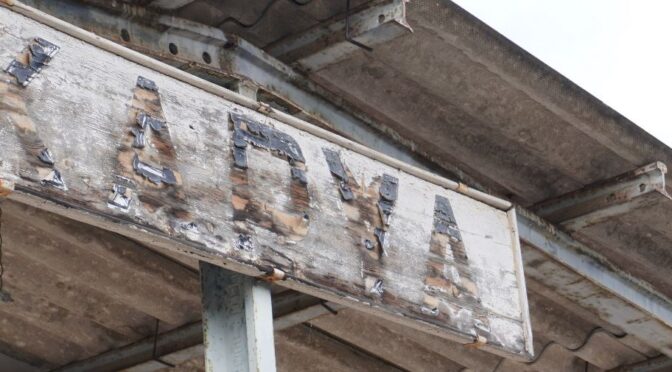
Karya is represented as a site where the Organisation Todt deployed between 300 and 500 Jewish men from the Thessaloniki ghetto for forced labor in 1943. At the railway station in the central Greek regional unit of Fthiotida, they were forced under catastrophic conditions to blast rock for a bypass track on the Athens–Thessaloniki line intended to serve Wehrmacht trains; most of them were subsequently deported to Auschwitz. Documentation of the deployment survives primarily through approximately 80 photographs in the album of the engineer Hanns Rössler, who was involved in the construction work on behalf of the Organisation Todt in 1943. The images depict the forced labor from the perpetrators’ perspective. Andreas Assael, the son of a survivor from Thessaloniki, acquired the album in 2002 and has researched its history over many years.
The Karya section is curated by Valentin Schneider (National Hellenic Research Foundation and the University of Osnabrück), who also oversees the section “German Occupation in Greece | GODB.” The site itself was examined in March and April 2023 in a historical-geoarchaeological survey by the Interdisciplinary Research Group on Conflict Landscapes (Interdisziplinäre Arbeitsgruppe Konfliktlandschaften) at the University of Osnabrück, led by Christoph Rass, with the participation of students from the University of Osnabrück and Aristotle University of Thessaloniki.
The field surveys and 3D models produced by the Osnabrück team are presented as part of the broader project within the German-Greek traveling exhibition “Karya 1943. Forced Labor and the Holocaust”, which was conceived by the Documentation Center Nazi Forced Labor together with the Foundation Memorial to the Murdered Jews of Europe, the University of Osnabrück, the Jewish Museum of Greece, and Aristotle University of Thessaloniki, and inaugurated in Berlin on 4 September 2024.
The methods and findings of the survey are set out in the research report in IAK Working Paper 3 (Christoph Rass, Lukas Hennies, Andre Jepsen, September 2024). According to the report, the camp existed for only a few months. Later modifications to the terrain complicate the interpretation of the findings, but at the same time make Karya a case study in the long-term development of forced labor sites.
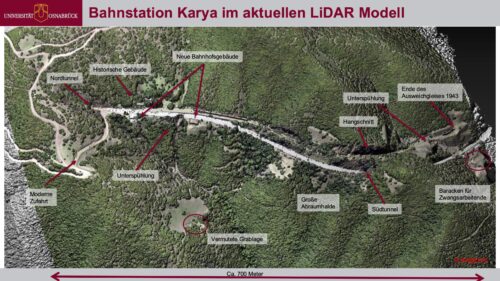
The results of the fieldwork in Karya can be read in several places on this blog: in the dispatches from Karya from April 2023, in the report on the exhibition opening in Berlin, and in a 360-degree virtual tour of the exhibition. A documentary film by Timos Zdoupas, VirtUOS, documents the work on site.
At the Eynard Mansion, the curators work with VR and other digital applications, original maps, photographs, sound installations, artistic works, and personal objects belonging to prisoners. The exhibition is funded as part of a European Research Council project (Horizon 2020).
In Athens, Karya takes its place alongside Famagusta, Gyaros, and the villages of Ionia. For conflict landscape research, a compelling question arises: how does the interpretation of a site of German occupational violence shift when it becomes part of a difficult heritage shared by three states?
Exhibition Eynard Mansion, Ag. Konstantinou 20 / Menandrou, Athens (Metro Omonia) 5–28 November 2026, Thursday and Friday 12–7 pm, Saturday 11 am–3 pm Admission free; guided tours throughout the run Contact: media-office@eliamep.gr
Find the original post at »Difficult Heritages« in Athen | Karya und das unbequeme Erbe der deutschen Besatzung Griechenlands im Zweiten Weltkrieg. on nghm.hypotheses.org.
This post was automatically translated from the German original.