NGHM researches | Conflict landscapes in the longue durée: New interdisciplinary project approved

By TEAM NGHM & NGHM-Team · Originally published on nghm.hypotheses.org
On 22 October 2026, the Presidential Board of the University of Osnabrück resolved to fund the project “Konfliktlandschaften: Materielle und diskursive Hervorbringung gewaltüberformter Orte und Räume in der longue durée” [“Conflict Landscapes: The Material and Discursive Production of Violence-Transformed Places and Spaces in the longue durée”]. Six professorships from two departments will thereby collaborate between January 2027 and December 2029 on a question that has occupied Osnabrück’s conflict landscape research since its beginnings: how violence transforms places and spaces, and what happens to them after a violent event.
The funding comes from the UOS funding line “Open Topic Cluster Funding,” through which the university supports collaborative and ideally interdisciplinary research projects for up to three years. It will enable fieldwork, workshops at the real-world laboratory in Kalkriese, and Visiting Fellowships, with which the Osnabrück group intends to prepare a larger research project.
The Production of Sites of Violence
The project conceives of conflict landscapes as violence-transformed places and spaces in which material traces, discursive interpretations, and practices of memory culture and politics mutually produce one another. The consortium is developing a procedural logic for this purpose that proceeds in four steps from genesis and re-inscription through legibility and diachronic actor sequences to impact and instrumentalization. This logic is being tested at three sites whose conflict histories span two millennia: Kalkriese, the Ammertal valley, and the Karst region.
From Kalkriese to the Interdisciplinary Working Group on Conflict Landscapes
The project stands within a research tradition that originated in Kalkriese. The excavations at the site of the Battle of the Teutoburg Forest, which the University of Osnabrück investigates jointly with the Museum and Park Kalkriese, have shaped battlefield archaeology in Germany at a methodological level. Achim Rost and Susanne Wilbers-Rost have done pioneering work here: they conceptualized the recovery, looting, and redistribution of objects following the battle as “post-battle processes” that co-determine the distribution of finds. Christoph Rass transferred this concept to contemporary history in 2011, using the example of the Hürtgenwald.1 From 2014, the Interdisziplinäre Arbeitsgruppe Konfliktlandschaften [Interdisciplinary Working Group on Conflict Landscapes] (IAK), under his leadership, brought these strands together into the Osnabrück model of conflict landscape research; it extended the concept to encompass the discursive production of violence-transformed places and further developed it into “post-violence processes” for camp, extermination, and repression landscapes.
Using this approach, the IAK works at the sites of the ‘Emsland camps’ as well as at sites of German occupation violence in Belarus and Greece. Since 2022, the working group has published the series “Konfliktlandschaften” [Conflict Landscapes], whose third volume appeared in September 2026. The breadth of the approach’s applicability is currently demonstrated by a new project and an exhibition. From autumn 2026, the Pro*Niedersachsen project “Moorlandschaften als Interventionsräume” [“Peatland Landscapes as Spaces of Intervention”], conducted jointly with the Emsland Moormuseum, is examining the transformation of the Bourtanger Moor between 1945 and 2025, thereby extending conflict landscape research to encompass an environmental history case. In Athens, the exhibition “Difficult Heritages: Greece | Cyprus | Turkey” will run from 5 to 28 November 2026, presenting, among other things, the Holocaust site of Karya, which a collaborative team involving the IAK surveyed through historical-geoarchaeological prospection in spring 2023.
Research in an Interdisciplinary Team
The consortium brings together six disciplines from the University of Osnabrück. The spokesperson is Marcus Zagermann (Roman Provincial Archaeology), and the co-spokesperson is Christoph Rass (Contemporary History and Historical Migration Research); they are joined by Christiane Kunst (Ancient History), Christoph Mauntel (Medieval History), Ulrich Schneckener (International Relations and Peace and Conflict Studies), and Björn Waske (Remote Sensing and Digital Image Processing). The ways in which their approaches interlock can be traced across the three sites.
In Kalkriese, the group is establishing its real-world laboratory. There, new excavations are combined with a prospection of the extended operational area: Waske and Zagermann fly the terrain with drones equipped with LiDAR sensors that measure the ground surface even beneath vegetation; a machine learning procedure then extracts from these data the anomalies indicative of Roman camps and march routes. Kunst, Zagermann, and Rass set the ancient narratives of the battle alongside the Kalkriese findings and compare them with early modern cases. Together with Mauntel, Rass and Zagermann also trace who has overwritten the site since then — from the recovery and looting parties of antiquity to the cartographers who sought to locate the battlefield between the sixteenth and nineteenth centuries, through to the museum of the present day. At this single find site, the group is testing for the first time how finds, monuments, texts, maps, and lived memory can be read together as a conflict landscape.
In summer 2027, the group will move to the Ammertal valley, an Alpine landscape in which Roman provincial administration, local practices of violence, and post-antique appropriation have overwritten the same spaces since 15 BCE. Waske and Zagermann will survey the valley with LiDAR and multispectral sensors; Rass will examine the same data to investigate how walls, ditches, and barracks of early modern structures of violence can be detected within them. Mauntel and Kunst will simultaneously analyze the pre-modern maps and texts that describe the valley as a space of conflict.
In spring 2028, the group will turn to the Karst region, a trinational landscape between Italy, Slovenia, and Austria. There, Italian and Slovene-Yugoslav partisan and Resistenza units fought against National Socialist occupation and repression units that also deployed locally recruited forces. Until 1954, the Foibe killings perpetrated by paramilitary actors, anti-Slavic repression, and the post-war competition of memories overlaid this history of violence. Schneckener situates these actors within the political-science typology of forms and agents of violence and maps the documented violent events within a geographic information system. Rass and Mauntel investigate the competing memory regimes of the three countries: the memory of the Foibe with its intertwining of victim and perpetrator ascriptions, the memory of partisan struggle and the Resistenza, and the memory of anti-Slavic repression. Here, too, the reading extends back into antiquity, as Kunst and Zagermann set the ancient image of a ‘landscape of brigandage’ against the expansion of late Roman military posts from the third century onward.
At each of the three sites, every discipline poses its own questions and contributes its own findings, which only in their interplay render the landscape newly legible. The consortium thereby follows the Osnabrück model of the IAK. The introduction to the first volume of the “Konfliktlandschaften” series formulated in 2022 the idea that in this model, archaeology, unlike in established ‘conflict landscape studies,’ does not occupy a methodologically leading central position; rather, what is sought is an interlocking of perspectives, questions, methods, and findings “ohne dominierende Leitdisziplin” [“without a dominant lead discipline”].2
Conflict Landscapes of the Present
The methodology of the new project is intended to apply equally to apparently concluded conflict landscapes and to those currently being produced by Russia’s war against Ukraine, the violent conflicts in the Middle East, or the migration-related conflicts along the externalized EU external border. Applied to these, it should render visible heritage conflicts, authoritarian politics of history, and democratic resilience as competing modes of engaging with violence-transformed spaces. Over the next three years, the consortium will develop this procedural logic at the three sites; whether it can be transferred to the conflict landscapes of the present is the overarching question that will guide future research.
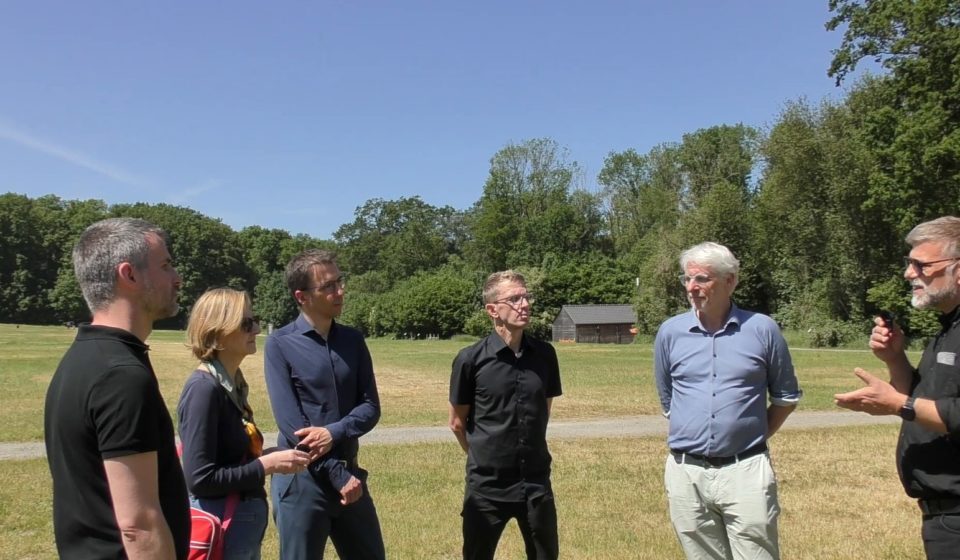
Header image: The application team during a video shoot at Park Kalkriese on 27 May 2026, from left: Christoph Mauntel, Christiane Kunst, Marcus Zagermann, Björn Waske, Ulrich Schneckener, and Christoph Rass (still image: NGHM).
- Christoph Rass / Jens Lohmeier, Transformations: Post-Battle Processes on the Hürtgenwald Battlefield, in: Journal of Conflict Archaeology 6 (2011), no. 3, pp. 179–199, DOI: 10.1179/157407811X13160762840242. ↩︎
- Mirjam Adam / Christoph Rass, Konfliktlandschaften – interdisziplinär lesen [Conflict Landscapes – Reading Interdisciplinarily], in: Christoph Rass / Mirjam Adam (eds.), Konfliktlandschaften interdisziplinär lesen, Göttingen 2022 (Konfliktlandschaften, vol. 1), pp. 13–30, DOI: 10.14220/9783737014618.13. ↩︎
Find the original post at NGHM forscht | Konfliktlandschaften in der longue durée: Neues interdisziplinäres Vorhaben bewilligt on nghm.hypotheses.org.
This post was automatically translated from the German original.