By Jessica Wehner & Eduard Usov · Originally published on nghm.hypotheses.org
The monthly newsletter of the Working Group on Contemporary History and Historical Migration Research at the University of Osnabrück
By Eduard Usov & Jessica Wehner
Violence and memory, categories and their consequences, canonical texts and new experiments – October 2026 offered a remarkably multi-layered mix on the NGHM blog. Several contributions circled around the question of how history is made visible, processed, and communicated: whether at sites of National Socialist violence in the Emsland region or in Greece, or in Cambridge at a conference on the consequential dividing line between ‘refugee’ and ‘migrant’. At the same time, the NGHM team launched into teaching for the winter semester 2026/27. What connected the month’s contributions was less a single theme than a shared interest: namely, how categories emerge, how places speak, and how knowledge circulates – in other words, how history is made.
Our October newsletter reports on the team’s wide-ranging activities.
Insights
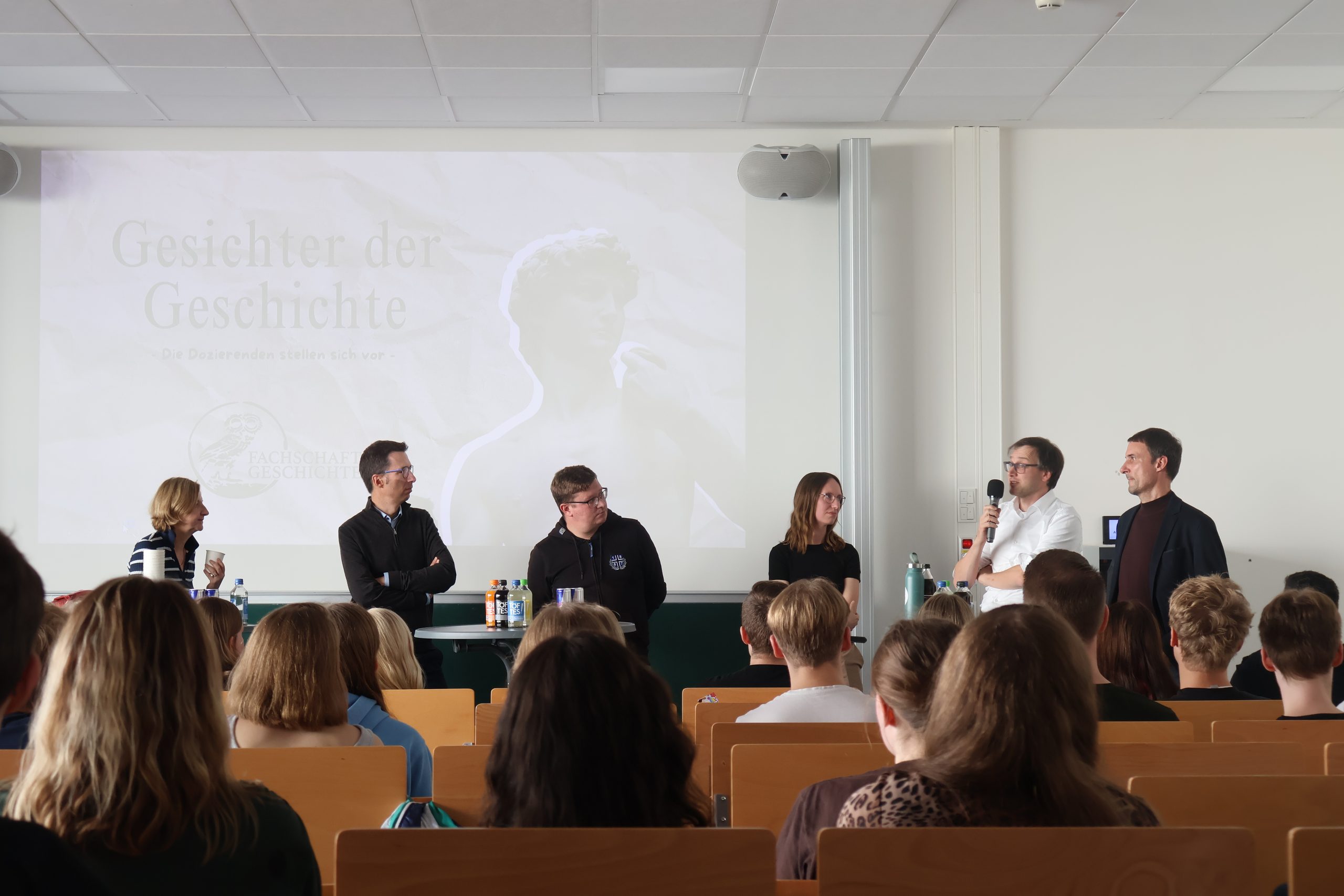
During freshers’ week, Sebastian Musch introduced the Professorship for Contemporary History and Historical Migration Research to new students as part of the “Faces of History” format. We welcome all first-semester students, look forward to seeing you in our courses, and wish you a great start to your studies!
The department’s teaching staff introduce themselves, l. to r.: Christiane Kunst, Marcus Zagermann, Marcel Lewerentz, Lara Jäger, Sebastian Musch and Martin Schlutow (Photo: Jessica Wehner)
A first focus lies on the long nineteenth century. It asks how knowledge is produced, who negotiates it in public, and how it shapes conceptions of the self and the other. Musch‘s lecture examines European images of Asia for this purpose. The introductory seminar taught by Wehner and Hennies investigates the relationship between science, power, and the public sphere. A second approach concerns the handling of difficult and contested heritage. One course asks how colonial heritage in the north-west German region is researched and remembered. Another course addresses the musealization of industrial culture. In both cases, the focus is on how the past takes shape in sites of memory, collections, and exhibitions. Third, images as historical sources come to the fore. A practical course uses the example of Greece to show how photography produced interpretations situated between the ideal of antiquity and the experience of occupation.
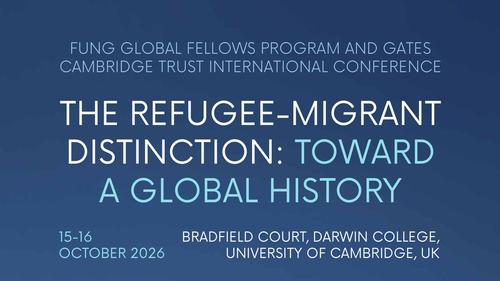
While courses were getting underway in Osnabrück, the focus elsewhere was on the discussion of research projects and findings. Christoph Rass and Sebastian Huhn attended a two-day conference in Cambridge on 15 and 16 October 2026, devoted to one of the most fundamental and consequential categorizations in the history of migration: the distinction between ‘refugee’ and ‘migrant’. The conference “The Refugee-Migrant Distinction: Toward a Global History” took place at Darwin College and was made possible by the Fung Global Fellows Program at Princeton and the Gates Cambridge Trust.
Organised by Jeremy Adelman, Bastiaan Bouwman, and Fabrice Langrognet, the conference brought together experts from history, law, and related disciplines. Their shared starting point was provocative: the supposedly clear dividing line between ‘refugee’ and ‘migrant’ is neither neutral nor ontologically given, but historically produced, politically charged, and accompanied by concrete consequences for the people concerned. The organisers proposed understanding the conference as an exercise in “provincializing the international refugee regime” – that is, as an attempt to critically interrogate the top-down perspective emanating from states and global governance. Six panels unfolded this question across more than a century and a half and four continents. In the first panel, Aytek Soner Alpan, Mae Ngai, and Catherine Nolan-Ferrell examined categories beyond the established pair of terms – from the Ottoman concept of ‘mübadil’, which transformed an assigned designation into a legal claim, to the ‘colored refugee camps’ of the American Civil War and the uprooted Guatemalan Maya campesinos in the Mexican state of Chiapas. The second panel approached the question from the endpoint: who decides when someone ceases to be a refugee? Noel Mariam George, Wolfgang Thiele, and Tosin Durodola showed, through cases from India, Japan, and Nigeria, how the withdrawal of refugee status pushed people into legal grey zones.
Panel 3 in the Bradfield Court of Darwin College (Photo: Sebastian Huhn)
The third panel, which Rass himself chaired, placed labour and precarity at its centre. Laura Robson challenged the prevailing interpretation that the Nansen passport had been a first step towards international refugee protection – in reality, she argued, it had served primarily to facilitate the placement of workers and the removal of unwanted migrants, thereby establishing the genealogy of the ‘guest worker’. Jiajia Duan reconstructed the case of the freighter Golden Venture of 1993 to show how undocumented Chinese passengers navigated between the categories of ‘illegal alien’ and ‘refugee’.
Also noteworthy was how closely the conference engaged with the thinking developed at Osnabrück’s Collaborative Research Centre 1604 “Production of Migration” – a sign that the research pursued there is resonating internationally. The full post is well worth reading for anyone who wants to understand how categories do not merely describe but actively create realities.
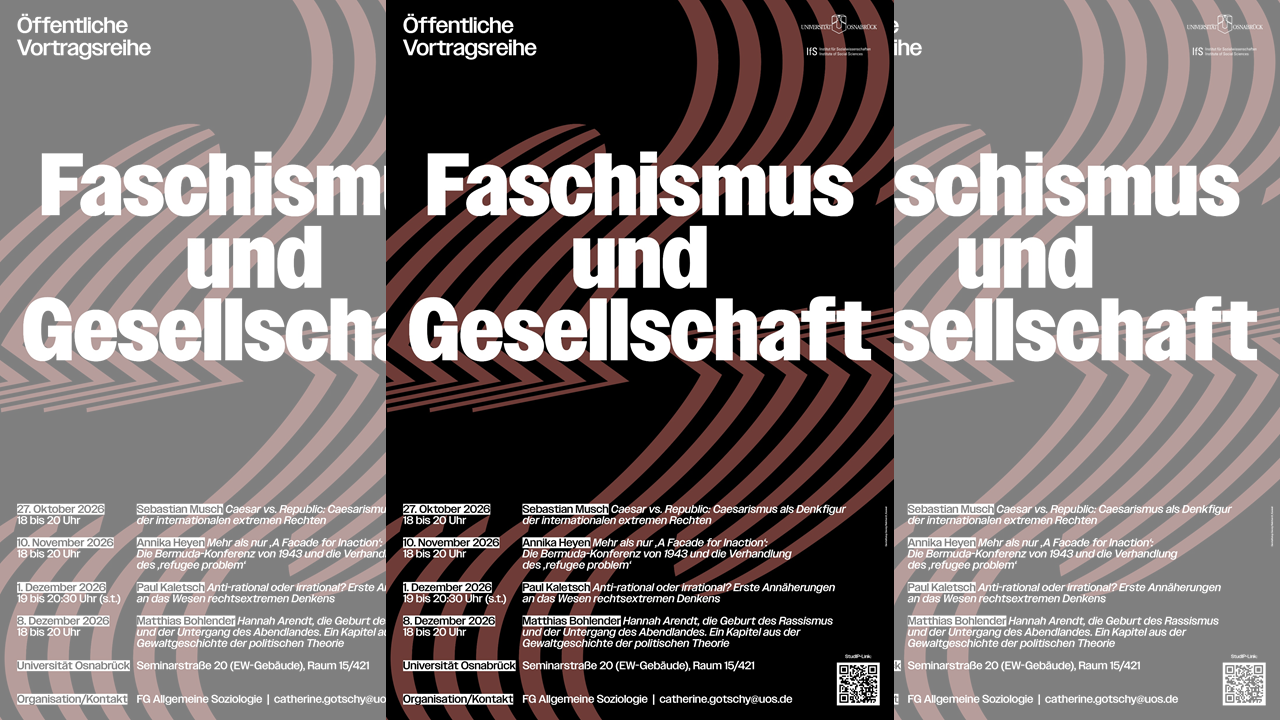
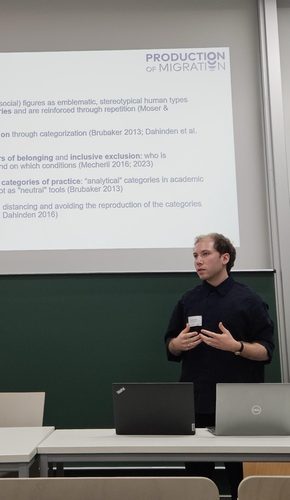
On 27 October, Sebastian Musch gave a talk entitled “Caesar vs. Republic: Caesarism as a Conceptual Figure of the International Far Right” as part of the lecture series “Fascism and Society” at the Institute for Social Sciences of the University of Osnabrück, organised by the Professorship for General Sociology. In the talk, Sebastian offered an intellectual-historical overview of the idea of Caesarist rule in Oswald Spengler’s Der Untergang des Abendlandes [The Decline of the West] of 1918, and the reception of this idea within the German New Right and the American MAGA movement.
On 10 November 2026, a further contribution from Team NGHM follows: Annika Heyen: More than just ‘A Facade for Inaction’: The Bermuda Conference of 1943 and the Negotiation of the ‘refugee problem’
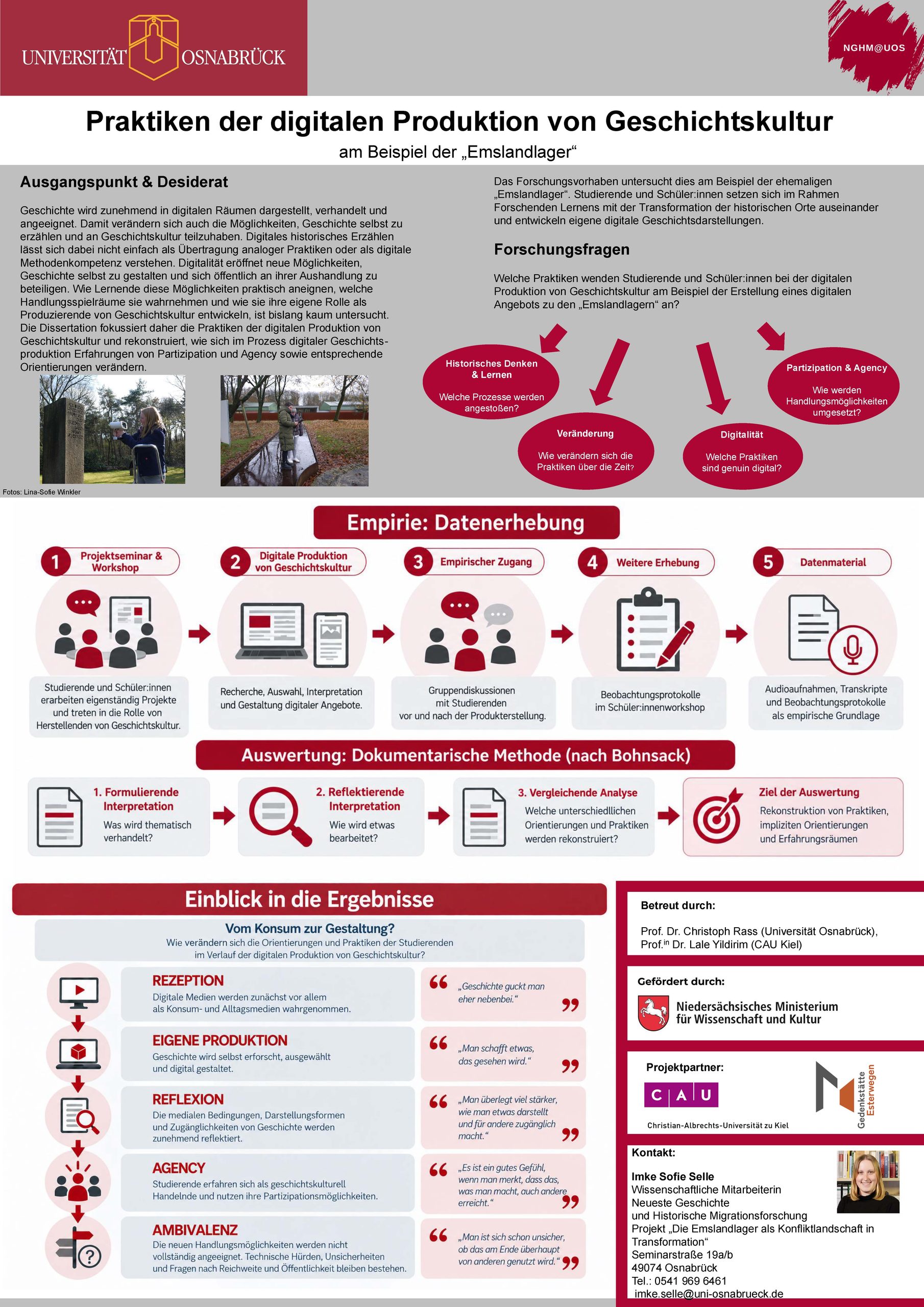
From 30 September to 2 October, Imke Selle attended the Biennial Conference of the Konferenz für Geschichtsdidaktik in Bielefeld. The conference was held under the theme “Uncertain Times – History Education in Democracy” [“Unsichere Zeiten – Geschichtsdidaktik in der Demokratie”]. A central question raised was whether historical learning can still fulfil its ascribed orientation function despite the current polycrisis. There, she chaired the panel “Platformisation of Memory/Memories: History-Cultural Agency and Historical Democracy Education” [“Plattformisierung der Erinnerung(en): Geschichtskulturelle Agency und historische Demokratiebildung”] and also presented a poster on her doctoral research project “Practices of the Digital Production of History Culture Using the Example of the ‘Emsland Camps'” [“Praktiken der digitalen Produktion von Geschichtskultur am Beispiel der ‘Emslandlager'”].
Not only results were discussed in October; new research projects were also set in motion: on 22 October 2026, the Executive Board of the University of Osnabrück decided to fund the project »Conflict Landscapes: Material and Discursive Production of Violence-Shaped Places and Spaces in the longue durée« [»Konfliktlandschaften: Materielle und diskursive Hervorbringung gewaltüberformter Orte und Räume in der longue durée«]. The funding comes from the »Open Topic Cluster Funding« programme. From January 2027 to December 2029, six professorships from two departments will collaborate on the question of how violence transforms places and spaces, and what happens to them in the aftermath of a violent event. The spokesperson is Marcus Zagermann (Provincial Roman Archaeology), with Christoph Rass as co-spokesperson. Also involved are Christiane Kunst, Christoph Mauntel, Ulrich Schneckener, and Björn Waske.
The consortium is developing a procedural framework and testing it at three sites with two millennia of conflict history: at Kalkriese, in the Ammertal, and in the Karst region. Methodologically, the spectrum ranges from LiDAR aerial surveys and machine learning to ancient texts and early modern maps, as well as the analysis of competing memory regimes. The project builds on the Osnabrück model of the Interdisciplinary Working Group Conflict Landscapes (IAK) [Interdisziplinäre Arbeitsgruppe Konfliktlandschaften], which Christoph Rass has led since 2014. This model relies on an interplay of disciplines without a single dominant lead discipline. Field research, workshops at the real-world laboratory in Kalkriese, and visiting fellowships are intended to lay the groundwork for a larger research project.
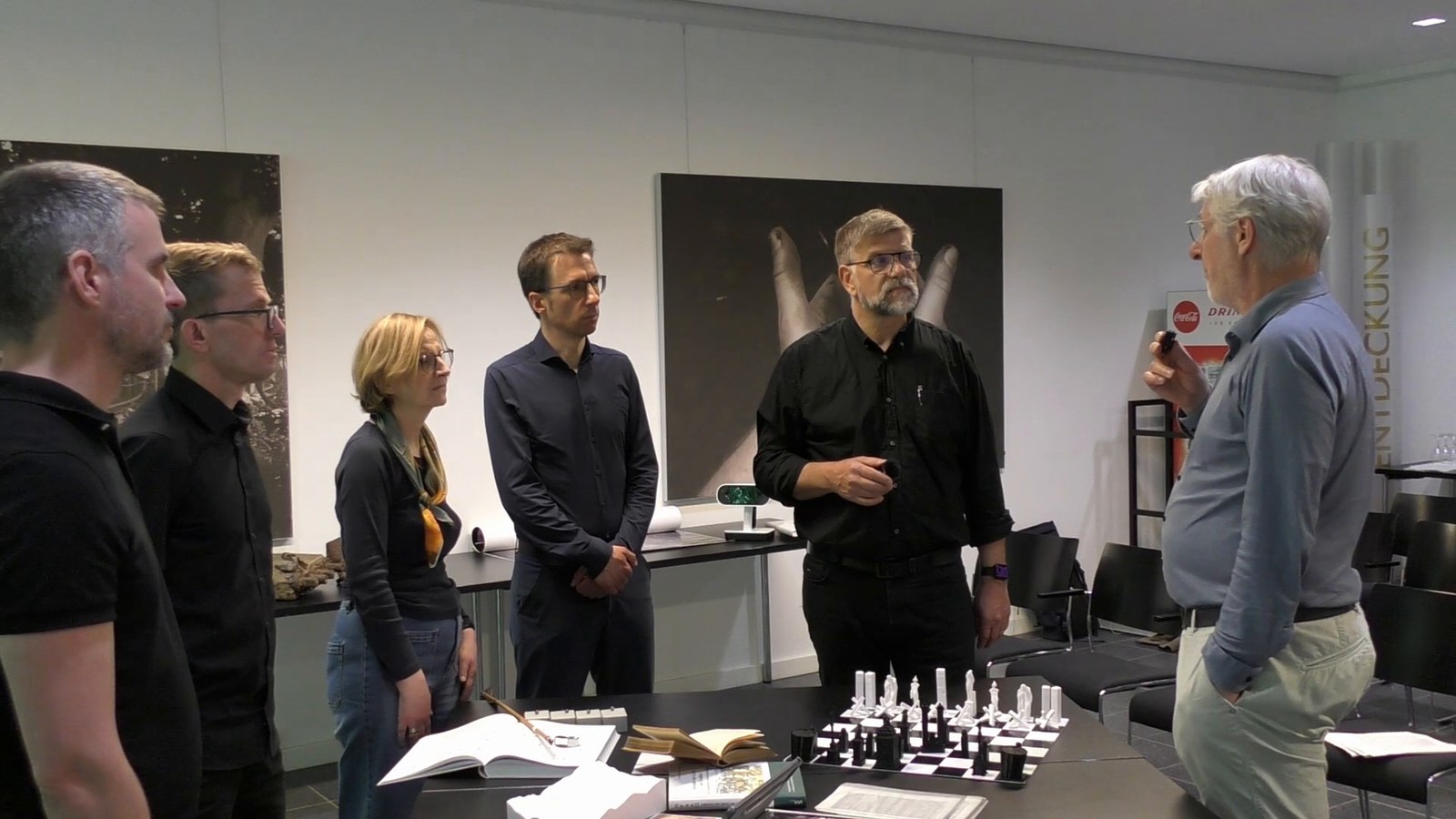
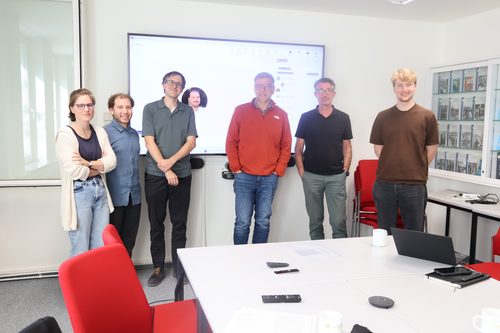
The application team during the video shoot at Kalkriese on 27 May 2026, from left: Christoph Mauntel, Björn Waske, Christiane Kunst, Marcus Zagermann, Christoph Rass, and Ulrich Schneckener (still from the application video, NGHM).
History@SFB
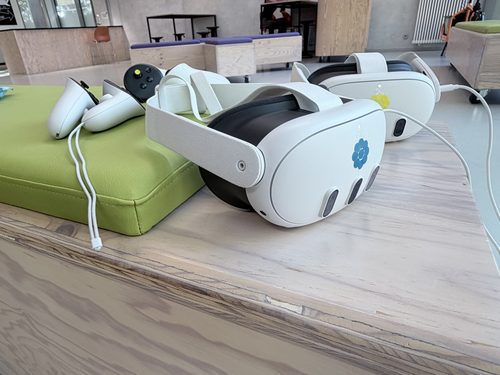
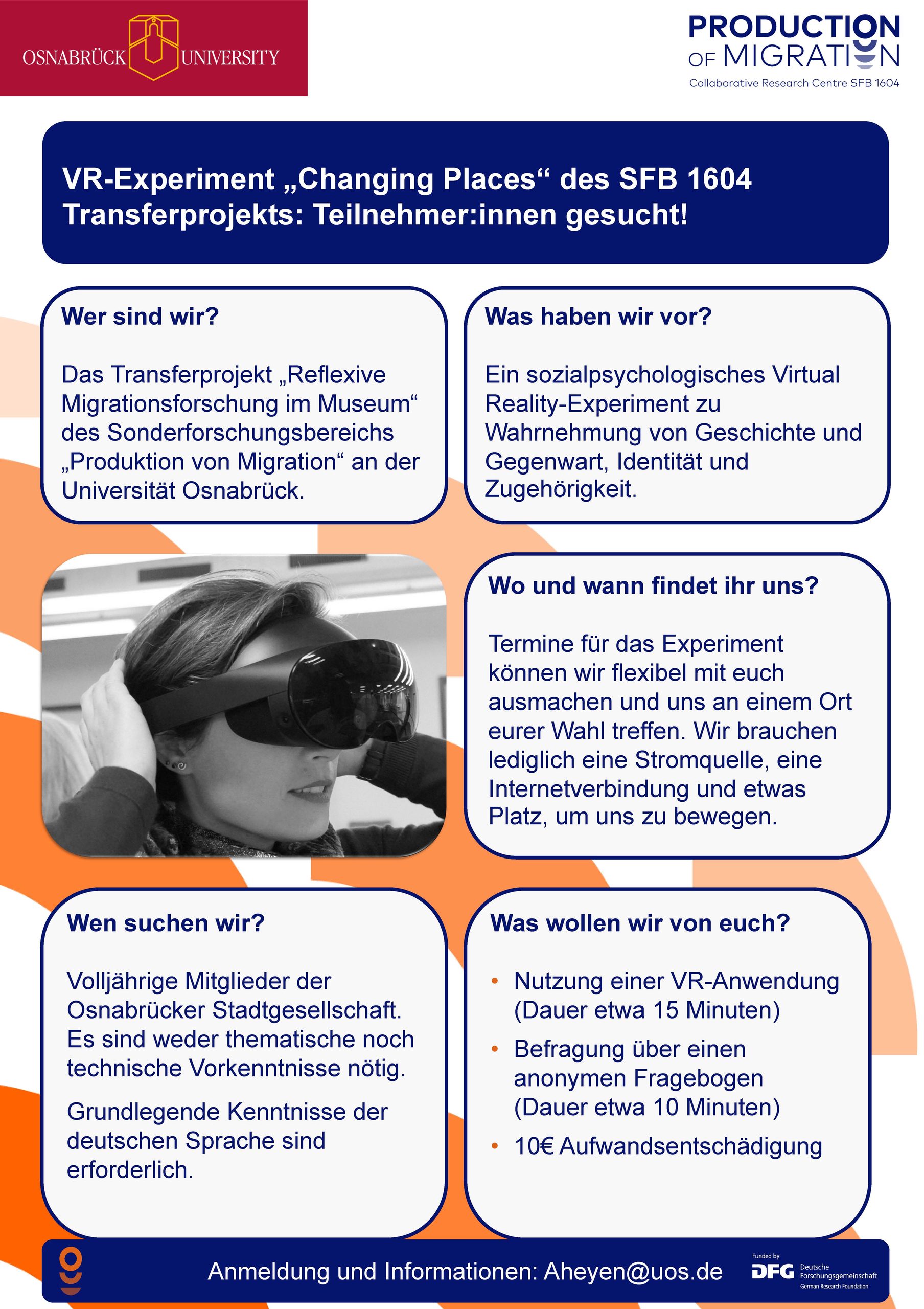
During the course of October, Tim Ott, Johannes Pufahl, and Annika Heyen from the SFB 1604 Transfer Project invited participants to take part in the VR experiment “Changing Places”. Exploring the question of the extent to which the identification potential of historically charged sites changes — and for whom — when they are digitally altered, study participants spent approximately 10 minutes in one of two virtual versions of the Osnabrück Peace Hall [Osnabrücker Friedenssaal] that were identical in structure but differed in their content. Afterwards, their experiences during this “visit” were recorded using a social-psychological questionnaire developed by Julia Becker. In order to extend the sample further into Osnabrück’s non-university civic society, the Transfer Project team is currently searching for suitable public venues as well as established groups — associations, initiatives, etc. — that they can visit with their VR equipment before the end of the year.
If you are interested, Annika Heyen is happy to provide further information at the following email address: aheyen@uni-osnabrueck.de.
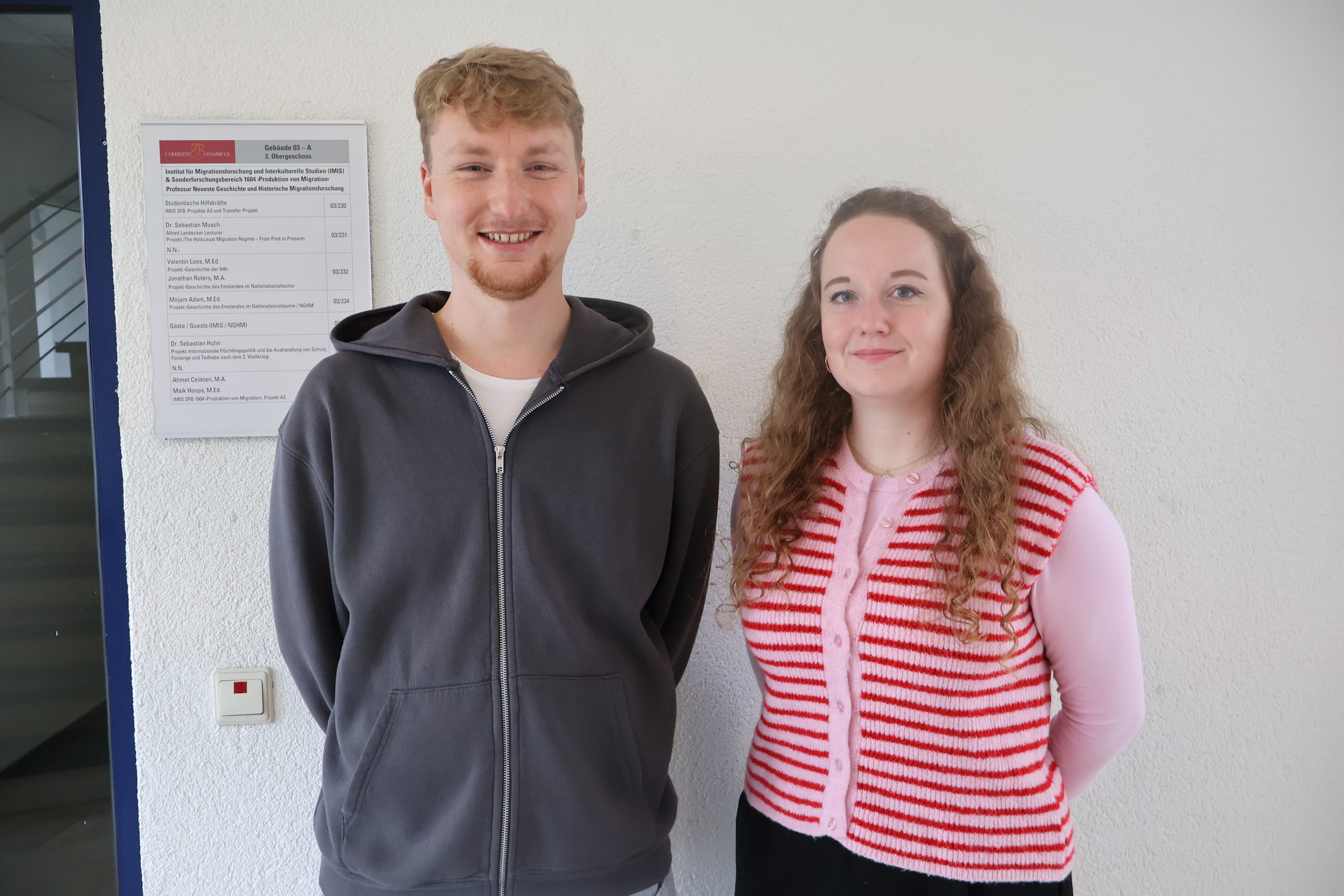
On 5 and 6 October, Maik Hoops, Ahmet Celikten, Jonathan Roters, and Annika Heyen presented the current status of their doctoral projects and initial excerpts from their dissertations and exposés within the framework of the Integrated Research Training Group of the Collaborative Research Centre 1604 “Production of Migration”. Sebastian Huhn and Sebastian Musch, along with other doctoral researchers of the Collaborative Research Centre, provided commentary on their contributions.
l. to r.: Annika Heyen, Ahmet Celikten, Sebastian Musch, Christoph Rass, Sebastian Huhn and Jonathan Rothers (Photo: Jessica Wehner)
(Photo: Jennifer-Louise Ahmed-Robinson)
From 7 to 9 October 2026, the DeZIM Conference 2026 “The Contested Normality of Migration” took place at Bielefeld University. On the first day of the conference, Ahmet Celikten from the A3 project team of the CRC 1604 “Production of Migration” presented initial empirical findings from his doctoral thesis in the panel “Belonging I”. In his presentation “Negotiating Belonging through Academic Knowledge: The Migrantized ‘Other’ in German Educational Discourse”, he demonstrated how the categories used to describe migrantized children have changed over the past 50 years. The panel provided a productive framework for further discussions and an exchange on the politics of knowledge production as well as on reflexive migration research.
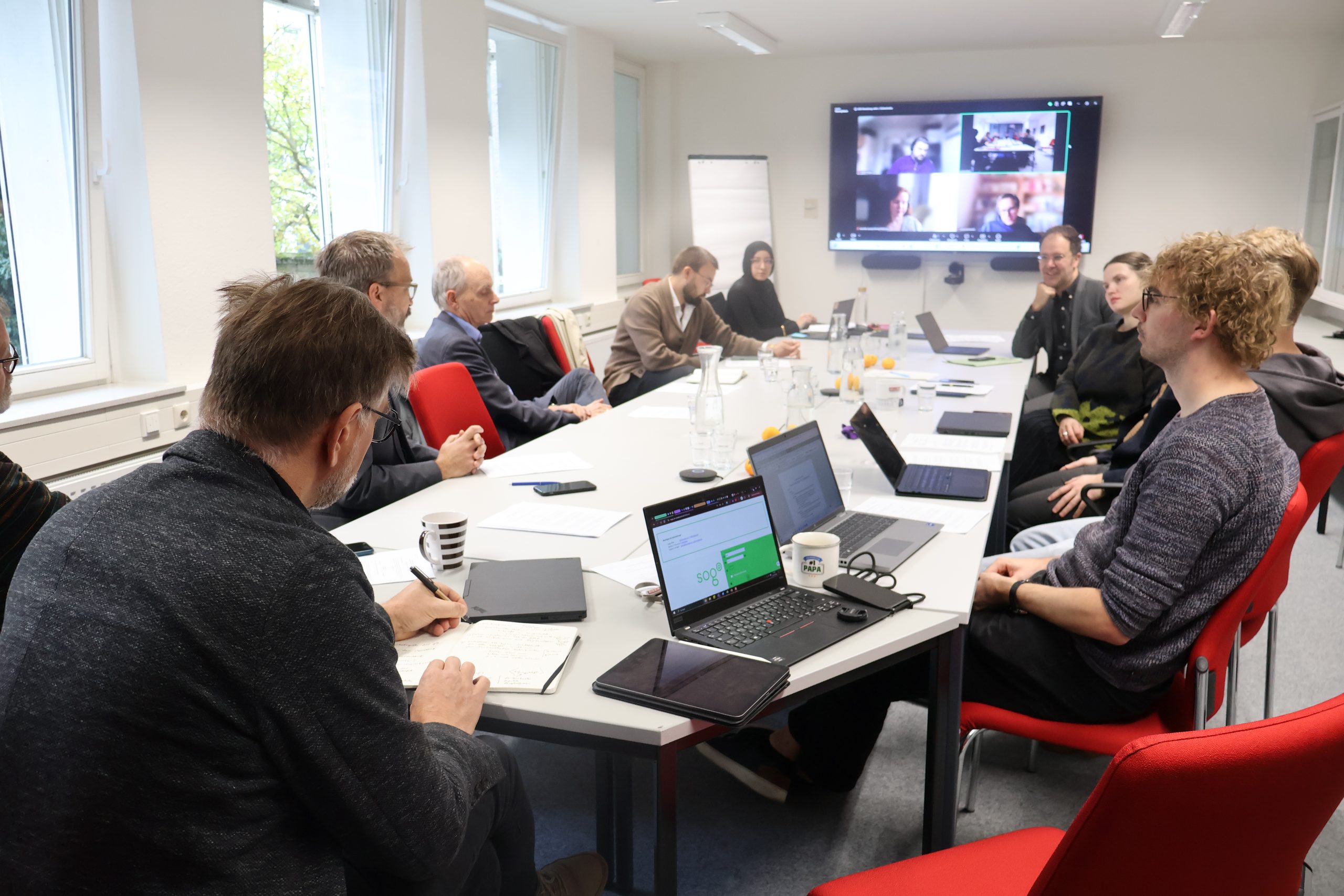
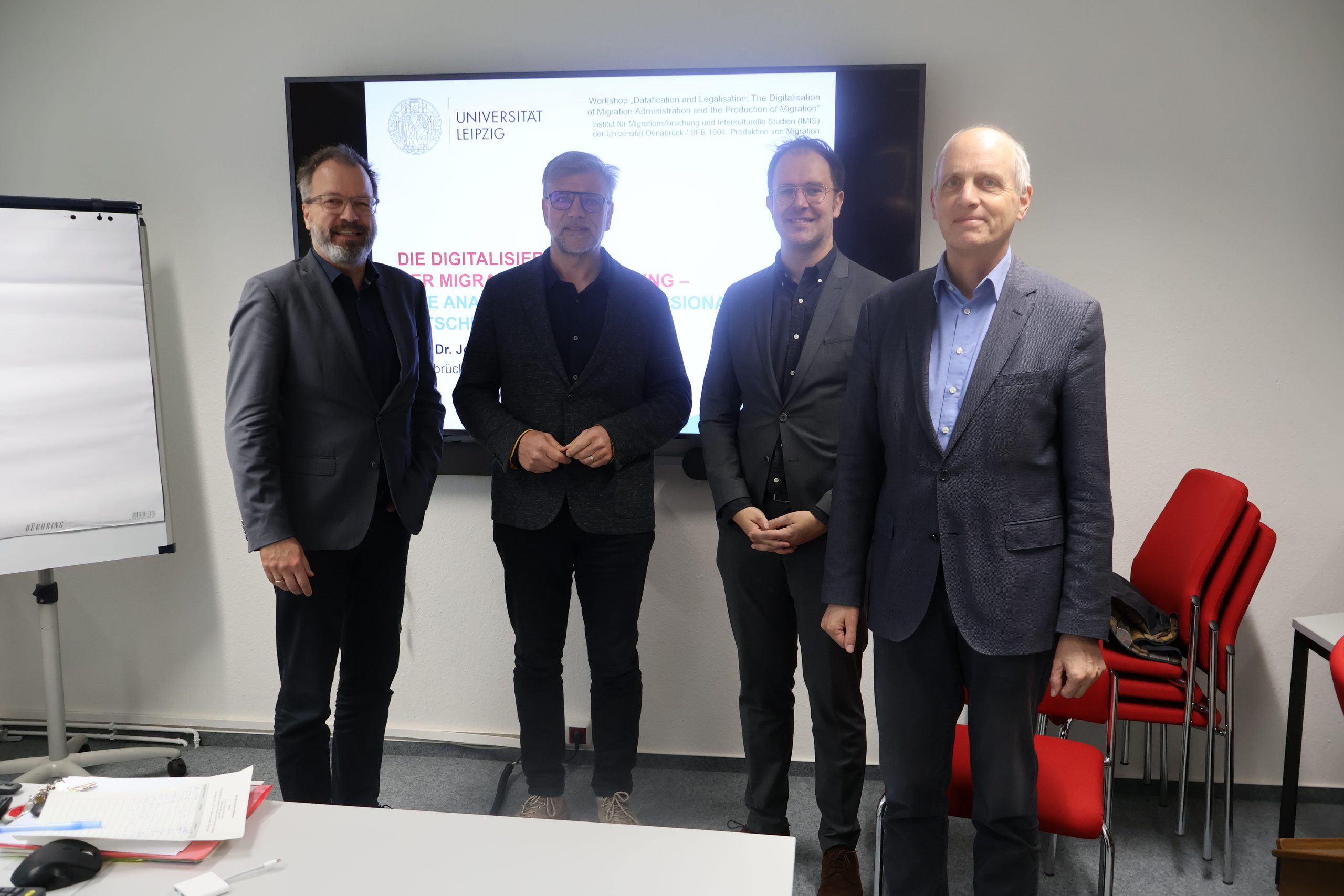
On 28 October 2026, Johannes Eichenhofer (University of Leipzig) presented his book project “The Digitalisation of Migration Administration” for discussion within the Osnabrück Collaborative Research Centre 1604 “Production of Migration”. The legal scholar examined how digital technology transforms an administrative apparatus that makes decisions on residence and protection. In doing so, he drew on the distinction between substantive law, organisational law, and procedural law. Sub-studies on digital administrative access, migration data protection law, and the deployment of artificial intelligence elaborate the project further. In conclusion, he worked through a scenario in which digital application processes consolidate all three dimensions within a single code.
During the discussion, Andreas Pott, Thomas Groß, Jennifer-Louise Robinson, and Jens Schneider drew connections to the CRC’s research programme and to the practice of visa procedures. Christoph Rass added a historical perspective, reminding participants that the registration of people marked as ‘foreign’ in lists and registers dates back to the early modern period. Eichenhofer took up this idea through the concept of the “data twin”, bringing to the fore the question of how figures of migration are produced as data persons.
The book is expected to be published Open Access in 2027.
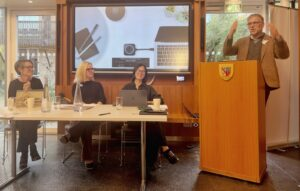
Workshop participants during the discussion (Photos: Jessica Wehner)
Notes
On 28 October, the student research assistants and doctoral researchers of the working group convened for their regular discussion round at the start of the semester. Together, in the transition between semesters, participants reflected on the current situation and looked ahead to the tasks and challenges of the coming semester. Representatives were also elected to facilitate internal communication within the working group. Jonathan Rothers and Ilka Schwerdtfeger will jointly assume this role during the winter semester 2026/27. The team extends its gratitude to both for their commitment!
Jonathan Roters and Ilka Schwerdtfeger take on the representative role in the winter semester 2026/27 (Photo: Jessica Wehner)
Following the scholarship offers already received by Annika Heyen and Imke Selle in July, a further team member now has cause for celebration: the Episcopal Study Foundation Cusanuswerk will fund the doctoral project of Jonathan Roters, expected to commence on 1 January 2027, for a period of three years. In addition to financial support, the scholarship encompasses a wide range of opportunities for academic mentoring and tutorial guidance within the scholarship holders’ network. In his doctoral project, Jonathan Roters examines the recurring equations found in the literature of the ‘long’ nineteenth century between socio-economically stigmatised European groups and ethnically stigmatised groups outside of Europe. The thesis asks whether and how socio-economic and ethnic mechanisms in the production of otherness converge in this phenomenon, rendering it productive for a theoretical discussion of the social production of deviance.
In November 2026, Karya – a site of National Socialist forced labor in the Central Greek regional unit of Fthiotida – formed part of the exhibition “Difficult Heritages: Greece | Cyprus | Turkey” at the Eynardos Mansion in Athens. Curated by Kalliopi Amygdalou and Valia Gialia, the exhibition brought together researchers and artists from Greece, Cyprus, and Turkey to present sites bearing the inscribed traces of imprisonment, occupation, displacement, and population exchange. In 1943, the Organisation Todt forced between 300 and 500 Jewish men from the Thessaloniki ghetto to perform labor at Karya: under catastrophic conditions, they were made to cut through rock in order to construct a relief track for the Wehrmacht. Most were subsequently deported to Auschwitz. This crime site is documented primarily through approximately 80 photographs from the album of the engineer Hanns Rössler – images taken from the perpetrators’ perspective, which Andreas Assael, the son of a survivor, acquired in 2002 and researched over many years.
The section on Karya in the Athens exhibition was the responsibility of Valentin Schneider (National Hellenic Research Foundation and the University of Osnabrück). The groundwork was laid by the Interdisciplinary Research Group on Conflict Landscapes at the University of Osnabrück, led by Christoph Rass: in spring 2023, students from Osnabrück and Thessaloniki conducted a historical-geoarchaeological survey there. Their 3D models and terrain surveys also fed into the German-Greek traveling exhibition “Karya 1943. Zwangsarbeit und Holocaust” [“Karya 1943. Forced Labor and the Holocaust”], which had opened in Berlin in September 2024. The fact that Karya now joined Famagusta, Gyaros, and the villages of Ionia in Athens raises a fundamental question: how does the interpretation of a site of German occupation violence change when it becomes part of an uncomfortable heritage shared by three states? The blog post invited readers to pursue this question further.
With the new academic year, a Footnote Society is being established in Osnabrück. During the winter semester 2026/27, this new reading circle will meet on three Tuesday evenings to read a single text in its entirety and debate it. The Footnote Society is open to students of all semesters as well as to academic staff.
Dates in winter semester 2026/27: Tuesday, 3 November 2026 · Tuesday, 8 December 2026 · Tuesday, 19 January 2027, 7–8 p.m. each time
Further information is available in StudIP course no. 2280.