Fundstücke | »Guests of the Reich«. An American Riposte to the Nazi Catchphrase ‘Gastarbeiter’, 1943

By Christoph Rass · Originally published on nghm.hypotheses.org
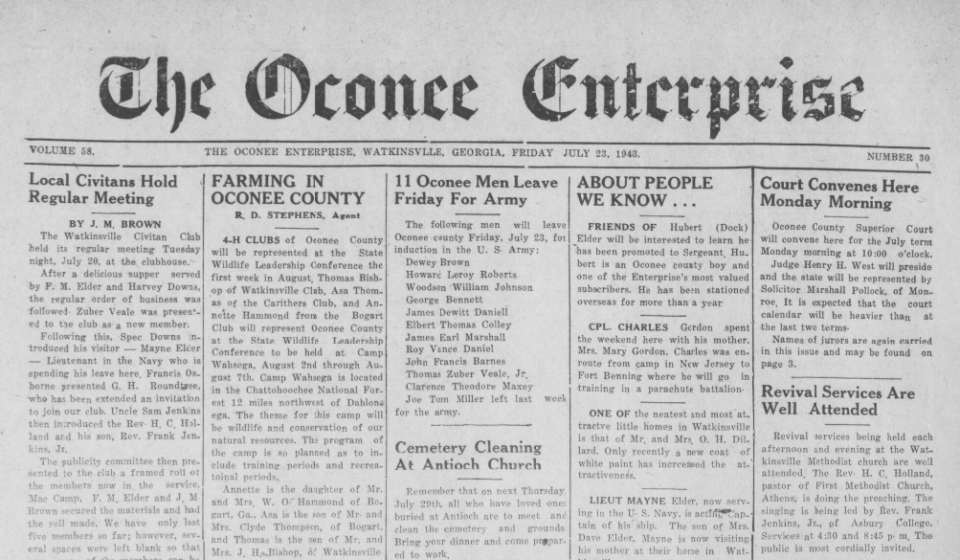
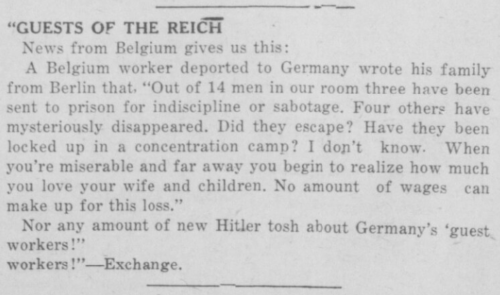
On 23 July 1943, The Oconee Enterprise, a weekly newspaper from Watkinsville in rural Georgia, printed on its opinion page a brief gloss taken from another publication (credited “—Exchange”) under the headline “GUESTS OF THE REICH”.
The article quotes a letter written by a Belgian worker deported to Berlin to his family, and builds toward the pair of sentences that constitute its real find: “No amount of wages can make up for this loss. Nor any amount of new Hitler tosh about Germany’s ‘guest workers’.” In a provincial paper on the American home front, the National Socialist propaganda term ‘Gastarbeiter’ [‘guest worker’] thus flashes briefly in its English translation, and is exposed in the same moment as a transparent lie.
Why does such a piece of evidence merit attention? It adds a node to the conceptual history of ‘Gastarbeiter’ at an unexpected point, one that previous reconstructions have not recorded. It must be situated within the genealogy of the term, and the question must be asked what it means for a research program concerned with the production of ‘figures of migration’.
‘Gastarbeiter’ is not, as is widely assumed, an invention of the early Federal Republic. The term was coined by Max Weber in the early twentieth century as a sociological category for a labor force that is economically integrated yet socially excluded: presence without belonging (Rass 2010, 2023, 2026). The National Socialist press adopted this word between 1933 and 1945 and deployed it for propaganda purposes. From 1941 onward, it was used to frame the ‘Ausländereinsatz’ [‘foreign worker deployment’], the system of forced labor that sustained the war economy (Herbert 1985; Amenda/Rass 2012). The semantics of legitimate exchange implied by the component ‘Gast’ [‘guest’] served to euphemize deportation, violence, and exploitation. The figure of the ‘Gastarbeiter’ functioned as a euphemism intended to render coercion legible as a guest relationship while simultaneously excluding any form of belonging in categorical terms: it helped to produce the social order of the National Socialist migration regime. This reinterpretation reached its propagandistic peak in 1943 and 1944.
It is precisely at this juncture that the gloss from Georgia intervenes—in English, however: it thereby also attests to one of the earliest translations of this category, into English and into the country of the wartime adversary. The earliest traceable American reception had hitherto been considered an entry in the dictionary “Nazi-Deutsch” compiled in the United States in 1944, which translated ‘Gastarbeiter’ as “foreign worker” (Paechter 1944: 31), alongside isolated mentions in the German-language exile press (Rass 2010). The term’s actual American career began in the late 1960s and reached an initial peak in the early 1980s. This periodization is anchored to a first traceable media trace in an Associated Press report from 1962; knowledge of its National Socialist prehistory was provided by Edward Homze a few years later in his 1967 study (Rass 2023).
This find pushes back the earliest marker, and simultaneously shifts its location. For already in the summer of 1943—a year before the “Nazi-Deutsch” glossary and a quarter of a century before Homze—the propaganda term appeared not in a specialist volume but in a weekly paper for farmers, and it appeared there already marked as propaganda: the gloss calls it “Hitler tosh,” and the ironic headline “GUESTS OF THE REICH” takes the guest metaphor at its word in order to expose it.
The counter-image against which the euphemism breaks apart appears in the same text. The deported Belgian writes from Berlin:
“Out of 14 men in our room three have been sent to prison for indiscipline or sabotage. Four others have mysteriously disappeared. Did they escape? Have they been locked up in a concentration camp? I don’t know.”
What confronts the person labeled a ‘guest’ is prison, disappearance, and the fear of the concentration camp; only after this does the sentence follow with which the paper rejects the propaganda.

This brief text makes clear that the American wartime public was capable of recognizing the euphemistic charge of the term long before it entered US vocabulary as an apparently neutral migration-policy category and was projected onto Mexican labor migration from the 1980s onward (Rass 2023). As a reprint from the press exchange (“Exchange”), the gloss was moreover intended for further circulation: the propaganda term and its refutation were in principle available within US media discourse during the war years.
For our work in Sub-project A3 of the Collaborative Research Centre 1604, which investigates the production of migration and its figures, such a data point furnishes a new detail: categories such as ‘Gastarbeiter’ do not merely describe migration but produce it—they render people legible as migrants of a particular kind, present and needed, yet not belonging. ‘Guest worker’ is, from this perspective, a figure of migration that in the National Socialist context translates coercion into hospitality and positions the marked individual on three levels of a social order: propagandistically privileged as a ‘Gastarbeiter’, read through the exclusion clause inscribed in the term, and in real life delivered over to the Nazi forced labor system. The gloss captures the rare moment in which this figure is caught in the act of its own production and rejected: it refuses the word ‘guest’ its intended effect and reads the category against the grain.
Conceptual history, understood in this way, is not a chronicle of word meanings but a history of the institutionalization of categories, of subjectification through their assignment, and of the immediate transformation of such figures of migration through their appropriation and deconstruction.
For the time being, little can be said about whether the quoted letter is authentic or whether the article was itself part of American information policy. The newspaper page shares the notice with contributions on the war against Imperial Japan in the Pacific and an article recruiting for the US Marine Corps. At the same time, we do not know in which language the possible original of the letter used the term ‘guest worker’ or ‘Gastarbeiter’, nor how and by whom the translation into English was made. What is now documented, however, is that knowledge of the production of the figure of the ‘Gastarbeiter’ through the European propaganda of the Nazi regime as part of its forced labor system was present and available in the United States around the middle of the Second World War. In an obscure location—and probably without significant impact—a newspaper gloss succeeded, through simple and authentic appropriation and naming, in dismantling a fait social of the Nazi regime: a figure of migration whose subsequent career after 1945 stands in the shadow of the ideological charge with which the Nazi state had invested it.
The Oconee Enterprise (Watkinsville, Georgia), issue of 23 July 1943, page 2. Georgia Historic Newspapers, Digital Library of Georgia. URL: https://gahistoricnewspapers.galileo.usg.edu/lccn/sn89053667/1943-07-23/ed-1/seq-2/ (accessed 23 July 2023).
In this series (NGHM@UOS): »Gastarbeiter«. Zur Geschichte eines Schlüsselbegriffs der Produktion von Migration (2020) · Neue Fundstücke zur Geschichte eines Unworts (2021) · Weitere Fundstücke zur Geschichte eines Unworts (2022) · Fundstücke | »Gastarbeiter« – »Gastarbeitnehmer«. Ein Moment der Kopräsenz (2025) · Long Essay | »Gastarbeiter« in der NS-Presse.
Reference: Christoph Rass: ›Gastarbeiter‹ in the Nazi Press (1933–1945). IMIS Working Paper 22 (2026); idem: ›Gastarbeiter‹ – ›Guest Worker‹. Translating a Keyword in Migration Politics. IMIS Working Paper 17 (2023).
Further reading: Amenda, Lars/Rass, Christoph (2012): Fremdarbeiter, Ostarbeiter, Gastarbeiter. Semantiken der Ungleichheit und ihre Praxis im »Ausländereinsatz«, in: Kramer/Nolzen (eds.): Ungleichheiten im »Dritten Reich«, Göttingen, pp. 90–117. · Herbert, Ulrich (1985): Fremdarbeiter. Politik und Praxis des »Ausländer-Einsatzes« in der Kriegswirtschaft des Dritten Reiches, Berlin/Bonn. · Paechter, Heinz (1944): Nazi-Deutsch. A Glossary of Contemporary German Usage, New York: Ungar. · Rass, Christoph (2010): Institutionalisierungsprozesse auf einem internationalen Arbeitsmarkt. Bilaterale Wanderungsverträge in Europa zwischen 1919 und 1974, Paderborn: Schöningh. · Rass, Christoph (2012): Staatsverträge und »Gastarbeiter« im Migrationsregime des »Dritten Reiches«, in: Oltmer (ed.): Nationalsozialistisches Migrationsregime und »Volksgemeinschaft«, Paderborn, pp. 159–183.
Find the original post at Fundstücke | »Guests of the Reich«. Eine amerikanische Replik auf das NS-Schlagwort ›Gastarbeiter‹, 1943 on nghm.hypotheses.org.
This post was automatically translated from the German original.