
By TEAM NGHM · Originally published on nghm.hypotheses.org
With the new series Inside.NGHM, we regularly offer insights into research and teaching at the Chair of Contemporary History and Historical Migration Research at the University of Osnabrück, while above all introducing the scholars who are behind it.
In the fifth edition, Sebastian Musch reports on his activities as a research associate at the UOS.
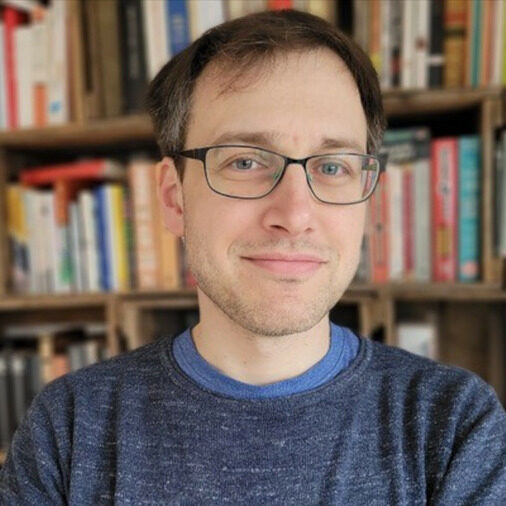
Sebastian Musch has been a research associate at the Chair of Contemporary History and Historical Migration Research since 2017, and is a member of the Institute for Migration Research and Intercultural Studies (IMIS) and the Collaborative Research Centre 1604 “The Production of Migration.” Since 2021 he has also been Alfred Landecker Lecturer, conducting research in the project “The Holocaust Migration Regime.” In the summer semester of 2026 he is standing in for the Chair.
Dear Sebastian, this semester you are standing in for the Chair of Contemporary History and Historical Migration Research. How did you actually become a historian?
Well, as is so often the case in life, it was a mixture of plans one makes, opportunities that arise from them, and a dash of chance. I did not actually study history at all to begin with, but started in Heidelberg with a combination of Jewish Studies and Semitics, though I quickly replaced Semitics with Philosophy.
The idea of engaging with Jewish Studies came to me really only because, after my school-leaving examinations, I spent a year doing alternative civilian service working with autistic children in Ra’anana, a suburb of Tel Aviv. I diligently attended Hebrew classes every day, alongside mainly new immigrants from Russia, France, and Iran. After a year I had quite a good command of Hebrew — admittedly a skill with only a limited range of practical applications — so that when it came to choosing a course of study I ultimately ended up in Jewish Studies. A decision I have never regretted to this day.
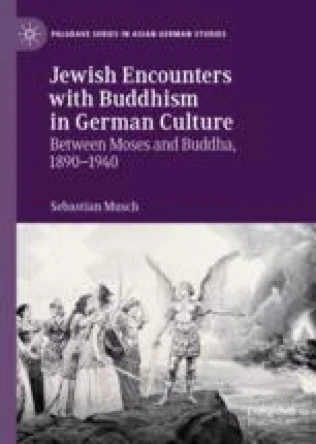
In Heidelberg I then studied, as I mentioned, Jewish Studies at the Hochschule für Jüdische Studien and Philosophy at the University of Heidelberg. In between, I spent a year as an exchange student in Milan, where I studied Philosophy and learned Italian, and already in my Magister thesis I focused on Jewish intellectual history. Afterwards I was offered the opportunity to pursue a doctorate, likewise with a focus on Jewish philosophy and intellectual history. In my doctoral dissertation I examined the perception of Buddhism among German-Jewish thinkers — also a topic I stumbled upon rather by chance. By a roundabout route, after completing my M.A. I ended up in Sri Lanka, where I taught German as a foreign language and German history at Uva Wellassa University. Since Sri Lanka is an island shaped by Buddhism, I found myself wondering how German-Jewish thinkers and philosophers actually viewed Buddhism, and that is how I arrived at my dissertation topic. That is now some years ago, yet the subject still occupies me: in 2022 we launched a project at the University of Oxford on this theme, and just recently I wrote a survey article on the topic: https://diaspora.juedische-geschichte-online.net/beitrag/gjd:article-51
I remember my doctoral period as a time of great freedom. I did not hold a university position but got by on scholarships and part-time jobs. That was, of course, somewhat precarious, and I lost a great deal of time to applications. The advantage, however, was that I was able to spend the five years it ultimately took me in quite different places: first in Heidelberg, then a year in Haifa, a year in Berlin, and a year in Berkeley (USA), and subsequently, after a stint at the Deutsches Literaturarchiv in Marbach, in Ghent (Belgium). Throughout this time I was writing my dissertation; it was actually a wonderful period.
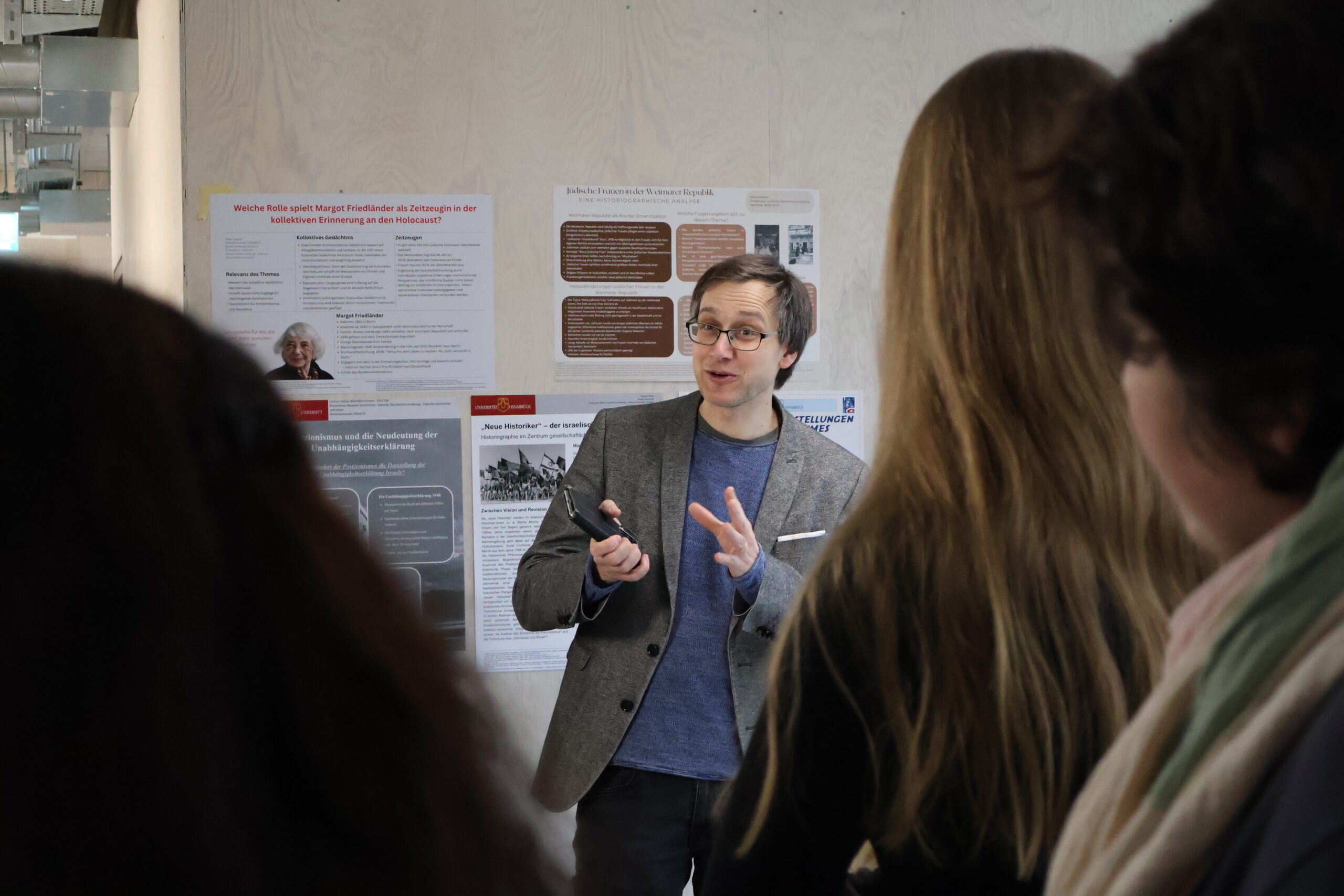
Shortly before I finished, I was given the opportunity to come to Osnabrück to work on a biography of Hermann Helfgott/Zvi Asaria as part of a project funded by the Fritz Thyssen Stiftung. That is how I ended up here. I have now been at the Osnabrück Historical Seminar for several years and can by this point rightfully call myself a historian. Following the project on Hermann Helfgott/Zvi Asaria, I have been working since 2021 as an Alfred Landecker Lecturer at the intersection of migration history and Holocaust research. After all these years I am still entirely satisfied to be working in such a dynamic and stimulating environment.
What are you currently researching?
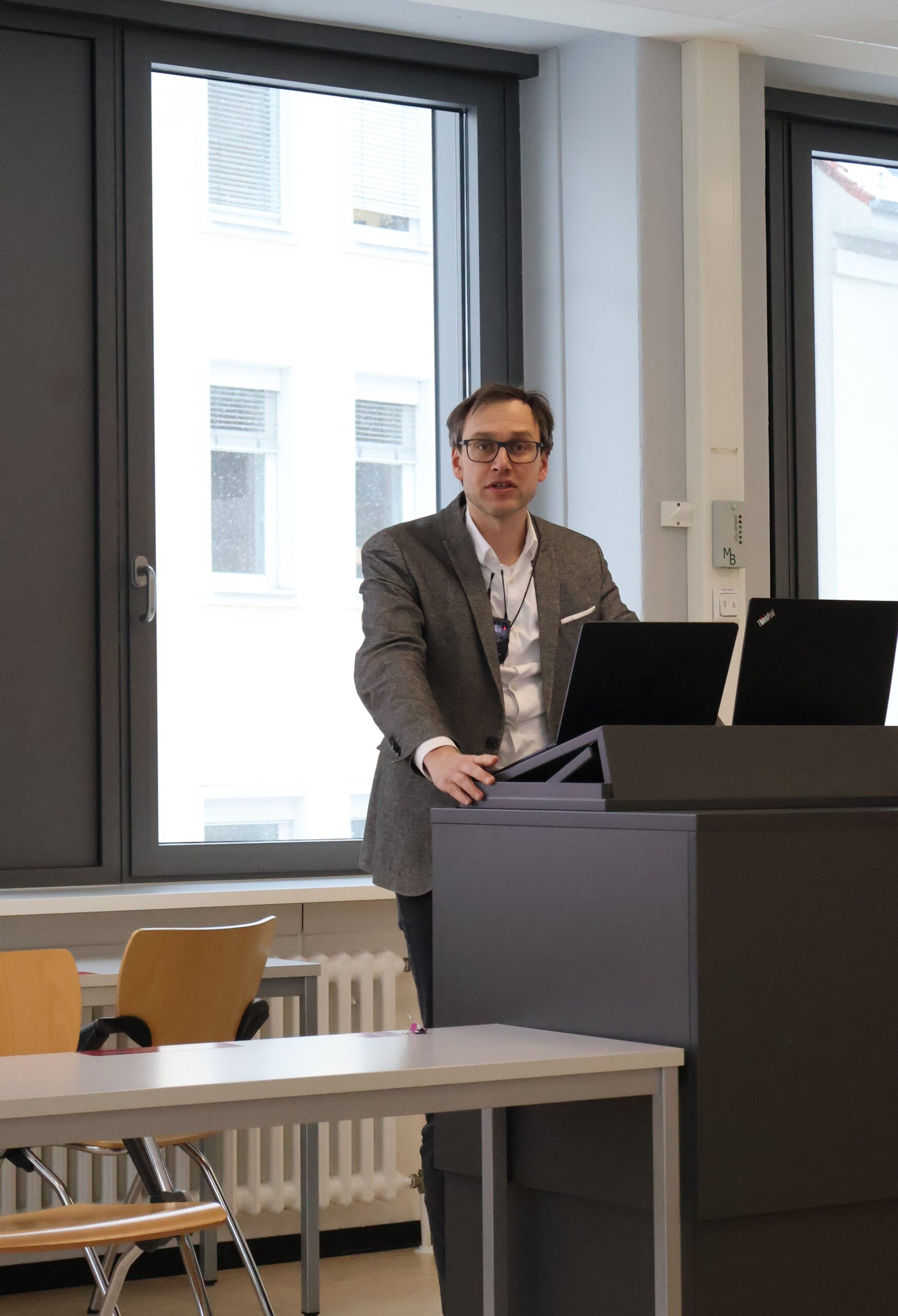
My primary research focus is on Jewish history of the 19th and 20th centuries. At present, I am deeply engaged with the history of Jewish migration, particularly at the intersection of Holocaust studies and migration research. In my view, a migration-historical perspective on the 20th century — both for the years of National Socialist persecution and for the postwar period — brings into focus aspects that have hitherto been underrepresented in the scholarship. Migration conferences in particular move to the center of attention here. We have been researching conferences for several years now, for example the Bermuda Conference in April 1943, as sites at which central categories of the then-current and also contemporary understanding of migration were formed. Since 2024, Osnabrück has been home to the Collaborative Research Centre 1604 “Produktion von Migration” [“Production of Migration”], which does not treat migration as a given phenomenon but instead asks how it is produced in the first place. It is precisely at this juncture that Jewish history and Holocaust research become connectable. For those who were classified between 1933 and 1945 as a ‘refugee’, as a ‘stateless person’, or after 1945 as a ‘displaced person’, what was at stake was no mere administrative formality, but rather access to visas, quota places, and support services — and, in extreme cases, the question of survival. These figures did not fall from the sky. They were produced in consulates, in aid organizations, and at international conferences. The CRC speaks of ‘figures’ and ‘infrastructures’, and these concepts fit my material with remarkable precision.
For me, the opportunity runs in both directions. Holocaust research gains an analytical vocabulary with which persecution and flight can be described not merely as a sequence of events, but as the product of ordering work. The research network, in turn, gains historical depth: the categories by which migration is decided upon today have a prehistory in the 1930s and 1940s and in the postwar order that emerged from them. The fact that this can be discussed here not in isolation, but together with geographers, sociologists, and legal scholars around a shared table, is a luxury that is not available in many other places.
Another focus of my work in recent years has been the study of flight and flight networks during the Second World War — on the one hand toward South and East Asia, and on the other hand in connection with humanitarian questions. In 2024, I co-organized a two-week workshop on this topic at the United States Holocaust Memorial Museum in Washington; this year I am part of a team organizing an international conference on the theme The Age of Humanitarianism. Jewish and Other Global Migrations Between Empire and Decolonisation.
Why do you enjoy being a historian?
I believe it is an extraordinary privilege that — despite the frantic pace of academic life with all its quirks — one can still find space to pursue interest-driven research. The best thing about my job is really that I can say: this interests me, I would like to read a book about it and write something about it. The fact that one can continually open up new fields of knowledge, and through reading and reflection position oneself within the accumulated knowledge of a given area, can and must think oneself argumentatively into a discourse — indeed, inscribe oneself into a discourse — all of this I find deeply rewarding. Ultimately, this is a process that is never complete. There is always more to read, to learn, and to think through.
At the same time, I appreciate that it is not merely a vita contemplativa but also a vita activa with ever-new challenges. Of course, I spend a great deal of time at the computer answering emails or writing, but there is nevertheless considerable variety. When teaching and the organization of events are added to the mix, the image of the scholar in his quiet study — so often associated with the humanities — no longer holds. And I constantly have to do things for the first time, such as now delivering a semester-long lecture course on the history of Jewish migration — that is, doing something I have never done before. This is always challenging, but for that very reason never monotonous. I am constantly meeting new people, taking on new tasks, and traveling to new places. So: choose your research focus wisely! My focus on Buddhism took me frequently to South and East Asia; my focus on Jewish history has often brought me to the United States and to Israel. In all my years as a historian in Osnabrück or elsewhere, I have never once been bored.
What advice would you give to students who want to become historians?
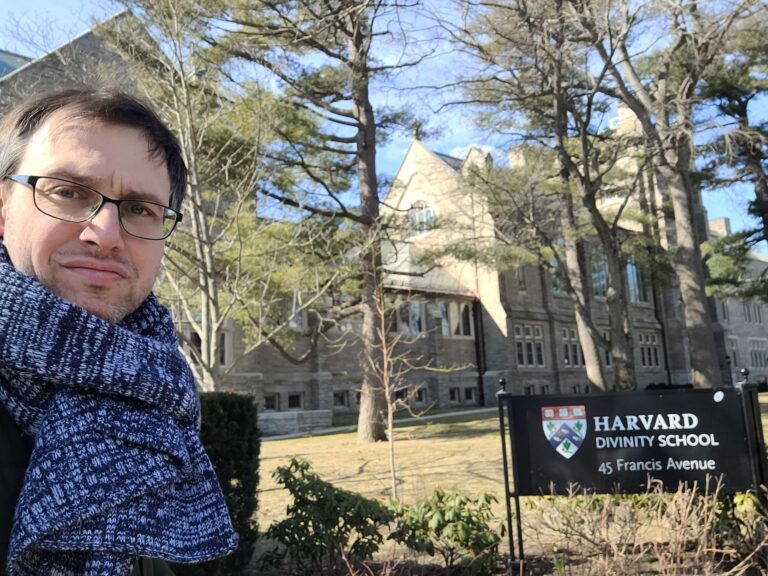
Learn languages, go abroad, and read books — and by that I do not necessarily mean only academic books, but also fiction. Why I say languages is clear: as historians, language is the instrument through which we must express ourselves, and at the same time our limit. For things for which we have no language, we can barely give expression; at the same time, we must also be able to read sources and texts that are not in German. And today, in academia, we must be able to argue and publish at a scholarly level in both German and English. Every additional language competence considerably expands the framework of what we are able to understand.
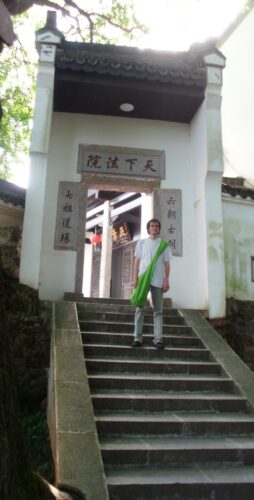
The same applies to my second piece of advice: go abroad! It is not only about learning a foreign language there — though of course that too — but also about getting to know a different university system and realizing that things work differently elsewhere than in Germany. I believe that in doing so one comes to know oneself better, grows through the experience, and broadens one’s own horizons — all qualities that make for a good historian. Scholarship today is global, and therefore scholars must, to a certain degree, also be citizens of the world.
My third piece of advice: read books. Certainly academic books and articles, as many as possible alongside all the other demands of daily life. But by all means also fine literature! As historians, we concern ourselves with reality. But, to put it in the words of Robert Musil: if there is a sense of reality, then there must also be a sense of possibility. I believe that literature enables us to develop this sense of possibility and to acquire a feel for the contingency of historical processes. So: by all means read the classics, but also contemporary literature.
What interests and hobbies do you have outside of your work at the university?
The work of an academic is already demanding in terms of time, and you really have to be fully committed to it. My wife is also an academic, and we have two young children (aged 6 and 3), so there is not much time left for anything else. For that reason, my leisure time is family time. Otherwise, I enjoy reading — not particularly surprising — and I also cook a great deal, often preparing rather elaborate meals. Much to the disappointment of my children, who would always prefer nothing but pasta with tomato sauce.
Find the original post at INSIDE.NGHM | Sebastian Musch on nghm.hypotheses.org.
This post was automatically translated from the German original.