
Mobility, Sedentariness and the ‘Other’ of Bourgeois Society | Cusanuswerk Funds Jonathan Roters’s Doctoral Project

By jroters · Originally published on nghm.hypotheses.org
On 9–10 October, the Cusanuswerk resolved to admit Jonathan Roters to the foundation’s doctoral funding programme. The project, supervised by Prof. Dr. Christoph Raß, will be supported for a period of three years through a monthly stipend as well as a range of non-material offerings. In it, Jonathan Roters investigates why, in the nineteenth century, European “beggars” and non-European “nomads” were regarded as the same “type of person” – and what role the mobility attributed to them plays in this.
The project departs from a simple observation: in the ‘long’ nineteenth century (c. 1780–1918), marginalised groups in Europe – such as those subsumed under labels like “vagabonds”, “beggars”, or “rogues” – were increasingly compared and equated with “uncivilised” groups outside Europe (the so-called “savages”).
The British social reformer Henry Mayhew, for instance, writes in his 1851 book London Labour and the London Poor:
Of the thousand millions of human beings that are said to constitute the population of the entire globe, there are – socially, morally, and perhaps even physically considered – but two distinct and broadly marked races, viz., the wanderers and the settlers – the vagabond and the citizen – the nomadic and the civilized tribes.1
At first glance, the two have little in common. “Vagabonds”, “criminals”, and similar figures served as the counter-image of the respectable, industrious citizen. The figure of the “savage” functioned as the counter-image of the “civilised” European. The one distinction followed a socio-economic logic, the other an ethnic one. And yet both could be conceived of as members of a distinct “race”.
In this context, “vagabonds” and “savages” not only converge within a shared category – as in Mayhew’s case – but the characteristics attributed to them also converge. Common colonial tropes such as those of licentiousness, godlessness, or cannibalism are transferred onto “vagabonds” and “rogues”.2 Conversely, “savages” are described in terms similar to those applied to European marginal groups – as “parasitic”. As hunters and gatherers, they are said to lack any concept of property, which is why they would appropriate the agricultural produce of civilised peoples.
The topos of socio-economic deviance, according to which “vagabonds” extract resources from the working population through begging, fraud, and theft, is thereby transposed into the colonial context.3 Towards the end of the nineteenth century, with the rise of biologistic interpretations, both groups came to be understood increasingly as bearers of one and the same biological constitution.4 Why, then, could figures from such disparate contexts be ascribed the same characteristics and conceived of as one “type of person”?
The Connection to Social Perceptions of Mobility
Roters suspects that the key lies in the mobility attributed to both groups. In the bourgeois imaginary, sedentariness stood, among other things, for “honest labour”, “order”, and “civilisation”.5 Drawing on and extending Cornelius Castoriadis’s theory of “society as imaginary institution”,6 he understands sedentariness as a symbolic codification of central normative conceptions of bourgeois society. Those perceived as non-sedentary – like “vagabonds” and “savages” – thereby also negated the norms symbolised through sedentariness, and could consequently be regarded as, among other things, lazy, criminal, and “uncivilised”. This dynamic is evident not least in the above-cited passage from Henry Mayhew, in which membership of the “race” of “wanderers” signals deviation from “bourgeois respectability” and “civilisation”.
In order to pursue this thesis, Roters applies three interrelated perspectives. First, he enquires into the mechanisms and developments in the history of knowledge that led to the equation described above. What intellectual-historical preconditions, what actors and modes of knowledge production, what intertextual references underpin the co-figuration of stigmatised groups within and outside Europe? Second, Roters pursues a historical semantics of non-sedentariness and perpetual mobility. If the mobility attributed to both groups is to be understood – as proposed above – as the catalyst for the observable processes of co-figuration, then semantic relations between attributions of mobility and attributions of secondary characteristics ought to be traceable in the relevant texts. What, then, does mobility mean for the actors in question, and how are attributions of socio-economic and civilisational deviance derived from mobility?
Third, the empirical findings of the study are to be rendered productive for a theoretical discussion of the production of ‘otherness’. The merging of forms of socio-economic and ethnic differentiation within this phenomenon is understood here as a suitable foundation for approaching an explanation of how specific meanings arise within structures of prejudice. The theoretical framework Roters draws upon is that of Cornelius Castoriadis, whose approach he will continuously develop and refine throughout the empirical work.
Association with the CRC 1604 “Production of Migration”
An overlap with the research interests of the Collaborative Research Centre 1604 “Production of Migration” at the University of Osnabrück arises from the perspective on mobility and deviance described above. Since May 2026, the doctoral project has therefore been associated with the CRC’s Integrated Research Training Group, in which regular exchange takes place with other doctoral researchers in the research network about the dissertation projects being developed within it.
Contact: jonathan.roters@uni-osnabrueck.de
- Mayhew, Henry: London Labour and the London Poor. A cyclopedia of the conditions and earnings of those that will work, those that cannot work, and those that will not work, Volume 1: The London Street-Folk, London: G. Woodfall and Son, 1851, p. 1. ↩︎
- Cf. Becker, Peter: Furcht vor Niedergang und Entartung: Nährboden für sozialdarwinistische Ideen im späten 19. Jahrhundert, in: Streitfall Evolution: eine Kulturgeschichte, Köln; Weimar; Wien: Böhlau Verlag, 2017, pp. 362–372, here p. 366. ↩︎
- Cf. Althammer, Beate: Vagabunden. Eine Geschichte von Armut, Bettel und Mobilität im Zeitalter der Industrialisierung (1815–1933), Essen: Klartext Verlag, 2017, p. 24. ↩︎
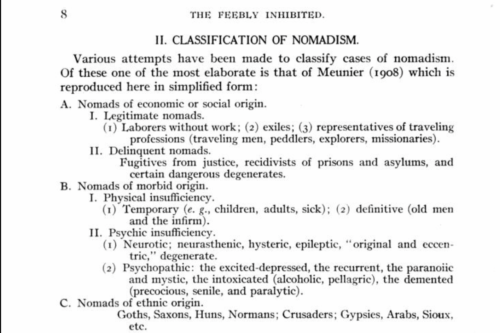
- Cf. e.g. Davenport, Charles: The feebly inhibited: Nomadism, or the wandering impulse, with special reference to heredity, Inheritance of temperament, Washington, D.C.: Carnegie Institution of Washington, 1915, p. 25. ↩︎
- McVeigh, Robbie: Theorising sedentarism: the roots of anti-nomadism, in: Acton, Thomas (ed.): Gypsy politics and Traveller identity, Hertfordshire: University of Hertfordshire Press, 1997, pp. 7–26. ↩︎
- Castoriadis, Cornelius: Gesellschaft als imaginäre Institution: Entwurf einer politischen Philosophie [The Imaginary Institution of Society], Frankfurt a.M.: Suhrkamp, 1984. ↩︎
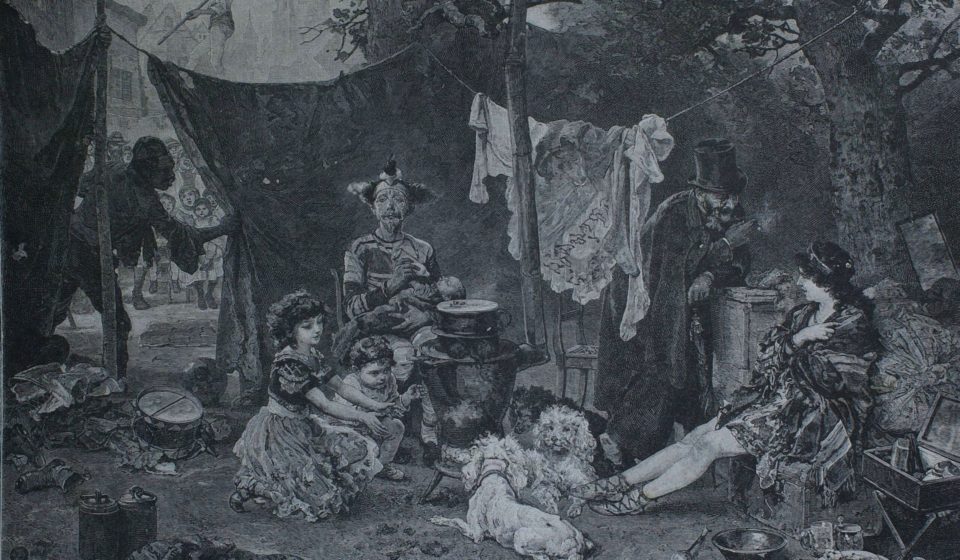
Header image: In der “Garderobe” der fahrenden Leute [In the “wardrobe” of the travelling people]. After the oil painting by Ludwig Knaus, printed in: Die Gartenlaube, vol. 1881, issue 41, p. 689.
Find the original post at Mobilität, Sesshaftigkeit und das ‘Andere’ der bürgerlichen Gesellschaft | Cusanuswerk fördert Promotionsvorhaben von Jonathan Roters on nghm.hypotheses.org.
This post was automatically translated from the German original.