

By Christoph Rass · Originally published on nghm.hypotheses.org
“[G]ender is a constitutive element of social relationships based on perceived differences between the sexes, and gender is a primary way of signifying relationships of power.” The sentence comes from the essay Gender: A Useful Category of Historical Analysis by Joan Wallach Scott, published in 1986, which appears as the second chapter in Gender and the Politics of History. This brings us to the thirteenth title on the NGHM reading list. With this book, the question of what historiography actually does shifted during the 1980s. Gender is left untranslated in this post because the German word ›Geschlecht‹ carries both bodily difference and its social interpretation within a single term, thereby effacing the very distinction on which Scott’s inquiry turns. In Scott’s work, gender is not simply another category alongside class and ›race‹, for the category rewrites how historical analysis renders power visible and co-produces it. The poststructuralist volume, which turns the methods of social history against their own premises, immediately divided the discipline.
Joan Wallach Scott, born in 1941 in Brooklyn, NY, grew up as the daughter of a history teacher and a history teacher, in a household where, as she later recounted, history and politics were discussed at the dinner table. Her father, Sam Wallach, president of the New York Teachers Union from 1945 to 1948, was dismissed by the New York Board of Education in the early 1950s for refusing to cooperate with the committees investigating alleged ‘Communists’ in the school system. After studying at Brandeis University (B.A. 1962), she completed her doctorate in 1969 at the University of Wisconsin–Madison, and her early work moved within the field of French social and labor history, whose guiding category of the ›worker‹ she would herself make the object of inquiry in this volume. Following positions at the University of Illinois at Chicago (1970 to 1972), Northwestern University (1972 to 1974), and the University of North Carolina at Chapel Hill (1974 to 1980), she moved to Brown University, where she built up the Pembroke Center for Teaching and Research on Women as its founding director. In 1985 she moved to the Institute for Advanced Study in Princeton, where she conducted research at its School of Social Science until 2014. Her scholarly papers from 1954 to 2019 are now held in the John Hay Library at Brown University; the collection forms part of the Pembroke Center’s Feminist Theory Archive.
The first edition of Gender and the Politics of History is divided into four parts and comprises nine essays. Part I, Toward a Feminist History, examines previous women’s history (women’s history) and develops the definition of gender that forms the core of the book. Part II, Gender and Class, applies the framework to language and class analysis, devoting a separate chapter to E. P. Thompson’s The Making of the English Working Class. Part III, Gender in History, tests the argument against the Parisian ready-to-wear garment trade of 1848, the trade statistics of 1847/48, and the discourse of political economy between 1840 and 1860. Part IV, Equality and Difference, connects the Sears case with a stocktaking of American women’s history from 1884 to 1984. Categories such as ›worker‹, ›class‹, or ›equality‹ are, the book’s central contention holds, already gendered before historians even pick them up.
Positive and negative reactions were immediate. When Scott presented the essay Gender: A Useful Category of Historical Analysis in a seminar at the Institute for Advanced Study in the autumn of 1985, the Princeton historians who had come specifically for the occasion were, as she wrote retrospectively in 2008, “to a man, appalled.” The essay nonetheless quickly became a point of reference. William H. Sewell Jr. called it in his review of the volume an “instant classic,” and according to figures compiled by the American Historical Association at the end of 2007, it had already been for five years the most downloaded essay from the AHR on JSTOR. The opposition, however, persisted. Joan Hoff charged poststructuralist gender history in general, and Scott in particular, with nihilism, presentism, ahistoricism, obfuscation, elitism, submission to patriarchy, ethnocentrism, irrelevance, and possible racism — so Joanne Meyerowitz later summarized the critique. Under attack was the very approach of making categories the object of analysis; Hoff even saw ›woman‹ as an analytical category obliterated.
The second controversy unfolded in a courtroom. In the discrimination suit brought by the Equal Employment Opportunity Commission against Sears, Roebuck and Company, Rosalind Rosenberg appeared in 1985 as an expert witness for the company and Alice Kessler-Harris for the Commission. The debate that Thomas Haskell and Sanford Levinson took up in the Texas Law Review in 1988, and to which Kessler-Harris responded there, made visible what Scott’s fundamental question means both theoretically and practically: when historians are called to testify in court as to whether a pattern of discrimination is ‘historical’, the very choice of category already helps determine the outcome.
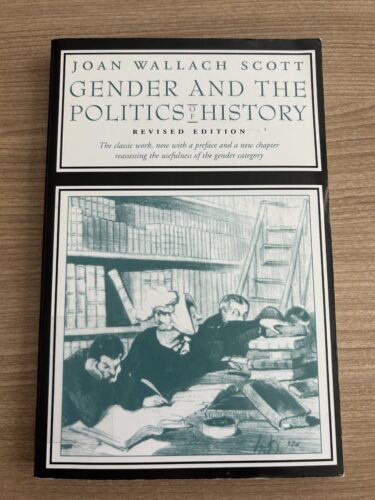
The abstractness of the early chapters was noted critically from the outset; they continue to demand more of readers than the later, case-based essays, in which the argument works with concrete material. The Joan Kelly Memorial Prize of the American Historical Association nonetheless went to the book as early as 1989, jointly with Mary Blewett’s Men, Women, and Work; the discipline thus honored it while still arguing heatedly about it. In 2018, Columbia University Press brought out an anniversary edition, with a preface written especially for this edition and the essay The Conundrum of Equality, printed in a book for the first time, which Scott had delivered at the Institute for Advanced Study in 1998 and published in 1999 as an Occasional Paper of the School of Social Science.
Scott’s argument touches on questions that will recur throughout the series. E. P. Thompson’s The Making of the English Working Class is also on the reading list, and Scott’s fourth chapter will prove productive there as a counter-reading.
Those who read the text today will find not so much a supplement to social history as a reflection on its presuppositions. The categories with which historians work themselves belong to what historical analysis has to explain. This finding connects directly to our work in Collaborative Research Centre 1604.
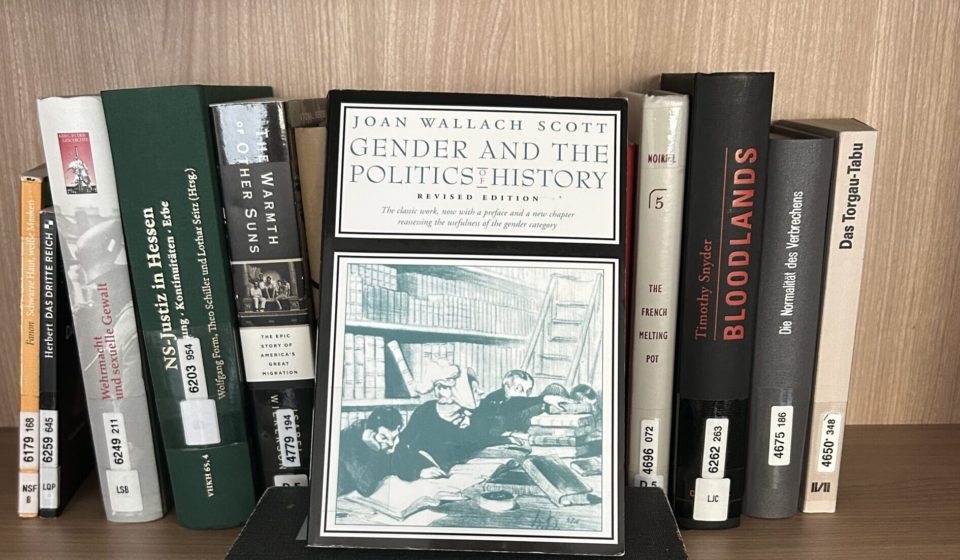
Students at Osnabrück will find the Revised Edition of 1999 (New York: Columbia University Press 1999, XVI, 267 pp.) in the open-access stacks of the University Library under the shelfmark 6187-725 6. This edition contains, in addition to the first edition, a preface to the Revised Edition and the supplementary chapter Some More Reflections on Gender and Politics, which is no longer included in the anniversary edition of 2018 (OPAC).
Joan Wallach Scott (b. 1941), Gender and the Politics of History, New York: Columbia University Press 1988; Revised Edition 1999; Anniversary Edition 2018.
References: Joan W. Scott, Gender: A Useful Category of Historical Analysis, in: The American Historical Review 91 (1986), no. 5, pp. 1053–1075, here p. 1067. Eadem, Unanswered Questions, in: The American Historical Review 113 (2008), no. 5, pp. 1422–1429, here p. 1422. Joanne Meyerowitz, A History of “Gender”, in: ibid., pp. 1346–1356, here pp. 1346 f. Joan Hoff, Gender as a Postmodern Category of Paralysis, in: Women’s History Review 3 (1994), no. 2, pp. 149–168, here p. 149. William H. Sewell Jr., review of Joan Wallach Scott, Gender and the Politics of History, in: History and Theory 29 (1990), no. 1, pp. 71–82, here p. 71. Thomas Haskell / Sanford Levinson, Academic Freedom and Expert Witnessing: Historians and the Sears Case, in: Texas Law Review 66 (1988), pp. 1629–1659. Alice Kessler-Harris, Academic Freedom and Expert Witnessing: A Response to Haskell and Levinson, in: Texas Law Review 67 (1988), pp. 429–440.
This post is part of the series NGHM reads, in which the 65 titles of the NGHM reading list are presented. The list can be explored as a knowledge graph.
Find the original post at NGHM liest | 13 | Scott: Gender and the Politics of History (1988) on nghm.hypotheses.org.
This post was automatically translated from the German original.