
This post was automatically translated from the German original at
NGHM liest | Mark Wyman: DPs: Europe’s Displaced Persons, 1945–51 (1989/1998).
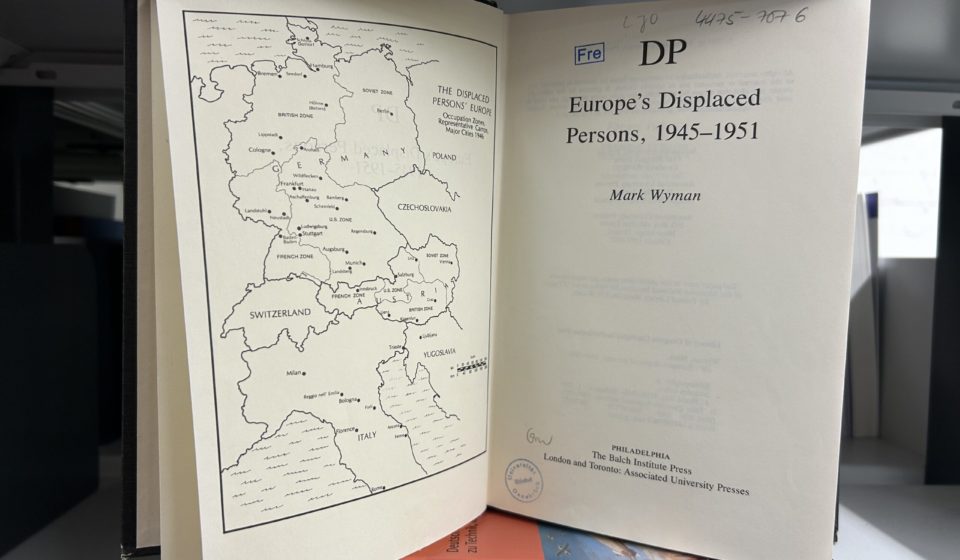
What becomes of millions of people whose suffering under persecution and violence-induced mobility does not end with the conclusion of the war in 1945, but instead enters a distinct and difficult-to-grasp next phase? Mark Wyman’s DPs: Europe’s Displaced Persons, 1945–51, the tenth title on the NGHM reading list and the first from the field of displaced persons and refugee history, answers this question with a book that first established the concept of the ‘displaced person’ as a historiographical unit of inquiry for an English-speaking audience.
One observation at the outset, which is unusual for a book about postwar refugees published in 1989: Wyman conducted approximately eighty interviews with former DPs as well as staff members of the relief organizations working with them. This oral history foundation underlies an account otherwise drawn from published primary sources and archival material, and it perceptibly shifts the tone of the book away from a mere history of diplomacy and administration. Those who had read about DPs only through the files of UNRRA, the IRO, or the American military government found in Wyman, for the first time and at considerable breadth, what those who had been administered had to say for themselves.
Wyman, now Distinguished Professor Emeritus of History at Illinois State University, was a Professor of History there at the time the book was written. His path to that position led through studies at the University of Washington, where he completed his doctorate, as well as earlier work as a labor reporter for the Minneapolis Tribune. His dissertation examined the hard-rock miners of the American West, and his body of work ranges from transnational studies of return migration and displaced persons to local history. From 1971 until his retirement in 2004, Wyman taught at ISU. When DPs first appeared in 1989 with Balch Institute Press in Philadelphia and was reissued as a paperback by Cornell University Press in 1998, the Cornell edition retained the original text and supplemented it with an ‘Introduction to the Cornell edition’, in which Wyman situates the subject within the post-Soviet contexts that emerged after 1989, including Croatian return programs, Lithuanian citizenship provisions for exile families extending to the grandchildren’s generation, and property restitution in Estonia.
The book itself begins in 1945 on a devastated continent.
From there, Wyman guides the reader through the provision of aid to the liberated, camp life, and repatriation policy with its forced returns to the Soviet Union, through the question of abducted children and the consolidation of the camps into distinct communities. A central section brings into focus the Jewish DPs as a ‘surviving remnant’ and the national exile cultures of the Baltic, Polish, and Ukrainian groups. The closing chapters trace the waves of emigration overseas as the ‘gates’ opened after 1948, and assess the political, cultural, and diplomatic ‘legacies’ of the DP problem. Methodologically, Wyman combines the aforementioned interviews with published sources and archival material into a narrative social and diplomatic history. The book has no programmatic theoretical architecture; rather, it narrates from within a body of material that was itself meant to challenge such theory.
Herein lies its enduring contribution. M. Mark Stolarik described DPs as the only work to present the situation of postwar refugees in Western Europe comprehensively and sympathetically. The Journal of American Ethnic History highlighted the broad interview base and characterized the book as an important overview intended to stimulate further research. The International Migration Review called it a fascinating and deeply moving book, while Choice commended the integration of diplomatic history, the history of international relations, and social history. In subsequent historiographical assessments, the book is regarded, alongside Wolfgang Jacobmeyer’s Vom Zwangsarbeiter zum heimatlosen Ausländer [From Forced Laborer to Stateless Foreigner] (Vandenhoeck & Ruprecht, Göttingen 1985), as a reference work of the ‘first wave’ of DP scholarship, upon which more recent studies build, including Gerard Daniel Cohen’s In War’s Wake (Oxford University Press 2011), Sheila Fitzpatrick’s Lost Souls (Princeton University Press 2024), and Ruth Balint’s Destination Elsewhere (Cornell University Press 2021).
Between these waves, however, lies a shift that is important for reading the book today. Cohen’s study and related works have moved the emphasis away from Wyman’s ethnographically narrative approach toward the postwar humanitarian regime and its international organizations. What Wyman narrates primarily as experience — camps, waiting, emigration — more recent studies read as the effect of a migration regime that first produces DPs as a governable category. Holding both lines together yields something that neither alone provides: a history in which the voices of those administered and the structures of administration render each other legible. When Gérard Noiriel’s The French Melting Pot, a classic on the state production of migration, appears later in this series, it will become apparent where Wyman’s book stands today: as an indispensable point of departure and as an invitation to read further.
The book’s final sentence belongs to the disappearance of its own subject: the letters DP, Wyman writes, would one day sound far away, and grandchildren would ask what a DP even was. This prediction has come true only in part. The historical subject recedes, the postwar DPs become a cipher requiring explanation, yet the term itself does not disappear but returns: more recent migration research has taken up ‘displaced persons’ again, as a broader, more inclusive alternative to ‘refugees’, and thus in reference to different circumstances than those of the original historical context. It is not the term that passes away, then, but its referent that shifts: the subject disappears while the category is reinterpreted and pressed into service for the present.
That ‘displaced persons’ in the 1940s already described less a social reality than it produced a political ‘category of action’ makes the difference between what the expression once named and what it is meant to name today the proper subject of historical inquiry (Huhn and Rass 2024).
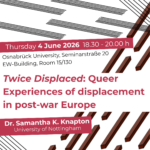
How necessary this work remains, and how important it is to interrogate the history of violence-induced mobility during and after the Second World War anew, was demonstrated on 4 June 2026 by an evening lecture in Osnabrück: Dr. Samantha Knapton (University of Nottingham) spoke at the invitation of the Research Group for Contemporary History and Historical Migration Studies on “Twice Displaced: Queer Experiences of Displacement in Post-war Europe”. Knapton turned her attention to those who were simultaneously queer and displaced persons, and whose exclusion did not end with the war but solidified during reconstruction: the ‘twice displaced’, driven from their homes as much as from their life plans. In doing so, the lecture extended precisely the question that Wyman’s book poses and that runs throughout this series: whose experience enters the historical record, and who falls through the categories of administration as well as of later historiography.
Students at Osnabrück can access DPs: Europe’s Displaced Persons, 1945–51 as an online resource through the University of Osnabrück library (OPAC).
Mark Wyman, DPs: Europe’s Displaced Persons, 1945–51, Ithaca: Cornell University Press 1998 (first edition Philadelphia: Balch Institute Press 1989).
This post is part of the series NGHM reads, in which the 65 titles of the NGHM reading list are presented. The list can be explored as a knowledge graph.