
This post was automatically translated from the German original at
NGHM-Tracker (7/26).
The monthly newsletter of the Working Group on Contemporary History and Historical Migration Research at the University of Osnabrück
By Eduard Usov & Jessica Wehner
June brought a remarkable thematic density: displacement, memory, and the question of whose experiences become visible in historiography – and whose do not. At the center was Samantha Knapton’s lecture on queer experiences of displacement in postwar Europe, which also provided occasion to reflect more fundamentally on the blind spots of classical migration history. Added to this were insights into the conference travels of Team NGHM. What connected the contributions and events of the month was a shared question that rarely emerged so clearly: How do we decide which stories are told – and what methods can be used to grasp them at all?
Our June issue of the newsletter reports on the team’s wide-ranging activities.
Insights
The NGHM team co-hosted the fourth Alfred Landecker Lecture (organized by Dr. Sebastian Musch) together with IMIS and SFB 1604 on 4 June. Samantha Knapton (Nottingham) spoke on her concept of “twice displaced”: queer victims of Nazi persecution who survived the camps experienced, at the war’s end, not exclusion from a territory but exclusion from recognition and historiography – Knapton described the postwar years as the “straightest” decade of the twentieth century. Using the case of Pierre Seel, she demonstrated how one survivor never received state recognition and died stateless in 2005.
Methodologically, Knapton argued for reading queer absences in the archive not as gaps in the sources but as products of the categories themselves (such as the continued enforcement of §175). A purely empiricist reading of the files, she contended, reproduces epistemic violence. The discussion left open the question of where the boundary lies between disciplined reconstruction and reading meaning into silence.
Christoph Rass participated from 18 to 20 June in a conference organized by the Documentation and Learning Center Bückeberg, the Foundation of Lower Saxony Memorials, and Leibniz University Hannover, which explored the question “NS-Gesellschaft als ‘Volksgemeinschaft’?” [“National Socialist Society as ‘People’s Community’?”]. The focus was on social practices rather than conceptual labels – at the conference venue itself, the site of the “Reichserntedankfeste” [“Reich Harvest Thanksgiving Festivals”] (1933–1937).
The workshop presented findings from the DFG project “Überwachung. Macht. Ordnung.” [“Surveillance. Power. Order.”], which has digitally indexed the central card file of the Osnabrück State Police Office: surveillance knowledge derived more strongly from administrative and economic institutions than from the Party or the Gestapo, while private denunciation played a lesser role. During the wartime phase, almost two thirds of detention events concerned forced laborers. “Volksgemeinschaft” [“People’s Community”] thus appears as a socially distributed practice rather than a mere collective mood. An excursion to the learning center and a panel discussion with Elke Gryglewski and Wiebke Hiemesch connected these findings to questions of memorial site work.
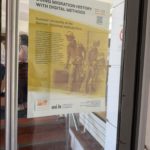
Afterwards, Christoph Rass continued on to Paris: there he delivered the keynote address at the Summer School ‘Doing Migration History with Digital Methods’, which took place from 22 to 26 June at the German Historical Institute Paris (DHIP / Institut historique allemand) and was organized by Prof. Dr. Mareike König in collaboration with the Luxembourg Centre for Contemporary and Digital History (C²DH, University of Luxembourg). His keynote, entitled “How Migration Became Data, How Data Makes Meaning, and How Reflexive Migration Research Intervenes,” addressed the possibilities of digital methods in reflexive migration research. An abridged version of the keynote will follow shortly as a blog post.
From 29 June to 1 July 2026, Jessica Wehner and Annika Heyen participated, at the invitation of Michael Mayer (Akademie für Politische Bildung Tutzing) and Frank Caestecker (University of Ghent), in the international conference “From Geneva to Schengen. Shaping Immigration and Refugee Protection in Western Europe, 1951–1994.” The conference was held at and organized by the Akademie für Politische Bildung Tutzing on the shores of Lake Starnberg – in partnership with the University of Ghent – and offered Wehner and Heyen the opportunity to present insights from their doctoral projects to an international audience.
Not only Team NGHM was traveling, but also the students: the Willy Brandt Seminar is currently taking place once again, offered annually by NGHM in collaboration with the Bundeskanzler-Willy-Brandt-Stiftung [Federal Chancellor Willy Brandt Foundation] in Berlin. The seminar with excursion, led by Frank Wolff, directly connects research and public history. On the one hand, students explore their own research questions using fascinating and rarely consulted sources from Willy Brandt’s estate. On the other hand, they develop concrete ideas for how these contents might be translated into a public exhibition. This year, participants are engaging with the question of what concepts of Europe were developed in exile and in resistance to National Socialism, how these differed according to political orientation, and which themes were foregrounded: How can peace be achieved? What kind of “Europe” is needed for this? How can imperialism be prevented? And how can rights be strengthened and secured?
To bring these questions to life, participants traveled to Berlin from 2 to 5 June 2026. There, the core part of the seminar took place once again in the Forum Willy Brandt – the Berlin permanent exhibition of the Bundeskanzler-Willy-Brandt-Stiftung, reserved exclusively for the seminar for several days. This allowed students to develop ideas intensively and directly “on site” for how history can be brought to the public. The seminar was complemented by excursions to the German Resistance Memorial Center (Gedenkstätte Deutscher Widerstand) and the Documentation Center Flight, Expulsion, Reconciliation (Dokumentationszentrum Flucht, Vertreibung, Versöhnung), where participants received special curatorial tours offering insights into the day-to-day work and behind-the-scenes processes of exhibition-making.
On 22 and 23 June 2026, an excursion to Cologne took place under the direction of Sebastian Musch. The focus was on the Jewish history of Cologne. The cathedral city on the Rhine can claim the oldest Jewish community north of the Alps, attested by the documented settlement of Jewish people there since 321 CE.
These approximately 1,700 years of Jewish life have been marked by persecution and antisemitism – above all during the National Socialist period, when almost the entire Jewish community of the city was expelled or murdered. At the same time, the Jewish history of Cologne is also a history of resilience, social advancement, and reconstruction. Particularly in the nineteenth and early twentieth centuries, Cologne’s Jewish community experienced a period of prosperity and recognition. The program included visits to the Cathedral, the Old Town, the synagogue, the Jewish cemetery in Bocklemünd, the Jawne Memorial and Learning Site, and the NS-Dokumentationszentrum [NS Documentation Center]. A joint excursion report by the participants will follow on this blog.
On 30 June, Sebastian Musch moderated a panel discussion on the topic of “Antisemitism Today” at the Nussbaum Museum in Osnabrück. The panelists were Michael Grünberg from the Jewish Community of Osnabrück, Pastor Dr. Daniela Koeppler, the Commissioner for Christian-Jewish Dialogue in the Kirchenkreis Melle-Georgsmarienhütte, Dr. Winfried Verburg from the Gesellschaft für Christlich-Jüdische Zusammenarbeit Osnabrück e.V. [Society for Christian-Jewish Cooperation Osnabrück], and Du’A Zeitun from the Muslimische Jugendcommunity Osnabrücker Land MUJOS e.V. [Muslim Youth Community of the Osnabrück Region]. The result was a lively discussion that above all underscored the necessity of providing a constructive framework for precisely such debates in public spaces. The panel discussion took place as part of the accompanying program for the exhibition Van den Yoden, which is on display at the Kulturgeschichtliches Museum Osnabrück [Museum of Cultural History Osnabrück] until 30 August 2026.
On 24 June, after three months, the guest stay of Morten Baarvig Thomsen at the Institute for Migration Research and Intercultural Studies (IMIS) and thus within the NGHM team came to an end. Morten used his time at the institute for exchanges with colleagues, participation in courses, and intensive work on his dissertation project ‘Experiences of the Danish Refugee Care System: Allied Displaced Persons in Denmark 1945–1953’.
History@SFB
On 1 June, Christoph Rass was a guest at the ReflexLab as part of the Transfer Project of the Collaborative Research Centre 1604 “Production of Migration”. Under the title “Revisiting Solingen and Hanau. The living memory of racist attack and the (potential) roles of migration researchers,” he entered into dialogue with Mert Peksen and Emma Brahm and their project “GeRäuMig,” likewise based at IMIS. What do the two projects have in common? Both engage, among other things, with the local culture of remembrance surrounding the racially motivated arson attack on the home of the Genç family at Untere Wernerstraße in Solingen on the night of 29 May 1993. Guided by the question of the influence researchers exert on cultures of remembrance, they discussed with Jens Schneider from the Reflex Lab their experiences in the field and the limits of what their work can and should achieve.
On 16 June, Annika Heyen, Johannes Pufahl, and Tim Ott, together with their colleague Marcel Storch from the working group for Remote Sensing and Digital Image Processing, quite literally went “into the field.” Marcel Storch, with support from the T-Project team, digitized the “Friedensbaracke” [Peace Barracks] in Osnabrück’s Landwehrviertel, surrounded in places by knee-high grass. The barracks were constructed in 1937 as part of a Wehrmacht training garrison, served from 1940 as a prisoner-of-war camp — from 1941 primarily for Serbian officers — and after the end of the war as a camp for so-called “Displaced Persons,” and subsequently until 2009 as barracks for British forces in Germany. Although hitherto associated primarily with the themes of war and peace, this site thus also has connections to the history of migration that are, however, barely visible at first glance.
The scanning operation employed two different methods: using a drone, a series of photographs was taken from which a so-called photogrammetric model of the barracks can be assembled. The terrestrial laser scanner, by contrast, works with LiDAR (Light Detection and Ranging), in which the device emits laser beams invisible to the human eye and measures the distance at which these beams encounter resistance. This produces a “point cloud,” from which in turn a three-dimensional digital model can be created. In addition to generating a digital twin of the barracks, the scanning operation aimed to compare these two methods on a single object in terms of their practicability and the quality of the digital model ultimately produced.
Notes
In June, the NGHM team bid farewell to Timo Diener. Timo had been a student research assistant in the team since early 2025 and supported the core team with research and teaching tasks. From July onwards, Timo will take up a traineeship position and complete his Master’s thesis. We wish him all the best for his professional future!
On 1 June, the NGHM team welcomed a familiar face: Eduard Usov, who was already part of NGHM within the A3 team of CRC 1604 and is currently completing his Bachelor’s degree, will now support the editorial work of the NGHM blog on Hypotheses. A detailed portrait of him is available.
On 15 June, the team was pleased to welcome Lennart Blömer. Lennart recently completed his Bachelor’s degree with a thesis on the construction of credibility in early National Socialist trials against judicial personnel. He will also present the findings of this work on 2 July at the sixth Tiny Desk Colloquium.
On 30 June, the first podcast episodes of CRC 1604 — Production of Migration were released. The series begins with a portrait of the research centre and subsequently features interviews. Among the episodes currently available, two were conceived and co-hosted by Christoph Rass, each with a different interlocutor: the first with Catherine S. Ramírez (Santa Cruz), the second with Lale Yildirim (Kiel). Both take as their starting point the question that guides the entire CRC: How does migration come into being? Not as a natural event that simply occurs, but as something that is produced — through politics, through institutions, through categories, and not least through scholarship itself.
Blog Posts in June
- Eduard Usov & Jessica Wehner: NGHM-Tracker (6/26), 1 June 2026.
- Team NGHM: Invitation: Lecture by Dr Samantha Knapton on Queer Experiences of Displacement, 2 June 2026.
- Team NGHM: NGHM reads | Mark Wyman: DPs: Europe’s Displaced Persons, 1945–51 (1989/1998), 5 June 2026.
- Christoph Rass: ›Twice Displaced‹: Queer Displacement in Post-War Europe, Lecture of 4 June, 9 June 2026.
- Christoph Rass: NGHM reads | Michel-Rolph Trouillot: Silencing the Past (1995), 15 June 2026.
- Christoph Rass: NGHM reads | Carlo Ginzburg: The Cheese and the Worms (1976), 22 June 2026.
- Christoph Rass: Production of ‘Volksgemeinschaft’. Notes on a Conference in Hameln, 24 June 2026.
- Team NGHM: Announcement: Tiny Desk Colloquium on 2 July 2026: Current Research in Migration History, 29 June 2026.
- Christoph Rass: ›Production Site‹ | The First Episodes of the SFB 1604 Podcast Are Online, 30 June 2026.
Outlook & Upcoming Events
On 2 July, the sixth Tiny Desk Colloquium on the theme of “Current Research in Migration History” will take place. Students will first have the opportunity to present their final and project work, followed in the second part by short presentations.
All interested parties are warmly invited to attend!
Registration is not required.