
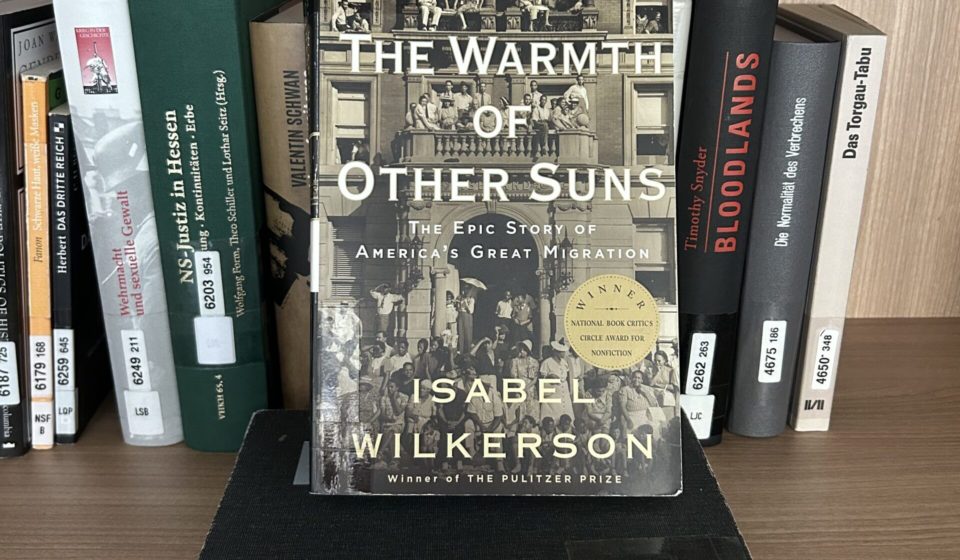

By Christoph Rass · Originally published on nghm.hypotheses.org
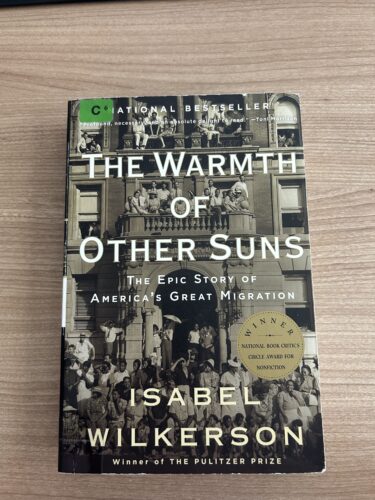
“Profound, necessary, and a delight to read”: With this verdict, Toni Morrison welcomed The Warmth of Other Suns by Isabel Wilkerson, the fifteenth title on the NGHM reading list and a book that is equally at home in the thematic field of ‘historians and narrative historiography’ as it is in historical migration research. Wilkerson tells the story of the Great Migration of the years between 1915 and 1970 not as economic history, but as a collective act of self-liberation.
Isabel Wilkerson, born in 1961, is the daughter of parents who had themselves come to Washington, D.C. during the Great Migration. She was the first Black woman to receive the Pulitzer Prize in journalism, in 1994 as Chicago Bureau Chief of the New York Times. Writing from this dual position — one of familial witness and journalistic precision — she chronicles a movement that encompassed around six million people and reshaped American postwar society. The Warmth of Other Suns is the result of fifteen years of research, interviews with more than twelve hundred migrants, and one decisive choice: not to tell the statistics, but to tell the people.

Three of them carry the book. Ida Mae Brandon Gladney leaves Mississippi in the late autumn of 1937; George Swanson Starling boards the Silver Meteor to New York in Eustis, Florida, on 14 April 1945; Robert Joseph Pershing Foster drives the long route from Monroe, Louisiana, to Los Angeles on Easter Monday 1953. Wilkerson follows their biographies from childhood in the South to the end of their lives in the cities of arrival. She interweaves these individual fates with broader historical and statistical contextualisation, but the weight remains with the people.
Therein lies precisely the argumentative thrust. The Great Migration had long been read as a reaction: to the mechanisation of the cotton harvest, to the demand of the war industry for labour — essentially, then, to economic push and pull factors. Wilkerson reverses the perspective. She does not ask what moved the people, but what they moved. Her protagonists are not economic reactive variables, but agents who made a decision — under the conditions of the Jim Crow regime, which Wilkerson reconstructs with precision in its racist contempt for human dignity. At the same time, she shows that this decision did not end at a railway station in the North. The second half of the book follows the three protagonists through Chicago, Harlem, and Los Angeles, through disappointments, modest advances, and family ruptures.
The book’s reception was exceptional. The Warmth of Other Suns won the National Book Critics Circle Award; Tom Brokaw called it “an epic for all Americans who want to understand the making of our modern nation”; David Levering Lewis, Jon Meacham, Gay Talese, and Cornel West praised the work effusively. David Oshinsky, writing in the New York Times Book Review, attributed a special status to the book: “[a] narrative epic rigorous enough to impress all but the crankiest of scholars, yet so immensely readable as to land the author a future place on Oprah’s couch.” In 2024, the newspaper placed the book at number two in its survey of the first twenty-five years of this century, making it the highest-ranked work of non-fiction on the list.
The objections appear in the very same review that confers this special status upon the book. Oshinsky concedes that historians might question Wilkerson’s approach because she favours “the migrants’ personal feelings over structural influences like the coming of the mechanical cotton picker.” He dismisses the objection in the same breath: Wilkerson knows the push and pull factors well; she has simply chosen to engage with them differently. More serious is what Oshinsky himself holds against her — namely, that she passes over Nicholas Lemann’s The Promised Land of 1991, that far darker assessment of the migration to Chicago, and that she contributes little to the subsequent generation beyond a generous enumeration of politicians, athletes, and musicians. The methodological objection deserves to be taken seriously. It is, at the same time, the mirror image of what Wilkerson has achieved: a history that does not dissolve the agency of its subjects into structural conditions.
This brings The Warmth of Other Suns close to a question that is central to the Collaborative Research Centre 1604 “Production of Migration”: Who produces migration? And how does this production relate to the actions of the migrants themselves? Wilkerson offers a clear answer: her protagonists are not the product of a regime, but those who subvert and even transform it. This question will return in a few weeks from a different perspective, when Gérard Noiriel’s The French Melting Pot is discussed on this list — a text that focuses more strongly on the state-driven production of migration categories.
Between the two approaches lies a methodological difference that continues to structure migration research to this day. Wilkerson demonstrates what narrative historiography can achieve when it directs attention not towards aggregates but towards individuals — and what it risks in doing so. Her book has shaped public perception of the Great Migration as a distinct historical phenomenon and continues to be widely read in schools and universities as an introductory text.
Whether the migration was worth it for the three protagonists is something Wilkerson addresses explicitly at the end. She does not answer the question with a thesis, however, but with three life histories. Reflection on that answer begins where our collective reading of such a book begins.
Students in Osnabrück will find Wilkerson’s The Warmth of Other Suns in the University Library, at the ‘Alte Münze’ location in the B-IMIS collection, under the shelf mark D5-4b10 4779-194 5 (OPAC), in the Vintage edition of 2011.
Isabel Wilkerson, The Warmth of Other Suns: The Epic Story of America’s Great Migration, New York: Random House 2010.
This post is part of the series NGHM reads, in which the 65 titles of the NGHM reading list are presented. The list can be explored as a knowledge graph.
Find the original post at NGHM liest | 15 | Wilkerson: The Warmth of Other Suns (2010) on nghm.hypotheses.org.
This post was automatically translated from the German original.