Research Revisited: Digital Exhibitions on the Hürtgen Forest Conflict Landscape

This post was automatically translated from the German original at
Research Revisited: Digitale Ausstellungen zur Konfliktlandschaft Hürtgenwald.
In the Research Revisited section, the NGHM team presents completed research projects and their results in an informal series. We begin with a retrospective look at digital exhibitions that we have developed in recent years in our projects at the intersection between academic research and Public History.
Between September 1944 and February 1945, the northern Eifel became the scene of heavy fighting between the Wehrmacht and the U.S. Army. The so-called “Battle of the Hürtgen Forest” cost thousands of soldiers their lives and left traces that remain visible today in the landscape and in regional memory culture. These traces, their transformations, and the often problematic interpretive patterns that surround them were at the centre of the research project “Learning Site ‘Battlefield’? New Didactics of a Conflict Landscape in the Hürtgen Forest”, led by Prof. Dr. Christoph Rass and funded by the Landschaftsverband Rheinland from 2020 to 2024.
This project has produced, among other things, digital exhibitions, three of which we would like to present again in this article. As project outcomes, they not only document historical events but also show how sites of violence become memory landscapes and what interpretive struggles are fought over them.
Omeka as a Tool for Digital Public History
The exhibitions were created using Omeka, an open-source platform for digital collections and exhibitions. Omeka was developed by the Roy Rosenzweig Center for History and New Media at George Mason University in Washington D.C. and has established itself in recent years as an important tool for museums, archives, and historical research projects.
At the Chair for Contemporary History and Historical Migration Research at the University of Osnabrück, we have been using Omeka in research and teaching since 2020. The software makes it possible to describe digital objects according to standardised metadata, organise them into collections, and develop narrative exhibitions from them. This is particularly valuable for working with students because they not only engage in source work but also learn to prepare historical knowledge for a broader public.
Three Exhibitions, Three Perspectives
Together with the Interdisciplinary Working Group on Conflict Landscapes (IAK) at the University of Osnabrück, Prof. Dr. Christoph Rass has researched the Hürtgen Forest conflict landscape over four years using methods from geoarchaeology, remote sensing, and historical approaches. The three exhibitions shown here focus on sites that are central to the region’s memory culture but are also problematic.
War Cemetery Hürtgen
The first exhibition is dedicated to the War Cemetery Hürtgen, which was opened in 1952 by Federal President Theodor Heuss. Today, 3,001 dead rest there, including 2,925 German soldiers. The exhibition shows that over 20 percent of those buried remained unknown and that most of the soldiers interred here were very young, many only 18 years old. Particularly curious was also the so-called cemetery dispute between the municipalities of Hürtgen and Vossenack over the establishment of the war cemeteries. The exhibition makes clear how complex and conflict-ridden the creation of such memorial sites was in the post-war period.
War Cemetery Vossenack
The second war cemetery in the region was established in 1952 on the strategically important “Hill 470”, after initially beginning with burials next to the municipal cemetery. Today, 2,367 Wehrmacht soldiers rest here. The exhibition documents not only the history of the site but also the continuous reburials of war dead there, which took place decades after the war’s end. In 1986, for example, 90 war dead were still transferred from Lich-Steinstraß to Vossenack because their original burial site had to make way for lignite mining. The exhibition makes clear that war cemeteries are not static places but are also subject to ongoing transformations.
Prisoner of War Camp Hollerath
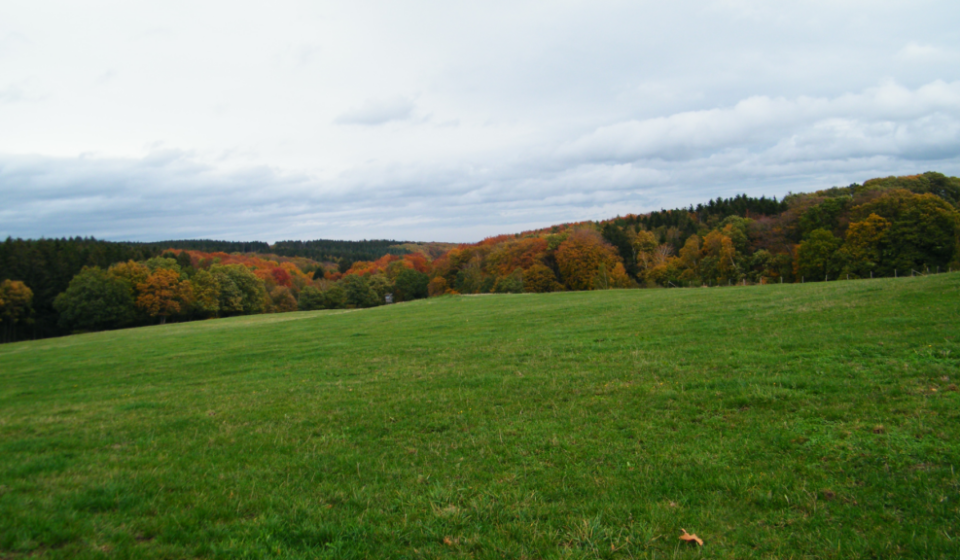
The third exhibition deals with a site that was almost forgotten for a long time. In the Schleiden district, at least 63 camps existed during the Second World War with over 6,500 interned prisoners of war and foreign civilian workers. One of these camps – for Soviet prisoners of war – was located in Hollerath. At the former site of this camp, nothing is visible at first glance that would recall the Second World War and Nazi rule: where the barbed-wire-enclosed accommodation barracks stood until the end of the war, there is now a pasture. However, the exhibition shows that traces of the camp and the Soviet prisoners of war interned there are still present in the soil. Using geoarchaeological methods, the IAK has made these invisible remains visible and documented them. The exhibition also addresses the lack of marking of the camp site in local memory culture and thus makes an important contribution to commemorating the victims of National Socialism.
Interdisciplinary Methods and Digital Mediation
This exhibition particularly well illustrates the methodological diversity of Osnabrück’s conflict landscape research. The IAK team has not only worked in archives but has also used magnetometry, ground-penetrating radar, LiDAR scanners, and 3D modelling. These methods make it possible, among other things, to detect traces in the soil that are no longer visible above ground. The digital exhibitions are also connected to other mediation formats: with Digiwalks that can be used on site, with 360-degree tours, and with 3D models of monuments and remains.
The exhibitions make clear how productive the combination of historical studies, archaeology, geophysics, and Digital Public History can be. They also show how important it is not only to research sites marked by violence but also to publicly address their history and their problematic interpretations.
Credits
The three exhibitions are the result of intensive teamwork. Under the leadership of Prof. Dr. Christoph Rass, the Interdisciplinary Working Group on Conflict Landscapes at the University of Osnabrück has conducted research in the region over four years. The project coordinator Mirjam Adam, M.Ed., implemented the exhibitions with the project team.
Special thanks are due to our sadly deceased colleague Frank Möller, whose well-founded texts formed the basis for the exhibitions on the war cemeteries of Vossenack and Hürtgen. Franz Albert Heinen was indispensable for the documentation of the former prisoner of war camp Hollerath with his fundamental research and valuable insights.
Numerous student assistants participated in the field research, data collection, and preparation of materials. Their participation and collaboration show how important the integration of research and teaching is for projects of this kind.
The three exhibitions are accessible at konfliktlandschaften.nghm-uos.de. They mark the beginning of a larger series of nine digital exhibitions on the Hürtgen Forest conflict landscape. The project impressively demonstrates how Digital Public History can contribute to developing critical perspectives on problematic memorial sites and making them accessible to a broader public.