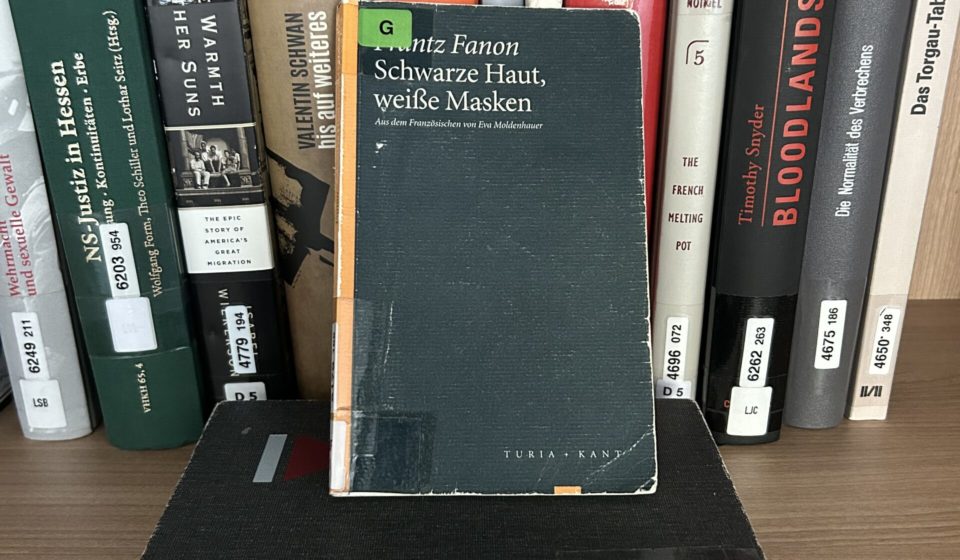

What does the racializing gaze do to those it falls upon — and how do colonial conditions become psychic structures? Frantz Fanon’s Black Skin, White Masks, the eleventh title on the NGHM reading list, this time drawn from the field of postcolonial theory and criticism, answers these questions with a book that interweaves psychiatry, philosophy, and anticolonial analysis in a manner that, three decades later, became the founding text of Postcolonial Studies.
At the time of writing, Frantz Omar Fanon was in his late twenties. Born in 1925 in Fort-de-France, Martinique, he had fought with the Forces françaises libres during the Second World War, subsequently studied medicine and philosophy in Lyon, and qualified as a psychiatrist in 1951. The manuscript from which Peau noire, masques blancs emerged was originally intended as a dissertation — the faculty of psychiatry rejected it as too political and methodologically unorthodox. For his medical degree, Fanon instead submitted a narrower, neurological study in 1951. The book was published in 1952 by Éditions du Seuil in Paris; in 1953, Fanon took up a senior position at the Blida-Joinville psychiatric clinic in Algeria, and from 1956 onwards he worked for the Algerian liberation front FLN, later also serving as its ambassador to Ghana. He died in the United States in 1961 of leukemia, aged thirty-six.
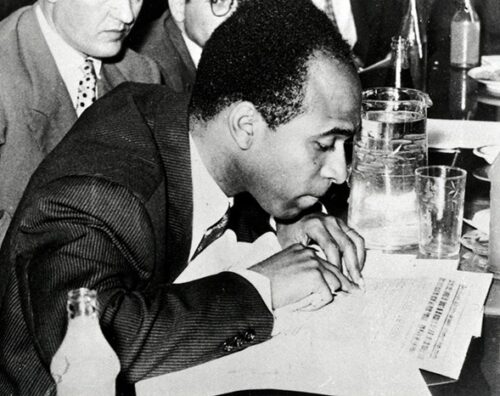
The book thus emerged at a point of transition: between academic training and anticolonial engagement, between clinic and manifesto.
Fanon’s argument begins with an observation that is simultaneously autoethnographic and clinical: in the colonial situation, Black people are confronted with a white ‘mask’ against which they are inevitably compelled to measure themselves. Racism appears here not as prejudice or a side effect, but as a constitutive, complementarily neurotic structure that pushes the colonized into a position of inferiority and the colonizers into one of superiority. This colonial situation resembles, in Fanon’s words, a ‘constellation of delirium.’ Proceeding from language and relations of recognition — the relationships between Black and white people, between women of color and white men, and vice versa — he elaborates an ‘inferiority complex’ that is to be read not in terms of individual psychology, but as an effect of the colonial order itself. In his theoretical engagement, he brings Marx, Hegel, Sartre, and the existentialists into dialogue with Freud, Jung, Adler, and Lacan; Lacan’s mirror stage and Sartre’s phenomenology of the gaze carry particular weight.
At the center stands the famous street scene from the chapter on the ‘lived experience of the Black man’: “Look, a N_!” […] “Mama, look, the N_ there, I’m scared!” In this scene, Fanon captures phenomenologically what his theoretical analysis unfolds structurally: the moment in which the racializing gaze of the other fixes one’s own existence from the outside. The final section turns to the question of recognition and liberation — while simultaneously distancing itself from a Négritude perceived as backward-looking.
The reception unfolded in waves. During the 1960s, in the context of leftist and anticolonial movements, Fanon was read intensively; the 1970s brought a decline in interest, before he was rediscovered from the 1980s onwards for the emerging field of Postcolonial Studies. Homi K. Bhabha’s preface “Remembering Fanon” to the 1986 English reissue is regarded as the key text of this rediscovery, effectively elevating Black Skin, White Masks to the status of a founding manifesto of Postcolonial Studies. Stuart Hall, Paul Gilroy, and Achille Mbembe have continued to engage with Fanon; Jean-Paul Sartre had already brought him to a wide audience early on, in his preface to The Wretched of the Earth. Criticism came from various directions: the historian Barbara Lüthi, then at the University of Cologne, argued at the Historikertag in 2016 that Fanon was “not necessarily helpful for an analysis of concrete historical constellations” — but could nonetheless sharpen one’s awareness of the epistemic dimension of colonial violence. From a liberal-conservative perspective, Fanon continues to be addressed as a problematic point of reference, particularly with regard to the argument developed in The Wretched of the Earth that National Socialism had applied colonial methods of violence to ‘white’ people — a thought already formulated by Aimé Césaire in Discours sur le colonialisme (1950).
What endures is the conceptual interweaving itself: racism is grasped as a structure that profoundly shapes subject formation, not as an attitude that could be corrected. Fanon’s categories — mask, gaze, recognition, the Manichaeism of the colonial world — are firmly established in racism studies, migration research, and critical theory. On the NGHM Blog, Fanon is explicitly named in the introduction to the reading list as one of those authors whose writings are only comprehensible against the background of his experiences as a psychiatrist and anticolonial activist, and he is assigned to the postcolonial tradition that our research group seeks to bring into dialogue with Holocaust and migration studies. When Joan Wallach Scott follows later in this series as an author who methodologically reframes the question of category and representation, it will become apparent wherein Fanon’s analysis consists: in showing how the gaze of the other becomes one’s own inner structure — even before the categories in which that gaze operates have been historically unpacked.
The temporal displacement of the German reception remains noteworthy: between the French original and the first German translation by Eva Moldenhauer (1980) lie almost three decades, nearly two decades after Fanon’s death — a delay that itself belongs to the history of reception.
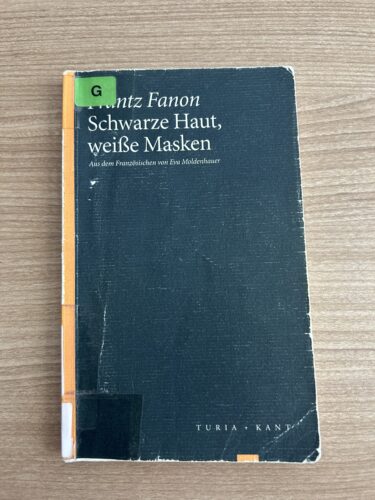
Students in Osnabrück will find Fanon’s Black Skin, White Masks in the Bereichsbibliothek Alte Münze under the shelf mark NSF B 6179-168 8 (OPAC).
Frantz Fanon (1925–1961), Schwarze Haut, weiße Masken, Frankfurt am Main: Syndikat 1980.
This post is part of the series NGHM liest [NGHM Reads], in which the 65 titles of the NGHM reading list are presented. The list can be explored as a knowledge graph.
This post was automatically translated from the German original at
NGHM liest | 11 | Frantz Fanon: Schwarze Haut, weiße Masken (1980).