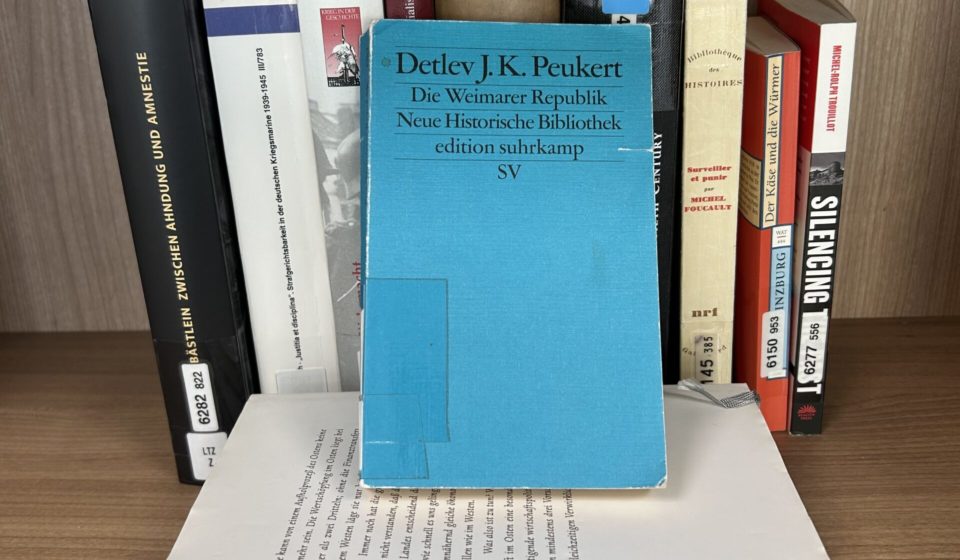

Was Weimar a failed democracy, or the culmination of an era that delegitimized itself? Detlev Peukert’s Die Weimarer Republik. Krisenjahre der klassischen Moderne [The Weimar Republic: The Crisis Years of Classical Modernity] – the tenth title on the NGHM reading list from the field of modern German history – shifted the perspective on the first German democracy upon its publication in 1987, moving away from a mere interpretation as the prehistory of National Socialism. In its place emerged the social and cultural history of a society in which modernization itself developed pathogenic characteristics.
When the book was published by Suhrkamp Verlag, Peukert was a research assistant at the University of Essen, where he had worked under Lutz Niethammer since 1978. In 1988 he took over the directorship of the Forschungsstelle für die Geschichte des Nationalsozialismus [Research Centre for the History of National Socialism] in Hamburg; a year later he was appointed professor at Essen. He died in 1990, not yet 40 years old, from complications related to AIDS. He had completed his doctorate in 1979 under Hans Mommsen on the KPD in the resistance, and his habilitation in 1984 under Niethammer with a study on the history of German youth welfare. A member of the DKP until 1978, and thereafter of the SPD, Peukert belonged to that generation of West German historians who began to pose the relationship between scholarship and the Holocaust as a question of modernity itself. Coming from the history of everyday life (Alltagsgeschichte), he developed an approach that rendered social discipline, the welfare state, and exclusion legible as facets of the same process.
Peukert reads the Republic not as a narrative of decline, but as the culmination and simultaneously the crisis phase of ‘Classical Modernity’, whose periodization he deliberately does not align with the political period 1918–1933: for him it extends from the turn of the century to around 1930. In this interpretation, the Weimar Republic stands under the sign of a general crisis of this transformation. The era is characterized not by tentative but by accelerated change: the welfare state, mass culture, gender orders, and political conflicts unfold simultaneously and mutually delegitimize one another. The Republic was, as Peukert argues, ultimately brought to failure by particular forces, without this failure having been necessarily predetermined.
Methodologically, Peukert combines structural political analysis with the history of social policy, everyday life, and culture. He places particular emphasis on the ‘middle years’ of the Republic, roughly between 1924 and 1929: in these years, Peukert discerns both the vulnerability to crisis and the resilience of the polity simultaneously. One of his characterizations of Weimar culture – which describes the sophisticated and breathless exploration of all the possibilities of modernity in a movement in which stylistic forms are tested and almost simultaneously discarded again – has become a formula that has transcended the book itself: Norbert Lammert drew upon it in his keynote address to the Shakespeare-Gesellschaft [Shakespeare Society] in 2009 in Weimar.
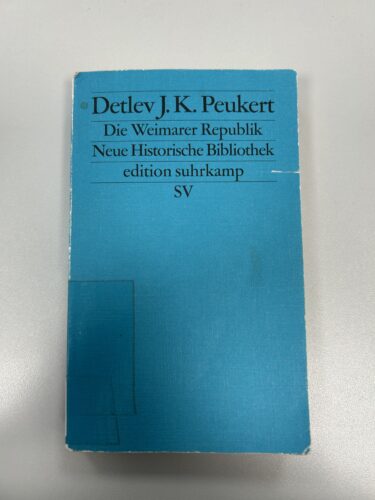
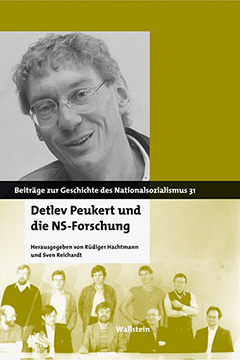
The book remains a standard work to this day. Helmut Walser Smith, in a review of the collected volume Detlev Peukert und die NS-Forschung [Detlev Peukert and NS Research] (2015), edited by Rüdiger Hachtmann and Sven Reichardt, recognizes Peukert as one of the most productive German postwar historians and the Weimar book as a remarkable synthesis. However, criticism also set in early. Smith and other contributors to the volume problematize the concept of ‘Classical Modernity’ as too vague. In an equally fundamental critique, Frank Bajohr argues in his contribution that Peukert worked almost entirely without an international, comparative perspective, and that the relationship to antisemitism and the concrete practice of NS policy remained underexplored in his work. Moritz Föllmer and Rüdiger Graf approached the matter from a different angle: they interrogated the close linkage of ‘Weimar’ and ‘crisis’ as a historiographical narrative, the results of which appeared in 2005 in the collected volume Die ›Krise‹ der Weimarer Republik [The ‘Crisis’ of the Weimar Republic]. Christoph Thonfeld situates the study historiographically in 2016 in Krisenjahre revisited: it had rapidly become formative for a social and cultural historical approach to the Weimar Republic, but had, as his assessment after roughly two decades of research concludes, ultimately raised more questions than it had answered.
For the incongruence between Peukert’s periodization of Classical Modernity and the political period 1918–1933 is not a flaw in the book, but its analytical program. Those who do not read the Republic backwards from 1933, but instead situate it within a longer arc of ambivalent, destructively pathogenic modernization, gain sight of lines of conflict that would disappear in a narrative of decline. Peukert’s Weimar is a society that cannot come to terms with its own modernity, because it experiences too much of it simultaneously.
Those who, in the earlier contributions to this series, follow Foucault’s argument that modern power operates productively – that is, produces subjects, knowledge, and categories – can understand Peukert’s approach as a contemporary historical application of that argument: the welfare state and social discipline, care and exclusion, then appear in Classical Modernity not as opposites, but as two sides of the same process.
Later in this series, Ulrich Herbert’s Das Dritte Reich [The Third Reich] will be discussed – a work that channels Peukert’s question about modernity as a condition of National Socialism into different methodological directions. At the same time, a secondary strand of his work can be interpreted as suggesting that the question of the dark sides of modernity was not, for Peukert, an exclusively German one: between 1984 and 1987 he published several studies on the history of Latin America, including a contribution in 1986 – published under the Hispanicized form of his given name, Detlev Julio K. Peukert – in the Jahrbuch für Geschichte Lateinamerikas [Yearbook for the History of Latin America], a Spanish-language article on the repeated offers by the Dominican Republic to annex itself to the United States in the nineteenth century.
Students at Osnabrück will find Peukert’s Die Weimarer Republik in the Bibliothek Alte Münze [Old Mint Library] under the shelf mark LQO 6209-598 5 (OPAC).
Detlev Peukert (1950–1990), Die Weimarer Republik. Krisenjahre der klassischen Moderne, Frankfurt am Main: Suhrkamp 1987.
This post is part of the series NGHM liest [NGHM Reads], in which the 65 titles on the NGHM reading list are presented. The list can be explored as a knowledge graph.
This post was automatically translated from the German original at
NGHM liest | 10 | Detlev Peukert: Die Weimarer Republik (1987).