Nachlese | Neuenhaus 2026 | A Handbook for the Region

By Christoph Rass · Originally published on nghm.hypotheses.org
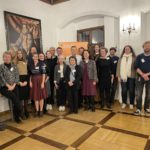
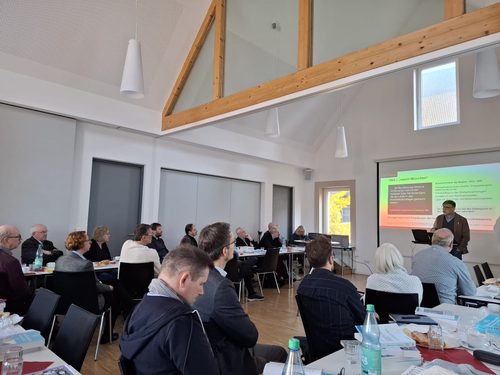
On 6 November 2026, the Arbeitskreis Geschichte Emsland | Bentheim [Working Group on the History of Emsland and Bentheim] convened at the parish hall »Die Brücke« of the Evangelical-Reformed congregation in Neuenhaus. The agenda included the future of regional history journals, a report on the handbook »Das Emsland in der NS-Zeit« [Emsland in the Nazi Era], and a lengthy series of current projects from the region, among them the new initiative on the moorland landscapes of Emsland, conducted jointly by the University of Osnabrück and the Emsland Moormuseum.
The Working Group and Its Programme
The working group brings together archivists, staff from museums and memorial sites, local historians, and academic historians from universities who work on the history of Emsland and the County of Bentheim. It meets on behalf of the Emsländische Landschaft for both districts; the session was convened and chaired by Dr. Thomas Brakmann of the Lower Saxony State Archive, Osnabrück Division. The meeting in Neuenhaus was designed, as the invitation stated, to foster shared exchange, generate new impulses, and take stock of current projects; accordingly, a substantial portion of the day was devoted to short presentations by participants, ranging from archaeological excavations in Lingen-Bramsche and the digitization of prisoner personnel files from the Emsland camps to a history of Papenburg told through biographical portraits.
The opening contribution came from Prof. Dr. Dietmar von Reeken (University of Oldenburg), who presented a survey of the problem under the title »Regionalgeschichtliche Zeitschriften: Vergangenheit, Gegenwart und mögliche Zukunft?« [Regional History Journals: Past, Present, and Possible Future?]. The question concerns the medium through which regional history has built its readership across generations. In Neuenhaus it took on an entirely practical dimension when the editors of the regional yearbooks presented their new volumes during the project round. Von Reeken also drew on his own extensive experience: he has co-edited the Niedersächsisches Jahrbuch für Landesgeschichte [Lower Saxon Yearbook for Regional History] since 2014 and has repeatedly engaged with regional periodicals both as historical sources and as sites of historical culture, most recently with a contribution on »200 Jahre Oldenburgischer Hauskalender« [200 Years of the Oldenburg Household Almanac] (2026) and previously with the question of whether modern popular almanacs can serve as historical sources (2018).
Among the project presentations was a new initiative by the Research Group on Contemporary History and Historical Migration Studies: »Moorlandschaften als Interventionsräume. Sozio-ökologische Transformation und Paradigmenwechsel im Emsland (1945–2025)« [Moorland Landscapes as Spaces of Intervention: Socio-Ecological Transformation and Paradigm Shift in Emsland (1945–2025)], conducted jointly by the University of Osnabrück and the Emsland Moormuseum in Geeste under the direction of Dr. Tanja Hasselberg, funded through the Pro*Niedersachsen programme, and carried out by Dr. Michael Schmidt. The project focuses on the Bourtanger Moor, which underwent two fundamental transformations during the twentieth century: from moorland colonization, which the Emsland Plan after 1950 pursued on a massive scale in order to maximize agricultural development, to peatland conservation, rewetting, and climate protection, for which the Lower Saxon Moorland Conservation Programme of 1981 marked an institutional turning point. This twofold transformation gives rise to the project’s central question: under what conditions can democratic societies alter established development paths and achieve a paradigm shift? To answer it, the project combines the model of path dependency with the concept of intervention landscapes, developed by Thomas Bohn for the Pripyat Marshes and thus for an authoritarian planning regime, as well as with the concept of conflict landscapes elaborated by the Interdisciplinary Research Group on Conflict Landscapes in Osnabrück in relation to sites shaped by violence. Governance and negotiation thus become analytically accessible in their temporal interplay. The investigation is made possible not least by the holdings secured for the Moormuseum by the predecessor project on the Richard Collection, as well as by the now accessible records of the Emsland GmbH held in the district archive.
The Handbook »Das Emsland in der NS-Zeit«
The second presentation of the morning was devoted to the handbook that the Emsland district authority and the Chair of Contemporary History and Historical Migration Studies at the University of Osnabrück have been developing jointly since 2024. Christoph Rass opened with a quotation from the early phase of the political debate over the »Emsland camps«: in autumn 1966, the ARD broadcast an episode of the magazine programme »report München« on the »concentration camp in Emsland«, in which the mayor of Papenburg declared that the population had »nothing to do« with the inmates of the camps or with those who had brought them there. Sarah Andrees used this statement in 2023 in Emsländische Geschichte as the starting point for an analysis of school chronicles from the region, in which teachers had recorded, during the years of National Socialist rule, observations such as the sight of criminal prisoners working on road construction, prisoners of war employed as harvest helpers on farms, and school excursions to the camps. The camps were present in the everyday life of the region; the population accommodated itself to them and even profited from them.
Between these two findings lies a question that the handbook sets out to pursue. After 1945, Emsland long described itself as a stage upon which the state and the party had imposed a system of domination from outside; the handbook treats this narrative as an object of inquiry and examines whether the region was not rather a space of action in which the National Socialist movement was also able to mobilize locally. It therefore asks who exercised power in Emsland, who participated and profited, who was excluded from the so-called Volksgemeinschaft [people’s community], persecuted, and murdered, and how the region subsequently spoke about these events. In this respect, the project stands in the tradition established by Martin Broszat with »Bayern in der NS-Zeit« [Bavaria in the Nazi Era] in the late 1970s, as well as in more recent scholarship on the Volksgemeinschaft as social practice.
The project began with a stocktaking exercise: in 2022, Natalia Wollny produced a bibliographical study on behalf of the district authority; the online bibliography she compiled together with Helmut Lensing has been accessible via the Esterwegen Memorial Site since 2023. The state of research reflected therein reveals a continuing imbalance. The Emsland camps have been well documented since the volumes by Erich Kosthorst and Bernd Walter, while only a handful of studies exist on civilian forced labor on farms and in enterprises, the persecution of Sinti and Roma, Jehovah’s Witnesses, and the sick, or on the economy, schools, the press, and local administration.
Since then, the literature base has grown considerably further through new publications and additional research: the handbook’s literature database now comprises more than 1,200 titles, from which a digital library has been created for the authors and contributors. Research itself has also moved forward noticeably, for example in 2022 with the work of David Reinicke on the so-called ‘Moor-SA’ and of Ann Katrin Düben on the cultures of remembrance surrounding the camps, and in 2025 with the volume Lingen im Nationalsozialismus edited by Dietmar von Reeken, on which the handbook also draws, and with Martin Koers’s study of Soviet prisoners of war in the camps of the Emsland and Grafschaft Bentheim.
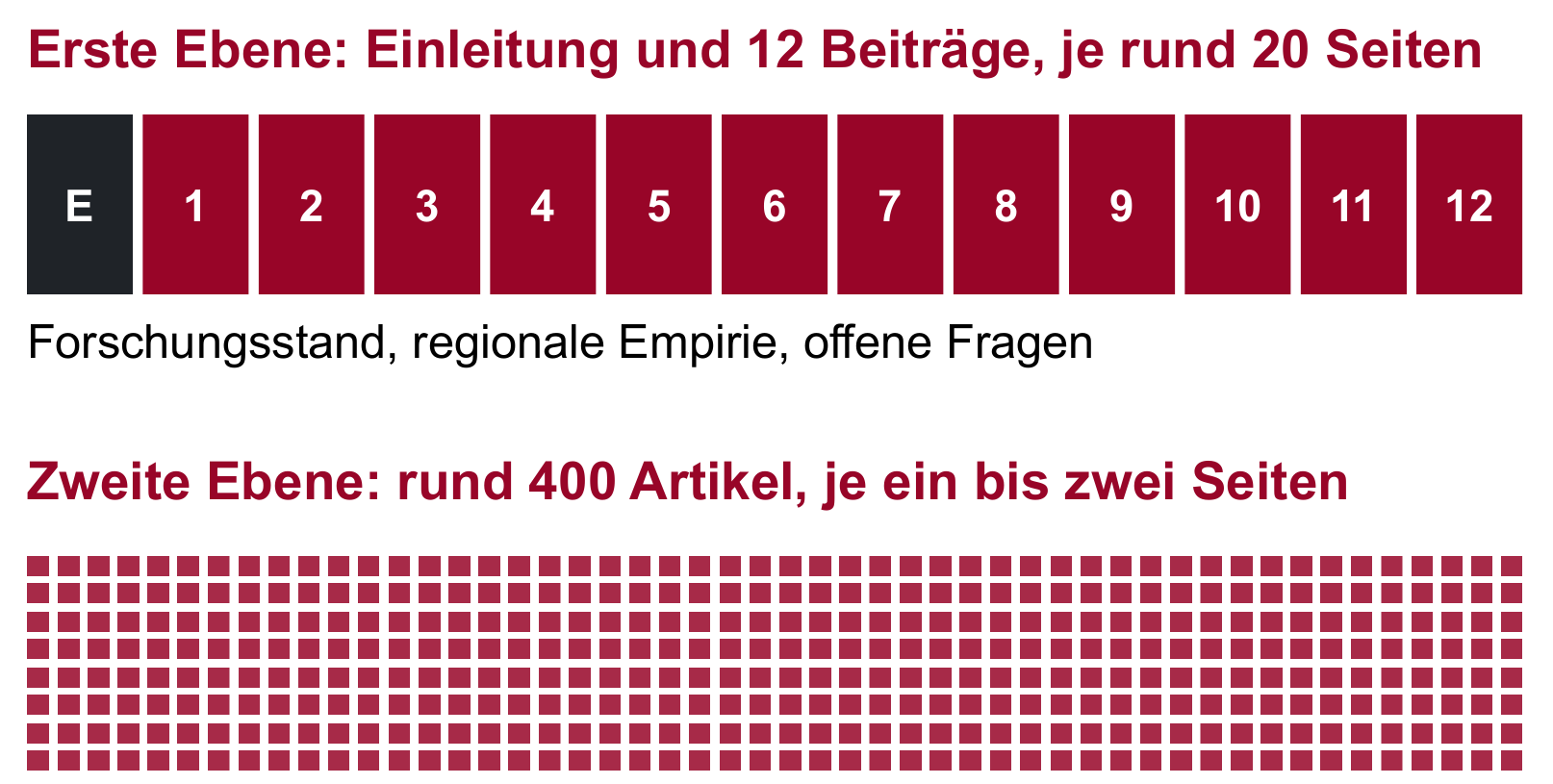
The handbook is structured on two levels. An introduction and twelve essays consolidate the state of research, provide foundational accounts, and identify desiderata as well as future research perspectives. Eleven of the essays guide the reader through four sections covering National Socialist rule in the Emsland and its aftermath. The first section addresses the imposition of that rule and the concept of the ‘Volksgemeinschaft’ [people’s community]; the second examines the spaces of terror and exploitation, which, alongside the camp system, include peatland development, settlement, militarization, and forced labor; the third deals with persecution and society; and the fourth covers the end of the war, Displaced Persons, and memory. The twelfth essay opens up the archives, libraries, and historical sites of the region. Alongside these essays stand approximately 400 short articles on places, persons, institutions, and events, assigned to the essays and cross-referenced with one another, so that readers in Werlte, Freren, or Lathen can find a subject close to them.
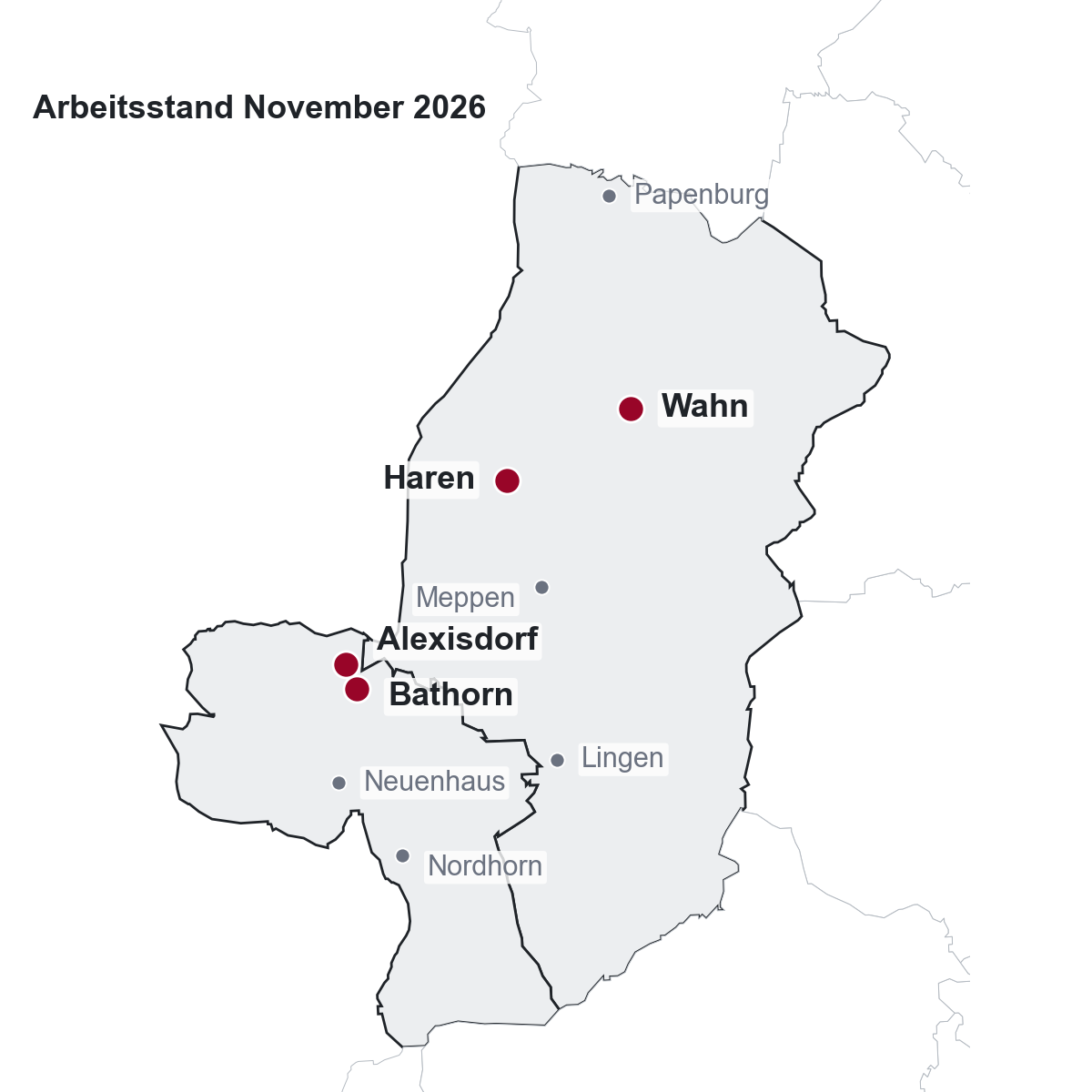
How these two levels interlock was illustrated in the presentation through three examples: the village of Wahn on the Hümmling, which had to make way for the expansion of the Krupp firing range by 1943; the camps Bathorn and Alexisdorf near Neuenhaus, whose prisoners of war worked on farms and in businesses in the surrounding area; and Haren, which the British military government had cleared for Polish Displaced Persons in May 1945 and which bore the name Maczków until 1948.
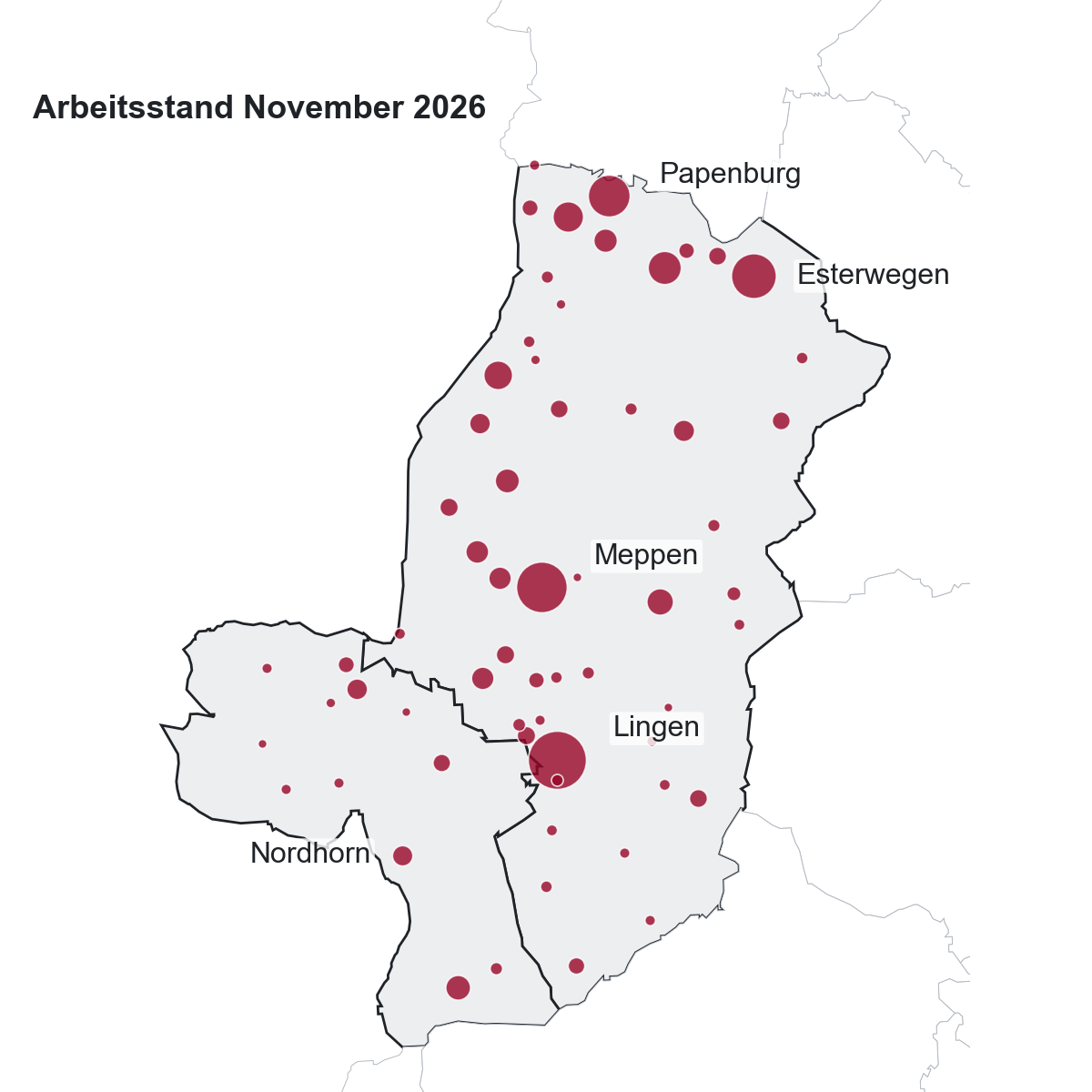
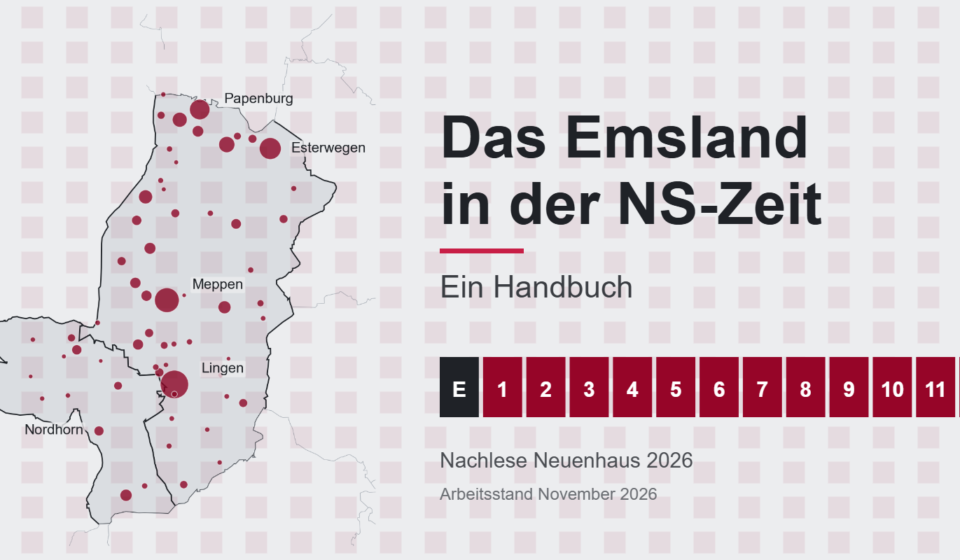
All articles relating to specific places are georeferenced. A first map thus makes visible where research and archival records are concentrated — in the towns with their archives and at the major camp sites — and where the region still shows gaps.
The locations appearing in the articles also demonstrate that this history does not end at the district boundary: it leads to Osnabrück and Berlin, to Sachsenhausen, Auschwitz, and Riga.
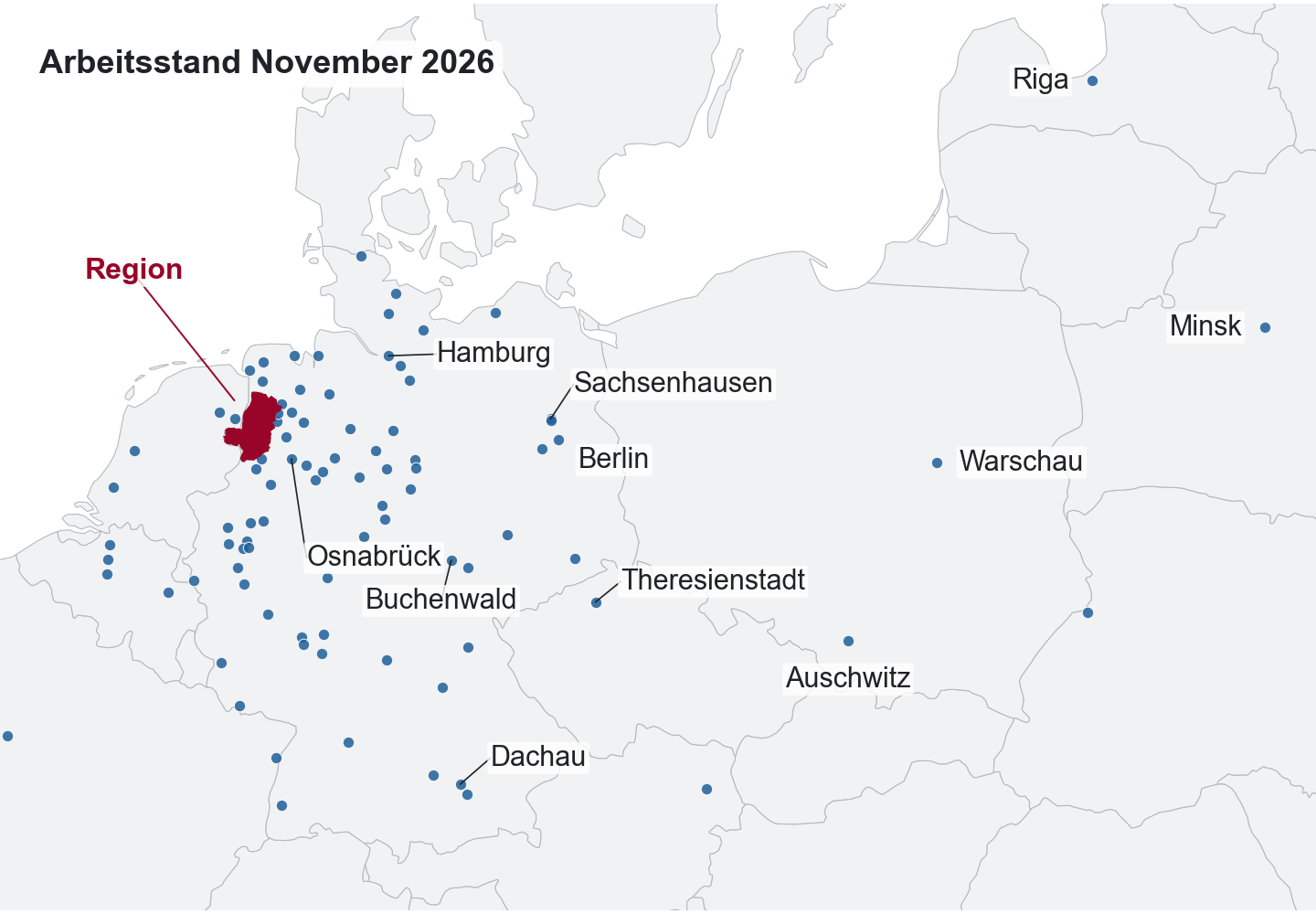
For the editorial team, the map serves as a working tool; in the finished handbook it will become a means of access, since a website will accompany the book, opening up essays and articles through indexes, chapters, and a map, and thereby addressing schools and educational outreach as well. The handbook is being written by a team drawn from memorial sites, archives, museums, and universities, combining local knowledge with research expertise; it is expected to be published in 2028.
The handbook understands itself as a stocktaking of research to date and as a starting point for further work towards a critical history of the Emsland during the National Socialist period. It consolidates what is known and names what remains open. For this it depends on archives, memorial sites, local history associations, and schools — that is, precisely the circle that gathered in Neuenhaus. We are glad to incorporate the suggestions and findings that emerged from the discussion into the ongoing work.
At the Günter Frank Haus
The afternoon program was devoted to the Günter Frank Haus, immediately adjacent to the conference venue, whose exhibition was guided by Christa Pfeifer of the Förderverein Günter Frank Haus e.V. The house grew out of an initiative from 2012 that sought to commemorate the deportation of the last Jewish men and women from Neuenhaus. Its name honors Günter Frank, the only Jewish child to grow up in Neuenhaus during the National Socialist period; he was murdered in Auschwitz in 1944 at the age of 16. The exhibition recounts the history of the Jewish families in Neuenhaus from the seventeenth century onwards, their exclusion, persecution, and annihilation, as well as the conduct of the non-Jewish neighborhood, ranging from accommodation to resistance. Students from the University of Osnabrück had already visited the house on 1 July 2026 as part of an excursion led by Dr. Sebastian Musch, which also took them to the Jewish cemetery in Neuenhaus (NGHM-Tracker 8/26).
Our thanks go to Dr. Thomas Brakmann for the invitation and the organization of the workshop, to the Emsländische Landschaft for their hospitality, and to the Landkreis Emsland, which initiated and funded the handbook. We are especially grateful to Dr. Philipp Scheid, head of the district’s cultural affairs department and our partner in this project.
Find the original post at Nachlese | Neuenhaus 2026 | Ein Handbuch für die Region on nghm.hypotheses.org.
This post was automatically translated from the German original.