
This post was automatically translated from the German original at
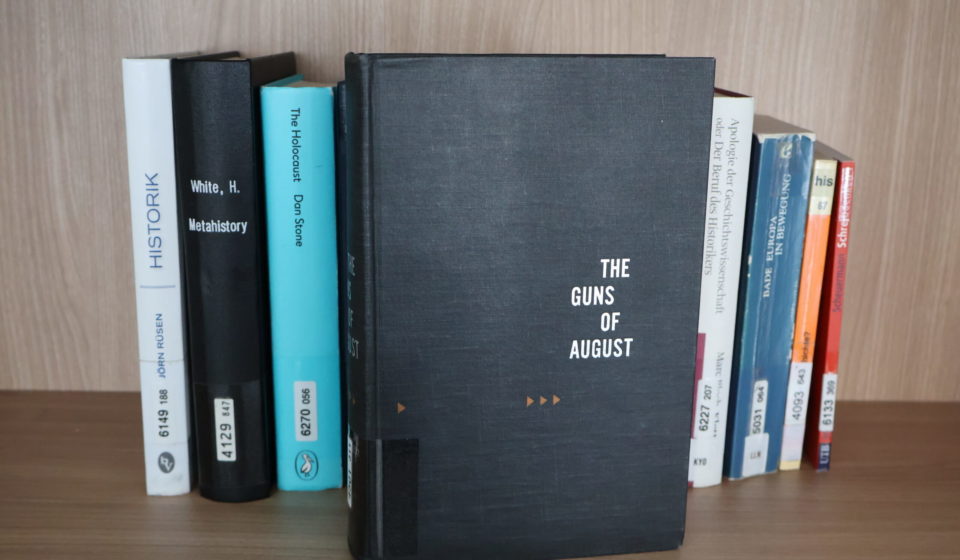
NGHM liest | Barbara W. Tuchman: The Guns of August (1962).
Can a history book prevent a nuclear war? Barbara W. Tuchman’s The Guns of August, the fourth title on the NGHM reading list, selected from the field of women historians and narrative historiography, recounts the first thirty days of the First World War as a story of miscalculations, institutional inertia, and the self-perpetuating momentum of military plans. The fact that John F. Kennedy read the book a few months before the Cuban Missile Crisis makes it a singular case: a historical text whose political impact can be precisely dated.
May 1910, London: the kings and heads of state of Europe gather for the funeral of Edward VII. With this scene Tuchman opens her book: a final group portrait of the old order, before the very alliances that held that order together would drag Europe into war four years later. From this symbolic endpoint, the text guides the reader through the war plans of the great powers: the Schlieffen Plan, the French Plan XVII, the Russian mobilization, the dispatch of the British Expeditionary Forces. Tuchman then narrates August 1914 itself—the fighting around Liège, the frontier battles, the destruction of Leuven, the pursuit of the warships Goeben and Breslau in the Mediterranean, Tannenberg on the Eastern Front—up to the First Battle of the Marne. The book concludes with the argument that these thirty days determined the war of attrition and, with it, the subsequent course of the century.
Tuchman did not come from the academy. She came from journalism and a politically connected family that was itself part of the history she described. Born in 1912 into an influential New York family (her grandfather Henry Morgenthau Sr. was U.S. Ambassador to the Ottoman Empire; her father Maurice Wertheim was a banker and owner of The Nation), she earned a bachelor’s degree in History and Literature from Radcliffe College in 1933, worked as a foreign correspondent during the Spanish Civil War and, during the Second World War, at the Office of War Information. She never completed a doctoral degree, something she later described as a liberation from academic constraints. Instead, she deliberately pursued a literary approach to historiography, conducting research at the New York Public Library, the Library of Congress, the British Public Record Office, and the Bibliothèque Nationale, and touring the battlefields of Belgium and France in a rented Renault. The Guns of August was published in late January 1962, at the height of the Cold War.
Its political impact came a few months later. Kennedy, who had read the book before the Cuban Missile Crisis, repeatedly invoked Tuchman’s warning about the escalatory dynamics of military mobilization. He told his brother Bobby: “I am not going to follow a course which will allow anyone to write a comparable book about this time [and call it] The Missiles of October.” British Prime Minister Harold Macmillan, who had also been profoundly influenced by the book, likewise resisted American pressure for an immediate NATO alert in October 1962. Graham Allison later analyzed this influence in Essence of Decision.
Academic reception was divided. The book won the 1963 Pulitzer Prize for General Nonfiction and became a bestseller; in 1998 the Modern Library included it in its list of the 100 Best Nonfiction works of the twentieth century. Several historians, however, criticized its evidentiary foundations: Ulrich Trumpener, writing in the Journal of Modern History, faulted the inadequate use of primary sources and judged that “as a scholarly contribution to the history of World War I” the book was “less satisfactory”; Tuchman had, he argued, ignored the authoritative works on diplomatic history by Sidney Fay, Luigi Albertini, Pierre Renouvin, and others, relying instead on general staff histories and controversial memoirs. Michael Gordon (New York Times Book Review, 1963) accused her of anti-German bias, arguing that the book gave the impression that the war was “half the result of the fecklessness of the Kaiser and half the result of the unbelievably vicious character of the German people.” Samuel R. Williamson Jr., writing in the Sewanee Review, found the analysis of civil-military relations and alliance structures wanting. Sidney Fay summed up the tension: Tuchman had misrepresented history, yet historians would have to write as she did, or they would be “out of business.”
Fay’s dictum encapsulates the productive tension that makes the book relevant to the reading list. The Guns of August is an ideal-typical case study in the tension between narrative accessibility and scholarly complexity: selective use of sources, deterministic assumptions about causality, and national stereotypes on the one hand; on the other, a text that reached a mass audience, influenced political decisions, and shaped a generation of popular historians—among them Margaret MacMillan, who wrote in 2014 that reading Tuchman’s narrative had been like watching history go “from black and white to Technicolor.”
Those who have taken seriously Carr’s argument from the first entry in this series—that historians do not collect facts but select them—will find in Tuchman a case that simultaneously confirms and tests Carr’s thesis: Tuchman’s selection, the focus on the Western Front, the absence of the Serbian-Austrian theater of war, and the dramatization of individual moments of decision not only shaped a narrative but forged a political instrument. The fact that Kennedy derived from this narrative a maxim for action during the Cuban Missile Crisis demonstrates that narrative historiography can exert genuine political relevance, and that the question of which past is narrated has consequences for the present that reach far beyond academic debate. Later in this series, Eric Hobsbawm’s The Age of Extremes will provide the analytical framework for the “short twentieth century” that begins, in Tuchman’s telling, with those thirty days in August.
One detail that Tuchman did not disclose until decades after publication remains a kind of footnote to her own method: as a two-year-old child she was aboard an Italian passenger steamer in the Mediterranean in August 1914, a vessel that witnessed the pursuit of the Goeben and Breslau—an episode she described in the book without identifying herself as an eyewitness.
Students at Osnabrück will find Tuchman’s The Guns of August in the B-Magazin under the shelf mark 4501-311 7 (OPAC).
Barbara W. Tuchman (1912–1989), The Guns of August, New York: Macmillan 1962.
This post is part of the series NGHM liest [NGHM Reads], in which the 65 titles of the NGHM reading list are presented. The list can be explored as a knowledge graph.