

This post was automatically translated from the German original at
NGHM-Tracker (5/26).
The monthly newsletter of the Working Group on Contemporary History and Historical Migration Research at the University of Osnabrück
By Benjamin Look & Jessica Wehner
April brought a remarkable density of impulses, ranging from Florence to Osnabrück, touching on fundamental questions in historical scholarship. With the new series “NGHM reads,” the team opened two windows onto historical theory and perpetrator research. What holds the month together is a shared willingness not to sidestep uncomfortable and open questions — in research, in teaching, and in dialogue.
Our April edition of the newsletter reports on the team’s wide-ranging activities.
Insights
From 23 to 24 April 2026, Christoph Rass and Sebastian Huhn participated in the conference of the InechO project (International Organizations and their European Consequences and Hidden Outcomes) at the Alcide De Gasperi Research Centre of the European University Institute in Florence. The project, developed by Kiran Klaus Patel and his team at LMU Munich, examines the afterlife of dissolved international organizations.
Christoph Rass and Sebastian Huhn presented a paper produced within the framework of the CRC 1604 “Production of Migration” that examines the dissolution of the International Refugee Organization (IRO, 1946–1952). The IRO was a singular institution insofar as it united legal protection, material welfare, and the resettlement of Displaced Persons under a single institutional roof. Its end followed neither the model of an orderly succession nor that of a straightforward dissolution. Sebastian Huhn and Christoph Rass propose the analytical concept of “functional disaggregation” to describe this process: the deliberate splitting of an integrated mandate across several successor organizations, each of which inherited specific functional components while institutional continuity was simultaneously denied. UNHCR took on legal protection with a minimal budget; the well-resourced ICEM — today’s IOM — inherited the operational transport apparatus along with twelve IRO ships. This process was accompanied by a double amnesia: both successor organizations distanced themselves from their IRO origins in carefully curated archives.
The paper’s discussion by Jessica Reinisch (Birkbeck, University of London) proved particularly productive: she pointed out that the pattern described characterizes not only the end but already the beginning of the IRO — UNRRA, too, was an integrated organization whose dissolution distributed functions unequally among successors. This observation points to a longer chain of international refugee organizations dating back to the 1920s and suggests that functional disaggregation does not describe a singular dissolution event, but rather a recurring mode in which the international community has repeatedly reorganized its response to violence-induced mobility. The paper will appear as a contribution in the planned edited volume of the InechO project.
The journey on 30 April did not take quite so far afield:
On that day, the opening of the digital exhibition on the largest old-age home for Displaced Persons took place in the assembly hall of the Lothar-Meyer-Gymnasium (LMG) in Varel. This home existed between 1950 and 1959 on the grounds of a former Wehrmacht barracks in the Lower Saxon town of Varel. The exhibition project emerged from an unusual collaboration: Sebastian Huhn (NGHM, University of Osnabrück) and Christian Lütje (LMG Varel) brought together university students and school pupils over two years in a joint research and exhibition project. The students from the Department of History at the University of Osnabrück explored this barely researched topic on the basis of national and international archival sources, while the school pupils developed biographical sketches of individual residents — among them victims of National Socialism, forced laborers, and refugees from Stalinism from at least thirteen countries. The home, which housed up to 1,000 people at any one time, stands as an exemplary case of a largely forgotten chapter in German and European postwar history: the early Federal Republic’s treatment of those Displaced Persons for whom resettlement had not been achieved.
Sebastian Huhn opened the evening with an introduction to the historical context: from the situation of the more than seven million Displaced Persons after the end of the war, through the work of the International Refugee Organization, to the transfer of responsibility for care to the early Federal Republic — and to the question of what its treatment of the home’s residents reveals about the social fabric of that era. From the Osnabrück team, Anna Louisa Asbrock, Timo Diener, Dirk Hobein, Lea Horstmann, Johannes Pufahl, Jannik Singer, and Hannah Spille also participated, offering the very interested guests insights into the exhibition. The vernissage attracted considerable public interest; the Nordwest-Zeitung also reported on the event.
The exhibition thus complements the extensive exhibition program of the Professorship for Contemporary History and Historical Migration Research. Further exhibitions on the following topics are also available:
- War Cemetery Hürtgen
- War Cemetery Vossenack
- Prisoner of War Camp Hollerath
- ‘Lager II Aschendorfermoor’
- ‘Kriegsgräberstätte’ Dalum
- The Camp System in the Emsland
- Maly Trascjanec: The Perpetrators
- Maly Trascjanec: The Culture of Remembrance
- Maly Trascjanec: Transformations of a Site of Extermination
- Path of Remembrance I. The Disenfranchisement in Vienna and Deportation to the East
- Path of Remembrance II. The Persecution and Extermination at Maly Trascjanec
- Path of Remembrance III. Commemoration at Maly Trascjanec
- Osnabrück in the First World War
- Osnabrück’s “Papenhütte”
- „Arrival Quarter Weidenstraße? A Contribution to Osnabrück’s History of Migration”
- The University of Osnabrück – Founding and Early Years
- The Lohstraße – Urban History Reflected in a Street
Since the beginning of April 2026, two international visiting scholars have been enriching the research group of Prof. Dr. Christoph Rass at the Institute for Migration Research and Intercultural Studies (IMIS) at the University of Osnabrück.
Matti Tapio Välimäki from the University of Helsinki and Morten Baarvig Thomsen from the University of Southern Denmark brought different national perspectives and historical periods to the table – and yet met on a shared analytical terrain: the state regulation of movement, residence, and expulsion. At the center of Välimäki’s research was the concept of the “Non-Entry Regime” at Finland’s eastern border. His argument was historically pointed: the much-discussed border closures of the 2020s represented less a rupture than the restoration of a decades-long, administratively silent practice that had shaped the Finnish-Soviet border relationship since the Cold War. Apparent crises – from Cold War defectors to recent “instrumentalization episodes” – thus appeared as moments in which an established consensus briefly became visible. Baarvig Thomsen, a doctoral candidate at the University of Southern Denmark, examines in his dissertation the approximately 34,000 so-called “non-German” Displaced Persons who passed through Danish refugee camps between 1945 and 1953. Rather than describing administrative structures from above, he inquired into the everyday processes of negotiation between refugees and Danish personnel – thereby challenging the image of passive recipients of aid in uniform waiting rooms. His stay in Osnabrück forms part of his doctoral project, funded by the New Carlsberg Foundation.
On 23 April, Matti also presented his current research projects in the colloquium of Team NGHM.
Team NGHM had the pleasure of welcoming a further international guest on 30 April. Dr. Carl Mauzy, Marilena‑Laskaridis Visiting Research Fellow at the University of Amsterdam and alumnus of King’s College London, works in modern Greek history with a particular focus on photography and visual history; in his lecture he presented current research on amateur photographs taken by German soldiers during the occupation of Greece from 1941 to 1944, and demonstrated how these images function as “uneasy witnesses,” mediating historical experiences, perceptions, and constellations of memory across national boundaries.
On 8 April, members of Team NGHM were invited to Technische Universität Dortmund, Department of Computer Science. At the inaugural event of the Master’s Project Group ‘Pattern Recognition’ at the chair of Prof. Dr. Gernot Fink, Imke Selle and Lukas Hennies spoke about the card index of the Emsland camps held at the Lower Saxony State Archive, Osnabrück branch, and its potential for automated indexing using computational methods. Their presentation conveyed the genesis, use, and archiving of the various card indexes of the Emsland camps, and explained historians’ scholarly interest in this serial collection.
This collaboration between the Chair of Contemporary History and Historical Migration Research and the Pattern Recognition research group thus offers students an interdisciplinary perspective on a historical source collection for the second time. As recently as 2025/26, a Master’s project group had undertaken the indexing of personal mass data from the so-called ‘CM/1’ files of the Arolsen Archives.
On 12 April, Prof. Dr. Christoph Rass delivered a lecture at the Augustaschacht in Osnabrück as part of a commemorative event for the victims of the Arbeitserziehungslager Ohrbeck, under the title “Almighty, Omniscient, Omnipresent? What the Osnabrück Gestapo Card Index Tells Us about National Socialist Rule and the Volksgemeinschaft.”
On 26 March 1945, nine days before British troops reached Osnabrück, an official of the Gestapo regional headquarters in Osnabrück filed the last card in a personal index that had been maintained since 1928. While the headquarters’ investigative files were burned in the courtyard of the castle, the officials took the card index with them as they fled: too important to consign to the flames, too incriminating to leave behind. With 48,767 index cards relating to approximately 48,000 individuals and 40,934 documented proceedings, it is today one of only six substantially preserved personal card indexes of a regional Gestapo office in the former territory of the Reich. The occasion for returning to this body of sources was a commemorative event organized by the Gedenkstätten Gestapokeller und Augustaschacht e.V. at the site of the former AEL Ohrbeck, at the Hüggel to the southwest of Osnabrück, in whose Augustaschacht pump house the Gestapo had thousands of foreign forced laborers subjected to disciplinary measures between January 1944 and March 1945. The state of research presented here was developed by the Research Group for Contemporary History and Historical Migration Research at the University of Osnabrück within the framework of the DFG project ‘Surveillance. Power. Order. Personal and Procedural Card Indexes as Instruments of Gestapo Rule’ (2018 to 2021), in which the Osnabrück card index was fully digitized and catalogued using a database for the first time as a regional Gestapo personal card index. A commemorative event now provided the opportunity to re-examine the Gestapo card index with a specific focus on the AEL Ohrbeck.
Three findings of the lecture may be briefly summarized: First, the card index reveals an institutional transformation of the regional headquarters that previous research had documented only for individual regional cases: 86.5 percent of the 4,719 identified detention events fall within Phase IV (1942–1945), and 77.1 percent concern persons identified in the card index as forced laborers. Second, the quantitative analysis renders the detention system visible as a Reich-wide infrastructure: 448 distinct places of detention, ranging from police prisons in the occupied Netherlands to concentration camps and penitentiaries in Silesia. At the center stand two labor education camps that together absorbed 53 percent of all identified detention events: the AEL Ohrbeck within the headquarters’ own district, and the AEL at Essen/Mülheim Airport administered by the Cologne Gestapo, to which the Osnabrück headquarters transferred more than one thousand persons. Third, the card index shifts the perspective on the Volksgemeinschaft as a practice of persecution. With 1,794 documented events, the labor office (Arbeitsamt) was by far the most frequent institutional partner of the headquarters, followed by district administrators (Landräte) (1,044), firms (1,102), and mayors (175).
History@SFB1604
From 14 to 17 April, Ahmet Celikten and Annika Heyen participated in the Spring School “Production of Migration” of the Collaborative Research Centre 1604. In addition to the doctoral researchers of the Collaborative Research Centre, 22 PhD students from 15 countries took part in the event. Nina Glick Schiller (University of Manchester) and Valentina Mazzucato (Maastricht University) also traveled to deliver the keynote lectures, while Nader Talebi (Humboldt University Berlin), Shahram Khosravi (Stockholm University), Janine Dahinden (University of Neuchâtel), and Stefan Manser-Egli led the workshop program. In the paper presentations, Ahmet Celikten spoke on “The Production of the Turkey-Related ‘Other’: A Mixed-Methods Analysis of Migrantized Figures in Academic Discourse” and Annika Heyen on “Categories and Crisis: The Production of the ‘Refugee’ in the Context of the 1943 Bermuda Conference.”
On 17 April, Annika Heyen, Johannes Pufahl and Tim Ott from the transfer project “Reflexive Migration Research in the Museum” supported Sebastian Musch and Thea Kruse in the excursion to Baracke 35 offered as part of the Spring School. The barracks, originally constructed as part of a Wehrmacht training camp, were used by the National Socialists during the Second World War as a prisoner-of-war camp, primarily for Serbian officers. After the end of the war, so-called ‘Displaced Persons’ were housed here prior to their repatriation or resettlement. The association that maintains the barracks focuses its work primarily on promoting peace and anti-war education. The aim of the excursion was to discuss the migration-historical aspects of the site together with members of the association “Antikriegsbaracke Atter-Osnabrück e.V.” Members of the transfer project also demonstrated how digital tools can be employed to think anew about a place and its significance.
Notes
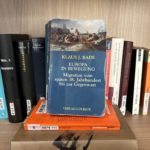
In April, the new series “NGHM Reads” was launched, in which the 65 titles of the NGHM reading list from the field of historiography and theory of history are presented. The following contributions are already available online:
- NGHM reads | Edward Hallett Carr: What is History? (1961)
- NGHM reads | Christopher R. Browning: Ordinary Men (1992)
- NGHM reads | Klaus J. Bade: Europa in Bewegung (2000)
Prof. Dr. Christoph Rass was a guest in the “Interrogation” at the Virtuos Centre of the University of Osnabrück. In this format, colleagues from Virtuos interview various professors about everyday life in research and teaching.
Among other things, Christoph Rass explains what historical practice looks like in academic study, which word must not be missing from the vocabulary of historians, and which animal he thinks the discipline of history would be.
Sebastian Musch has reviewed for Central European History the monograph Österreich und der Buddhismus. Asiatische Abenteuer vom 16. Jahrhundert bis um 1960 by Hubert Weitensfelder.
As of 15 April, we were able to welcome Gesa Landwehr to the NGHM team. She is studying Contemporary History in the specialist Master’s programme and is now supporting the project “The ‘Emsland Camps’ as a Conflict Landscape in Transformation” as a student research assistant. Alongside her work with us, she also works as a guide at the Villa_ – Forum for Memory Culture and Contemporary History. Gesa is interested in history from the perspective of public engagement. She finds it particularly exciting to explore ways of communicating history outside of schools and using digital tools. For example, in the course “Digital History Workshop: AI & Personal Information Management for Historians” she developed a web app and presented it at the most recent Tiny Desk Colloquium. We are delighted to have her support!
In mid-April, the A3 team of SFB 1604 bid farewell to Elif Celik, who had provided intensive support to the team over the past three months with data collection and literature research. We thank her for her valuable contributions and wish her all the best and every success in her Master’s studies.
At the end of April, Team NGHM also said farewell to Benjamin Look, who played a key role in editing the Tracker and the general blog. This issue of the Tracker is therefore the last one produced together. Benjamin will shortly be completing his Master’s degree, and Team NGHM wishes him all the best for his professional career!
Blog Posts in March
- Jessica Wehner and Benjamin Look: NGHM-Tracker (4/26), 01 April 2026.
- Team NGHM: HistOS invites | Forum HistOS in the Summer Semester 2026: Quo Vadis?!, 08 April 2026.
- Christoph Rass: IMIS Guests @ NGHM | Summer Semester 2026: Matti Välimäki (Helsinki) and Morten Baarvig Thomsen (Odense), 21 April 2026.
- Team NGHM: NGHM reads | Edward Hallett Carr: What is History? (1961), 24 April 2026.
- Christoph Rass and Sebastian Huhn: Hidden Legacies, Untidy Endings. Notes from the InechO Conference in Florence, 25 April 2026.
- Team NGHM: NGHM reads | Christopher R. Browning: Ordinary Men (1992), 27 April 2026.
Outlook & Upcoming Events
On 12 May, from 12:30 to 13:30, Lukas Hennies and Jessica Wehner will present, at the invitation of the network Hochschule.digital Niedersachsen, in the series “KI Kompakt” on the topic “Digital Tools and AI Use in Historical Studies: Potentials and Challenges for Teaching”.
The talk examines how students of history can be introduced to the critical use of both generative and non-generative AI. Specifically, approaches will be presented that concern both the production of (historical) knowledge and the development of educational formats with the aid of AI models. Drawing on practical examples from teaching at the Professorship for Contemporary History and Historical Migration Research (NGHM) at the University of Osnabrück, the talk will highlight the challenges and potentials that the technological development of ‘Artificial Intelligence’ entails and how it can be meaningfully integrated into teaching. Finally, the talk will discuss how a critically reflective use of digital tools can be structured.
Interested parties are warmly invited to attend the online lecture!