
By Christoph Rass · Originally published on nghm.hypotheses.org

The second week of my research trip took me to Corvallis. The Special Collections and Archives Research Center at Oregon State University holds the records of the Extension Service, the agricultural advisory body responsible for administering the Bracero Program in Oregon. Between 1942 and 1947, more than 15,136 men from Mexico came to the state through this program, while recruitment continued nationwide until the end of 1964. The American “guest worker” is a translation of the German “Gastarbeiter,” and the term did not become common in the United States until around 1980, when it was used to recategorize people who had immigrated from Mexico, namely as temporary labor that was not meant to become immigrants. This new figure of migration was deployed in two directions simultaneously: in support of the programs being debated in the 1980s, and at the same time retroactively, as a projection onto the Bracero Program, which was now to be called a “guest worker program.” For Collaborative Research Centre 1604 in Osnabrück, I am working on this relationship between the phenomenon and its designations, which always co-produce the social reality of migration. In Corvallis, the records from the period when that very reality was already being contested lie waiting, only under different names.
The Collection
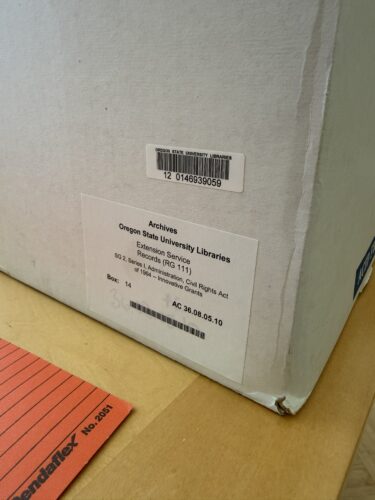
the Extension Service records (cr)
My visit to OSU was prepared by Natalia Fernández, who curates the Oregon Multicultural Archives at the Special Collections and Archives Research Center. On June 24, she sent me the sentence that set the working hypothesis for the week: in Oregon, the Extension Service had administered the program, “however, Bracero Program related materials were not labeled as such, and this collection is quite large (137 cubic feet).” Calculated at one archival box per cubic foot, that amounts to roughly forty linear meters of shelving in which the subject is not identified as such. Anyone searching for it must therefore read what the agency wrote instead.
Before my arrival, the archivists were already able to provide me with digital access to two volumes of the Hop Press, a newsletter for hop farmers that the Extension Service compiled “for the convenience of County Agents” (that is, for the advisory offices in the counties through which it reached individual farms).
1951: Mexican nationals
The issue of July 3, 1951, under the headline “FOOLING WITH FIRE,” warns against engaging workers without a contract and recalls the regulated recruitment of the wartime years:
“Mexican nationals, some years ago, rendered admirable assistance to hop growers in Oregon and elsewhere. It should be remembered, however, that they were recruited under inter-governmental pacts insuring ‘prevailing wage,’ housing, insurance, and other emoluments.”
For the people who came to the country in this way, the article uses a single designation: Mexican nationals, that is, their citizenship. The article contrasts this designation with the unregulated recruitment of its own present, following the initial expiration of the state-organized placement program in Oregon in 1947 (Garcia 2023):
“Proponents of the peons say they do not argue, agitate, or complain and labor long for as low as 20 cents an hour.”
Peons here refers to the agricultural workers from Mexico who had entered without a contract, and the passage can be read as suggesting that the promised docility was conditioned by their precarious, often illegalized legal status. A further article from the same volume quotes the Corvallis Gazette-Times of June 22, 1951: “300 ‘Wetbacks’ Get Boot From Northwest.” “Wetback” was at this time the common, racially charged slur for illegalized workers from Mexico. The origin and the work are the same as those of the previously recruited workers; the changed legal status enables exploitation and racist labeling.
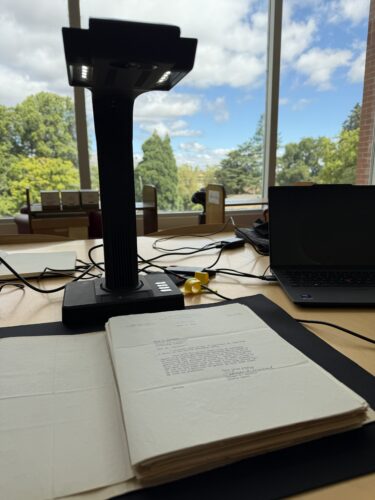
is the most essential piece of equipment (cr)
Five features are thus already present together in 1951 that three decades later would come to define the “guest worker”: intergovernmental recruitment, a guaranteed wage, secured housing, insurance, and the separation of contract labor from illegalized labor. In American usage at this point, there is no single word for this. The term “guest worker” would not be applied to labor migration into the United States until the late 1970s, and it entered official language in 1980, when a government report introduced it as “a literal translation of the German word Gastarbeiter” (Rass 2023: 18 and 39). In 1951, the phenomenon is present, but the designation is not yet; the figure still goes by other names.
1953: Mexican help
The issue of May 20, 1953, however, relays a report from the Hermiston Herald, from the eastern part of the state (the circular served hop farms across all of Oregon). Thirty-five men had arrived by bus in Hermiston, picked up on April 1 in Mexicali and recruited for the hop yards; the newspaper describes them as “swarthy.” The procedure is again described in full detail: a contract between the American and Mexican governments, an hourly wage of approximately ninety cents including all benefits, a state-mandated insurance policy, along with the explanation that no workers had been available on short notice. For the men themselves, the report offers three expressions: Mexican Nationals in the headline, along with Mexican laborers and Mexican help, and one verb: the farm had “imported Mexican help.” The newcomers are named by origin, social standing, and, once again in racializing terms, by skin color.
The Finding Aid
The preliminary finding aid for the Extension Service Records, which lists approximately 2,500 folder titles for the years 1903 to 2011, reveals the nomenclature of this administration. Over the course of decades, it names the work: “Farm Labor” for 1943, “Farm labor emergency: General” for the years 1943 to 1947, “Annual Report, Extension Farm Labor” for 1944, “Agricultural labor” for 1966 to 1973. None of these titles indicates where the people who performed this work came from, for Mexican, bracero, Hispanic, Latino, and immigrant do not appear among the folder titles in the finding aid at all.
The workers appear as a group in exactly six titles, all falling between 1965 and 1975: Rural Areas Poverty Programs: Migrant Programs from 1965, Valley Migrant League covering 1965 to 1968, Chicano-Indian Study Center of Oregon for 1971 and 1972, Migrant labor (housing) from 1972, together with Migrant programs and Minorities, both from 1975. Yet even these titles do not name origin, for ›migrant‹ here is a category of poverty and labor administration, not an ethnic one. The Valley Migrant League, founded in 1965 with funds from President Johnson’s War on Poverty, was open to anyone working in seasonal agriculture: it served a mostly Mexican and Mexican American clientele, alongside other ethnic minorities (Tucker 2023). Only the ›Chicano-Indian Study Center of Oregon‹ and, in the most generic form imaginable, ›Minorities‹ carry a marker of origin. These people receive a folder of their own, then, when a federal program addresses them and demands accountability, and even then the filing system records them as poor and mobile, not by descent. After 1975, no such title appears again in the finding aids and files I read.
Relevant subject files continue, until 1998, under Civil Rights Act of 1964, Counties and under a Cooperative Extension System National Center for Diversity. Within the folders, these people continue to appear in reports and in statistics, but they vanish as a subject heading. A Civil Rights and Equal Employment Opportunity Data Form from August 1974 illustrates the form in which rights appear here: as an obligation to provide evidence to a superior authority, as a survey to be completed, and not as a claim asserted by anyone. This is, in the first instance, a finding about the filing practices of an agency and not about the archive, since the titles of an agency’s records normally derive from its own registry. How much was added later in Corvallis is among the questions I am taking with me.
A Photograph Collection
Images of these men do exist, however, and they originate from the Extension Service itself. Anyone searching today for photographs of braceros in Oregon will find an online collection maintained by the university, available on the internet since October 2002. Lawrence Landis, who proposed the digitization, and Natalia Fernández describe it ten years later as follows: “The Braceros in Oregon Photograph Collection is an artificial collection” — at that point comprising at least 102 identified photographs, selected for digitization from five photographic holdings (Landis/Fernández 2012: 22 f.). As a collection, this assemblage never existed in its own right.
The same article identifies the provenance of the images. In order to implement the program and to dispel public anxieties, the Extension Service had produced promotional materials and even radio broadcasts, to which Landis and Fernández attach the observation: “It was in part due to these efforts that we now have a printed and photographic record of Braceros in Oregon” (ibid.: 22).
This body of records has thus been constructed twice: in the 1940s as publicity for the program, and six decades later as a digital collection. What is today most readily visible of these men is owed in part to the campaign promoting the very program that brought them here.
Natalia Fernández
On the afternoon of 12 August, I spoke with Natalia Fernández about this collection. She has overseen the Oregon Multicultural Archives since late 2010, an archive established in 2005 that, according to its own description, aims to document the histories of the “African American, Asian American, Latino/a, and Native American communities” of Oregon.
She describes the photograph collection as a curatorial decision and points out that the finding aid notes when a collection has been artificially assembled. She draws an explicit distinction between passive and active collecting, since establishing an archive such as the Oregon Multicultural Archives means actively producing records for the future. She also situates her own position within this: archivists wield considerable power, and were the post held by someone else, the holdings would look different.
What she says about collecting extends into description: the subject headings under which the agency filed its records were also assigned by someone, and the criteria by which this was done are nowhere recorded. Ultimately, it bears on my own work. I requested the boxes using the search terms of my discipline (bracero, Mexican, immigrant) and found the material only when I instead searched using the agency’s own vocabulary: farm labor and its cognates. The fact that the terminology of migration research yields nothing when applied to this collection is therefore not a problem of research methodology but a finding in itself: the language in which we now ask about these people is not the language in which the administration recorded them, and this very gap is itself an object of my project.
Absences
Across 632 pages of the Hop Press, neither bracero nor guest worker appears. The absence of guest worker is to be expected; the absence of bracero is not, for this word (derived from the Spanish brazo, meaning arm) was used to designate the recruited workers even during the program itself (Garcia 2023), and it remains to this day the key term in the memory of them; the university’s digital collection bears it in its name. Memory, then, carries a word that the registry does not know. Anyone moving from the collection to the files must change their vocabulary, and this gap belongs to the findings concerning an agency that did not use the word for the people whose labor it organized. The word count follows the same procedure we use in the Collaborative Research Centre to index the German-language scholarly literature on migration, diversity, and education published between 1960 and 2010: optical character recognition, a matrix of relevant terms, concordances.
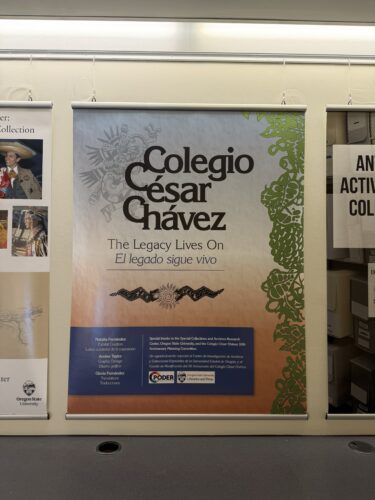
to the Colegio some years ago (cr)
Two further requests yielded little. RG 128, the records of the Department of Agricultural and Resource Economics, had been retrieved on account of its reports on rural structural change, and so far they contain nothing relevant to the research question. The collection of Colegio César Chávez, the first accredited four-year college in the United States under Chicano leadership, which existed from 1973 to 1983 in Mount Angel (Knutson/Hyatt-Evenson 2024), yielded a single relevant item: a newspaper article about a mushroom factory in which the phrase illegal alien appears four times. Even where the press speaks, then, legal status determines the sorting.
The Counter-Test
The counter-test lay on the table in the preceding week, for the records of the farmworkers’ union PCUN in Eugene concern the same labor in the same region, yet contain the very words absent from the hop advisory circular. A position paper of the Oregon Coalition Against the Reagan Immigration and Refugee Plan retrospectively applies the term guest worker to the Bracero Program in 1981, and sixteen years later, placards in Medford read “NO BRACERO Program HR 2377 IS RACIST” and “GUEST Worker IS Legalized Slavery.” Racism and exploitation are named plainly in these sources, and this is no accident of the record: the terms appear where there is contestation, for the struggle over naming presupposes that those being named, and their allies, are able to object — and that is precisely what a union exists to do. The procedure of the advisory service, by contrast, provides no form for a conflict of interests; where rights appear in its records, they appear as a form, as in that Data Form of 1974.
The fact that one side leaves behind records of conflict and the other annual reports is therefore not a distorting variable. The recording practices of the institution are decisive: a union seeking to enforce claims collects violations; a service advising farms documents progress. The construction of the object of inquiry is nonetheless comparable precisely for this reason, for instance in the case of farmworker housing, which one collection addresses as frequently as the other. In the union records, the same wretched barracks represent a condition that violates a norm and is therefore actionable; in the advisory service’s records, a practice that can be improved and is therefore amenable to advice. Accordingly, after a first pass through the material, want and complaint stand alongside the barracks many times more often in the Eugene files, while in the Corvallis documents, assistance and training predominate.

the archive (cr)
The grammar of the holdings also differs. In Eugene, farmworkers (real persons) appear more frequently than the more abstract term farm labor, whereas in Corvallis the ratio is reversed. This difference, too, fits the respective institutions: those who approach the rural world as a field of educable practice think in terms of operations, in which labor is a factor that may become scarce but cannot go on strike; those who approach it as a field of enforceable rights think in terms of persons, because rights accrue to individuals and it is individuals who experience abuse and discrimination. The effects that such categories produce once they enter circulation belong to the questions on which we are also working theoretically within CRC 1604 (Rass/Holst, in preparation).
My First Impression
Corvallis reveals an administration that names the procedure but not the people, for over three decades the work has had a subject heading. In this way, however, the people who had migrated and their living conditions are rendered virtually invisible, and grievances of the kind the union records would later document remain largely out of sight in these files.
On the German side, the history runs in a strikingly parallel fashion, though with a word already in existence. Gastarbeiter [‘guest worker’] is attested as early as Max Weber (Weber 1921: 12 and 126 f.), Nazi propaganda made it prominent from 1941 onward (see the Long Essay of 24 March 2025), and after 1945 it lost currency for a good decade and a half without disappearing entirely. The agreement concluded by the Federal Government with Italy in December 1955 then regulated the recruitment and placement of Italian Arbeitskräfte [‘workers/labor’] without employing any compound with Gast [‘guest’]. But a few years later the figure crossed the threshold of salience once more and became popular when, in June 1961, Ludwig Kroeber-Keneth in the Frankfurter Allgemeine and Werner Höfer in the Neue Illustrierte revived and circulated the term Gastarbeiter, thereby assigning immigrants a temporary, segregated, and in principle excluded place within social reality (Rass 2023: 18–20 and the Fundstücke of 1 March 2025).
Both administrations thus accomplish the same thing: in Oregon the word is still absent in 1951, in Bonn it is not used in 1955, and in both cases the production of the figure is already underway before it acquires its name. The figure emerges in each case outside the administration (in the Federal Republic within journalism, in the United States within political contestation in which those being named also speak), and once it is in the world it belongs to the matter itself, for rules, critique, and memory henceforth run in its terms. It is precisely in this sense that we speak within the Collaborative Research Centre of the ‘production of migration’: categories do not simply reflect migration, they help to constitute it.
Salem and Portland
In the coming week, archival work in Salem and Portland follows, in the Oregon State Archives and at the Oregon Historical Society, and with it the transition from the implementing agency to those who decided upon its mandates: that is, from the question of how a category comes into being to the question of what it brings about.
Bibliography
- Gamboa, Erasmo: Mexican Labor and World War II. Braceros in the Pacific Northwest, 1942–1947, Austin 1990 (new edition Seattle 2000; the standard account of the program in the Northwest).
- Garcia, Jerry: Bracero Program, in: The Oregon Encyclopedia, last updated 8 November 2023 (for the number of men recruited to Oregon and the end of recruitment in the state in 1947).
- Knutson, Ana / Hyatt-Evenson, Tania: Colegio César Chávez, in: The Oregon Encyclopedia, last updated 12 December 2024.
- Landis, Lawrence A. / Fernández, Natalia: Documenting Oregon’s Latino Heritage. The Braceros in Oregon Photograph Collection, in: OLA Quarterly 18 (2012), no. 3, pp. 21–27.
- Rass, Christoph / Holst, Hajo: When Categories Come Alive. Theorizing Generative Dynamics in ‘Figures of Migration’, manuscript, in preparation.
- Rass, Christoph: ›Gastarbeiter‹ – ›Guest Worker‹. Translating a Keyword in Migration Politics, IMIS Working Paper 17, Osnabrück 2023.
- Rass, Christoph: Fundstücke | ›Gastarbeiter‹ – ›Gastarbeitnehmer‹. Ein Moment der Kopräsenz, in: NGHM@UOS, 1 March 2025, DOI 10.58079/13emy.
- Rass, Christoph: Long Essay | ›Gastarbeiter‹ in der NS-Presse. Formative Jahre eines migrationspolitischen Schlüsselbegriffs, in: NGHM@UOS, 24 March 2025, DOI 10.58079/13k66.
- Rass, Christoph: Willamette Depesche #1 | Die Ankunft einer Figur. ›Guest worker‹ und ›bracero‹ in den PCUN Records, 1981 bis 1997, in: NGHM@UOS, 7 August 2026, DOI 10.58079/16nn9.
- Tucker, Kathy: Valley Migrant League, in: The Oregon Encyclopedia, Stand 8. November 2023.
- Weber, Max: Hinduismus und Buddhismus (= Gesammelte Aufsätze zur Religionssoziologie 2), Tübingen 1921.
Find the original post at Willamette Depesche #2 | Zweite Woche in den Extension Service Records, Corvallis. on nghm.hypotheses.org.
This post was automatically translated from the German original.