
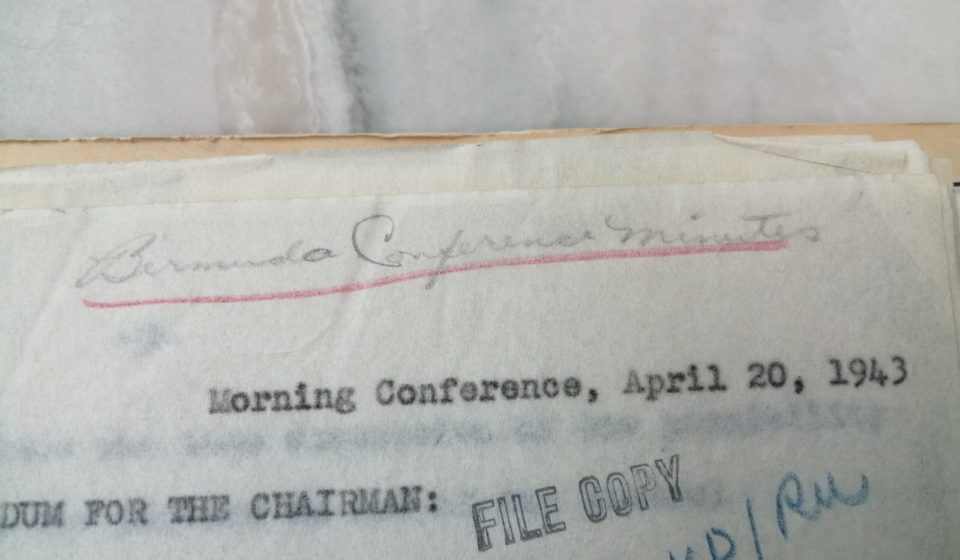
A problem of the present – a conference for the future? The 1943 Bermuda Conference on the “Refugee Problem” re-read from the perspective of a Migration Historian

By Annika Heyen, M.A. · Originally published on nghm.hypotheses.org
Even supposedly well-researched objects of history can generate new knowledge if considered from a new perspective. But how far can a researcher go in this regard while still valuing the established historiography? The following essay is an experiment of thought that explores two questions: First, how far can I go in my analysis of the 1943 Bermuda Conference from the perspective of historical migration studies, and how far can I deviate from established research in the field of Holocaust studies without telling a counter-history of the events? And second, what implications does this new perspective have for our understanding of the Bermuda Conference?
In April 1943, three delegates each from the United Kingdom and the United States of America met in Bermuda to discuss what they framed as the “refugee problem,” a problem at the heart of which were the persecuted Jews of Europe. However, in the midst of war, neither government was willing to change its existing restrictive refugee policies or divert resources from the war effort to the rescue of strangers, least of all Jews. Therefore, the Bermuda Conference concluded without any groundbreaking decisions being made; another failure after the 1938 Évian Conference, now in the face of systematic murder by the millions. At least, that is the narrative presented by the existing historiography covering the events of April 1943, a narrative that has been very much shaped by the perspective of Holocaust research.
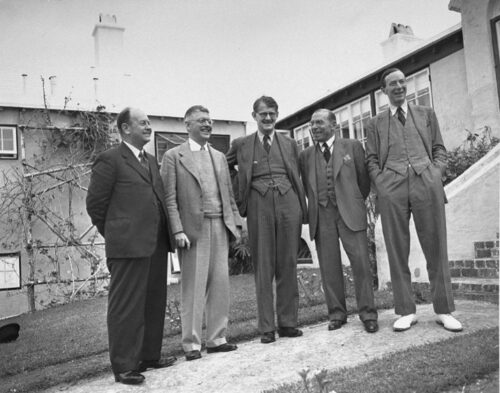
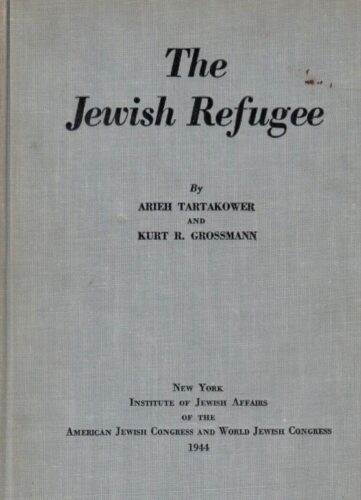
The first written accounts of the subject appeared as early as the final phase of the Second World War and the immediate postwar period, within the sphere of Jewish organizations that had worked to save the Jews of Europe and therefore took a keen interest in the Bermuda Conference.1 In the late 1960s, historians first gained access to the previously unpublished documents from the conference and began a more in-depth examination of the conference, which continued from the 1970s into the 1980s.2 Since then, the Bermuda Conference has repeatedly been cited as an example of the Allies’ failure to rescue the Jews. Although the Bermuda Conference bears the title “on the refugee problem,” migration scholars have so far neglected the topic. If at all mentioned, the only references to the conference are to the findings of the aforementioned research in Holocaust Studies, but there are no thorough examinations from the perspective of Historical Migration Research.3 How can an approach situated in this field produce new insights into a topic that historians have already engaged with for decades?
First of all, considering the Bermuda Conference through the lens of Migration History allows us to shift the analytical focus from the ever-pending question in existing literature of “why were the Jews not rescued?” to “how did states manage, restrict, classify, and govern mobility a) under wartime conditions and b) in view of humanitarian catastrophe?” By doing so, we widen our perspective in two ways. On the one hand, we are able to see beyond the image of the “failed conference” to consider the individual and collective agency of a broadened variety of actors – governmental as well as non-governmental – involved. On the other hand, by considering the Bermuda Conference as part of the development of a refugee and migration regime over the span of the 20th century, not just the Holocaust and the events of the Second World War, longer path dependencies become visible, some of which continue to shape our present. Consequently, the Bermuda Conference shifts from a one-dimensional event of humanitarian failure to a nexus of multiple historical streams spanning the 20th and into the 21st century.
To take these approaches seriously means to read the Bermuda Conference against the grain. While still paying attention to the existing research, this demands an emancipation from established knowledge on the topic in question. To consider the Bermuda Conference as part of a Migration Regime4 in perpetual development, rather than a short-handed response to catastrophe, sheds a different light on one of its main aspects: its purpose. From their experiences gained throughout the First World War and its aftermath, the US and UK were well aware that the “refugee problem” would only increase once the fighting was over. While in 1918 the necessary structures to address the mounting crisis were only in their infancy and – due to member states’ adherence to state sovereignty and rising interwar nationalism, which led to a lack of robust enforcement powers – never developed into a fully functioning system.5 Reinterpreting the 1943 Bermuda Conference as an attempt to preempt chaos already looming on the horizon – in the spring of 1943, the question was not if the Allies would win the war but when – shifts its focus from the problem of the conference’s present to laying the foundation for future action.
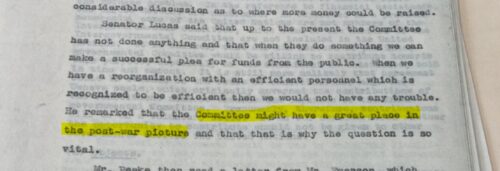
This reinterpretation allows us to recontextualize the conference’s outcome not as “meager results” and “failure” but as the starting point for long-term developments and institutional as well as conceptual path dependencies that only became visible years after the conference ended. The re-establishment and revision of the Intergovernmental Committee on Refugees in the context of the Bermuda Conference, its care and maintenance for refugees together with the United Nations Relief and Rehabilitation Administration (UNRRA) from this perspective appear as strategic rather than accidental and of long-term consequence with the transfer of responsibility first to the International Refugee Organization (IRO) in 1947 and ultimately to the office of the United Nations High Commissioner for Refugees (UNHCR) in 1951.6
- i.e., World Jewish Congress officials Arieh Tartakower and Kurt Grossmann: A. Tartakower and K. Grossmann, The Jewish Refugee (New York, NY 1944); K. Grossmann, ‘The Final Solution,’ The Antioch Review 15, 1 (1955), 55–72. ↩︎
- A.D. Morse, While Six Million Died (New York, NY 1968), 37–64; H.L. Feingold, Politics of Rescue: The Roosevelt Administration and the Holocaust 1938–1945 (New York, NY 1970), 167–207; S.S. Friedman, No Haven for the Oppressed: United States Policy Toward Jewish Refugees, 1938–1945 (Chicago, IL 2017), 155–80; Y. Bauer, The Holocaust in Historical Perspective (Seattle, WA 1978), 26–28, 84, 131–132, 151; M.N. Penkower: The Jews were expendable. Free World Diplomacy and the Holocaust (Urbana, IL 1983), 98–21; M.N. Penkower, ‘The Bermuda Conference and Its Aftermath: An Allied Quest for ‘Refuge’ during the Holocaust’, in M. Marrus (ed) The Nazi Holocaust. Part 8. Bystanders to the Holocaust, Vol. 1 (Berlin 1989), 413–32; H. Druks, The Failure to Rescue (New York, NY 1977), 39–47; D.S. Wyman, The Abandonment of the Jews: America and the Holocaust, 1941–1945 (New York, NY 2007), 104–23; D.S. Wyman, America and the Holocaust. A Thirteen Volume Set Documenting the Editor’s Book The Abandonment of the Jews. Volume 3: The Mock Rescue Conference: Bermuda (New York, NY 1990). ↩︎
- A sample in alphabetical order: I. Abella and H. Troper, None Is Too Many: Canada and the Jews of Europe, 1933–1948 (Toronto 1991); Y. Bauer, Jüdische Reaktionen auf den Holocaust (Berlin 2012); R. Breitman and A.M. Kraut, American Refugee Policy and European Jewry, 1933–1943 (Bloomington, IN 1987), 139; D. Dwork and R.J. van Pelt, Flight from the Reich: Refugee Jews, 1933–1946 (New York, NY 2009); R. Erbelding, Rescue Board: The Untold Story of America’s Efforts to Save the Jews of Europe (New York, NY 2018); T. Kushner, Refugees in an Age of Genocide: Global, National and Local Perspectives during the Twentieth Century (London 1999); T. Kushner, ‘The Western Allies and the Holocaust’, Holocaust and Genocide Studies, 5, 4 (1990), 381–402; P.A. Levine, ‘Attitudes and Action: Comparing the Responses of Mid-Level Bureaucrats to the Holocaust’, in D. Cesarini and P.A. Levine (eds) Bystanders to the Holocaust. A Re-Evaluation (Hoboken, NJ 2014), 212–36; L. London, Whitehall and the Jews, 1933–1948: British Immigration Policy, Jewish Refugees and the Holocaust (Cambridge 2003); M. Marrus, Die Unerwünschten. Europäische Flüchtlinge im 20. Jahrhundert (Berlin 1999); M. Marrus, The Holocaust in History (Hanover, NH 1987); R. Medoff, The Jews Should Keep Quiet (Lincoln, NE 2019); S. Musch, ‘Zwischen Bermuda und Palästina: Arieh Tartakowers und Kurt R. Grossmanns Suche nach Rettung für jüdische Flüchtlinge 1944’, Zeithistorische Forschung/Studies in Contemporary History, 15 (2018), 576–582; J. Newman, Nearly the New World: The British West Indies and the Flight from Nazism, 1933–1945 (New York, NY 2019); A. Patt, ‘No Place for the Displaced: The Jewish Refugee Crisis before, during and after the Second World War’, in S.T. Katz and J. Wetzel (eds) Refugee Policies from 1933 until Today. Challenges and Responsibilities (Berlin 2018), 97–121; G. Schubert, Der Fleck auf Uncle Sams Weißer Weste: Amerika und die jüdischen Flüchtlinge 1938–1945 (Frankfurt am Main 2003); M. Sompolinsky, Britain and the Holocaust: The Failure of Anglo-Jewish Leadership? (Brighton 1999); B. Taylor, Refugees in Twentieth-Century Britain: A History (Cambridge 2021); G. Wallance, ‘The World Jewish Congress during World War II’, in M. Rosensaft (ed) The World Jewish Congress, 1936–2016 (New York, NY 2017); B. Wasserstein, Britain and the Jews of Europe, 1939–1945 (London 1999). Recently, the present author, together with Sebastian Musch, tried to break up this narrative; see S. Musch and A. Heyen, ‘The Bermuda Conference in April 1943: Allied Politics, Jewish Organizations, and the Emergence of the International Migration Regime’, Holocaust Studies, 30, 2 (2024) 290–307. ↩︎
- C. Rass und F. Wolff, ‘What is in a Migration Regime? Genealogical Approach and Methodological Proposal,’ A. Pott et al. (eds.), Was ist ein Migrationsregime?/What is a Migration Regime? (Wiesbaden 2018), 19–64. ↩︎
- M. Mazower, Governing the World. The History of an Idea (London 2012), 199. ↩︎
- Musch and Heyen, ‘The Bermuda Conference’, 2024. ↩︎
Find the original post at A problem of the present – a conference for the future? The 1943 Bermuda Conference on the “Refugee Problem” re-read from the perspective of a Migration Historian on nghm.hypotheses.org.
This post was automatically translated from the German original.