
By Christoph Rass · Originally published on nghm.hypotheses.org
Can the National Socialist concentration camp be described as a distinct social order – and what changes when it is read not as a rupture with modernity, but as one of its products? Wolfgang Sofsky’s Die Ordnung des Terrors, the twelfth title on the NGHM reading list, poses precisely this question to a history of violence that had long resisted sociological approaches.
Sofsky’s book was published in 1993 by S. Fischer and was awarded the Geschwister-Scholl-Preis in the same year. It is the work of a sociologist approaching a subject that the historical discipline had long since claimed as its own – and which, for precisely that reason, sparked a debate reaching far beyond his own field. The jury honored the book with explicit reference to Eugen Kogon’s SS-Staat of 1946: since then, the jury noted, research into the National Socialist camp system had never ceased, yet attempts at a comprehensive explanation of its functioning had remained rare. Sofsky’s study fills exactly this gap – while simultaneously provoking a sharp but productive academic controversy.
The book’s argumentative approach is structural-analytical rather than chronological. Sofsky reconstructs the camp not as an institutional history, but as a social system of power whose organizing principle he terms ‘absolute power.’ In doing so, he draws primarily on prisoner testimonies – a choice of sources that is itself already a methodological commitment. It is not the perpetrators’ perspective that organizes the book, but rather what can be reconstructed from survivors’ accounts about the system’s functioning. From these testimonies, Sofsky extracts the dimensions along which absolute power is organized: space and time, social structures – both those of the SS personnel and those of the prisoner hierarchies – labor, and finally violence and death.
What he describes is the systematic destruction of a social world. At the same time, he demonstrates that this destruction does not unfold chaotically, but is rationally organized: as the mutilation of personal identity, as the alteration of the sense of space and time, as the gradual dissolution of the basic trust in the continuity of a social world. Humiliation and psychological coercion are not by-products, but instruments. The destructive power of National Socialist policy reaches into the ramified prisoner society itself, turning the victims into agents of a system that pursues their annihilation.
Herein lies the painful crux of the book.
For Sofsky, the concentration camp does not fall outside the framework of modern civilization; it is, rather, a constituent part of modernity, a product of the will to annihilation inherent in absolute power and large-scale technical organization. It is this thesis that provokes the controversy. It shifts the camp out of the realm of anomaly, civilizational rupture, and state of exception, and into the realm of what modern organizational rationality is capable of producing. Wolfgang Benz, writing in Der Spiegel, describes the book as an enrichment of our understanding of human nature, the organization of domination, and the exercise of violence; Jan Philipp Reemtsma, writing in Die Zeit, calls it an ‘indispensable standard work.’
At the same time, the book met with sharp criticism early on. The social psychologist Harald Welzer was among the first to challenge Sofsky’s approach. His critique sustained the debate for years and was revisited in a later re-reading by Maja Suderland in Medaon. The controversy revolves, in brief, around the question of what a structural-analytical approach to the camp can achieve and where it reaches its limits: does the sociological perspective suffice to capture the actions of prisoners and perpetrators, or does it overwrite them? It is a question that continues to resonate in scholarship to this day.
A connection between Sofsky and our work in the field of conflict landscape research in Osnabrück can be productively explored: where Sofsky reconstructs the camp as a social order, archaeological and historical approaches engage with the same sites through their material traces. Both approaches converge at the point where violence becomes legible as organized practice – and not as an exception to what modern institutions are capable of. Readers of Sofsky will later in this series be reminded of Snyder’s Bloodlands, which poses the same question about the order of National Socialist violence in a different register – geographical and comparative.
Sofsky’s book compels its readers to abandon the conceptual self-evidence with which ‘the camp’ is so often treated as the Other of modernity. What remains is an analysis that does not conceal the price of this shift: that absolute power can be described as a structure without thereby becoming any less incomprehensible.
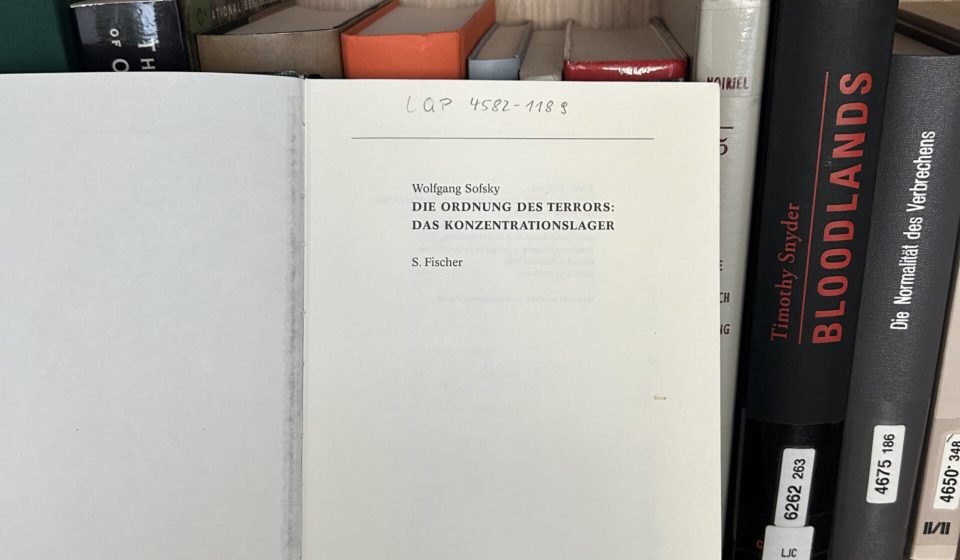
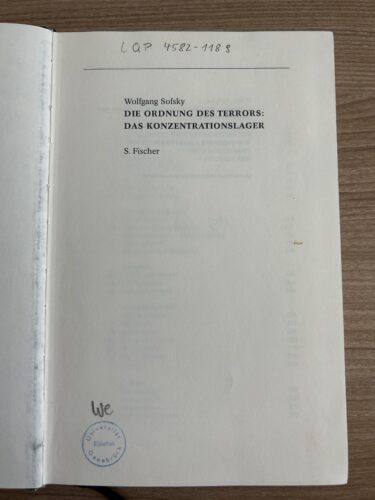
Students in Osnabrück will find Sofsky’s Die Ordnung des Terrors in the open-access stacks under the call number 4565-865 3 (OPAC).
Wolfgang Sofsky, Die Ordnung des Terrors. Das Konzentrationslager, Frankfurt am Main: S. Fischer 1993.
This post is part of the series NGHM liest, in which the 65 titles of the NGHM reading list are presented. The list can be explored as a knowledge graph.
Find the original post at NGHM liest | 12 | Sofsky: Die Ordnung des Terrors (1993) on nghm.hypotheses.org.
This post was automatically translated from the German original.