

Willamette Dispatch #1 | The Arrival of a Figure. ‘Guest worker’ and ‘bracero’ in the PCUN Records, 1981 to 1997.

By Christoph Rass · Originally published on nghm.hypotheses.org

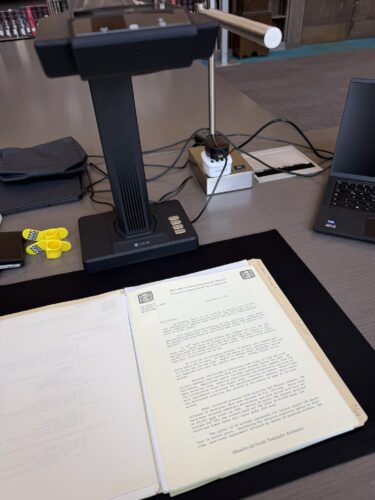
Since August 3rd I have been in Oregon for three weeks, with a document scanner in my luggage. The trip is part of subproject A3 of the CRC 1604 ‘Production of Migration’ and takes me through Eugene and Corvallis to Salem and Portland. It forms part of my work on the figure of the ‘guest worker’ and its origins in the German ‘Gastarbeiter’. How this figure was constructed within American immigration discourse is the subject of ‘Inventing the Guestworker’, the book that Julie Weise and I are currently seeing through to press. Here I am searching for what became of this figure in the Willamette Valley.
Background
The roots of my research question reach far back. Some scholarship dates ‘Gastarbeiter’ to the National Socialist era, other scholarship to the recruitment agreements of the Federal Republic. Both datings are too late. The term was shaped by Max Weber, in the ‘Wirtschaftsethik der Weltreligionen’ [‘Economic Ethics of the World Religions’], written during the First World War and published in 1916. There Weber speaks of ‘Gasthandwerkern’ [‘guest craftsmen’], of ‘Gastvölkern’ [‘guest peoples’], and finally of ‘Gastarbeitern’ [‘guest workers’], using these terms to designate groups occupying marginal positions in ancient India and Palestine. Twenty years earlier, in his study of agricultural labor in eastern Germany, he had spoken of ‘Wanderarbeitern’ [‘migrant workers’]. Why he shifted the figure remains an open question (Rass 2023: 11).
Why ‘guest’ and not ‘foreign’? In the legal German of the nineteenth century, both words frequently appeared side by side. In writings on the law of aliens, however, ‘Gast’ [‘guest’] carried a double meaning: the temporary nature of the sojourn and the obligation of the ‘host’ to treat those arriving with consideration. The term never lost this duality, and it accounts for part of its appeal (Jordans 1838: 291; Rass 2023: 12).
From the outset, what is designated is not an origin but a position: arrived from outside, tolerated temporarily, assigned to low-status labor, with no prospect of belonging (Rass 2023: 12). This is precisely why the word can be transposed. Nazi propaganda on the ‘Ausländereinsatz’ [‘deployment of foreign labor’] makes it standard vocabulary; the Federal Republic adopts it two decades later; from the 1960s onward it migrates as a loanword into approximately thirty languages. An expression that produces an exclusionary social order can be carried anywhere. The 50,000 people from Mexico who were to come to the United States annually under Reagan’s 1981 plan were likewise earmarked for such a categorization: the term ‘Gastarbeiter’, freshly imported from Germany, was to serve as a new designation signaling that these immigrants were to have no prospect of remaining or of belonging.
Reconstructing this transnational genealogy and its historical semantics has been an important strand of my research for years; how ‘Gastarbeiter’ became ‘guest worker’ in American immigration discourse is set out in my 2023 working paper.
Running alongside this is a second line of inquiry that concerns not the word but an instrument. ‘Institutionalisierungsprozesse auf einem internationalen Arbeitsmarkt’ [‘Institutionalization Processes on an International Labor Market’] (2010) was not about a figure of migration but about a type of contract that required and co-produced such figures — including the ‘Gastarbeiter’ — without ever making this explicit in the contract texts themselves: the bilateral migration treaties with which European states regulated the international mobilization of labor between 1919 and 1974. The question was how such an institution with its own logic comes into being, and how it operates over extended periods of time. Together with Julie Weise I have extended this line of inquiry across the Atlantic. ‘Migrating Concepts’ traces the transatlantic origins of the Bracero Program back to the interstate treaty practice of the interwar period (Weise/Rass 2024). It is thus not only the name that migrates, but also the instrument. The two, however, do not move in the same rhythm and each undergoes its own translation.
These lines of inquiry can initially be reconstructed from the records of governments, ministries, and commissions. Such records show how a figure is constructed from above. What happens to the figure once it arrives in an agricultural region and is taken up there in union offices, advice centers, and editorial rooms is not to be found in these records. It is these processes that I am searching for on this archival trip.
The PCUN Records in Eugene
The Special Collections and University Archives of the University of Oregon hold the records of PCUN, Pineros y Campesinos Unidos del Noroeste, the farmworkers’ union from Woodburn. Coll 335 comprises 79.5 linear feet in 58 containers, covering the period 1952 to 2012.
These 79.5 feet of archival material are an outcome, not a starting point. In 1999, PCUN staff, students from the University of Oregon, and the anthropologist Lynn Stephen organized the union’s archive in Woodburn. The occasion at the time was a book project for which fourteen interviews were also conducted. Eleven years later, in December 2010, a delegation from the SCUA traveled to Woodburn and took in whatever documents were held there: approximately 240 linear feet of material, comprising ring binders, audio cassettes, videotapes, photographs and negatives, posters, and ephemera. On June 6, 2011, the President of the University, Richard Lariviere, and the President of PCUN, Ramón Ramírez, signed a Deed of Gift in the Knight Library.
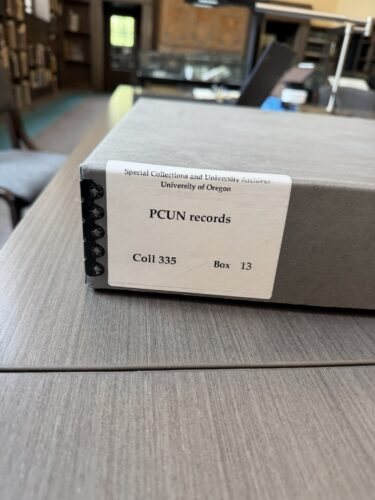
How do 240 feet of material become approximately 80 feet of archival holdings? The acquisition history, published in 2014 by two of those involved, makes the process transparent. The union had reasons to withhold certain documents: notes from collective bargaining negotiations, strategy meetings, anything touching on the immigration status of members. It took a further three years before the collection became accessible to researchers. A unpublished inventory existed by early 2013. In September 2013, Sonia de la Cruz began a nine-month fellowship and produced a bilingual finding aid. On May 7, 2014, the collection opened with an open house, in the same reading room where I am sitting this week.
What I am reading today is not an unfiltered reflection of the union’s history. It is the result of a chain of decisions: what was organized in 1999, what was collected in 2010, what was transferred in 2011, what was withheld, what was processed in 2014. For a project concerned with the production of categories, this is itself already part of the findings.
The Material
I was able to work through thirteen boxes in the first few days. One portion consists of subject files: Immigration and Farm Labor in Boxes 1 and 2, H-2A documents from 1980 to 1998, a folder on the Bracero Program, the campaign files against the Smith-Wyden bill of 1998. Box 54 contains the files on opposition to H-2A from 1980 to 2002, Box 55 the folder against the Smith-Graham bill of 1999, and Box 8 a 2004 newspaper article on a ‘nuevo programa bracero’ [‘new bracero program’].
The other part is more fruitful. Box 3 of the PCUN collection contains correspondence from 1977 to 2002, Box 10 posters and flyers, Box 13 the movement press. Boxes 16, 18, and 41 are photographic series of demonstrations between 1977 and 1998. In addition, there is a carton from the John Little Papers containing records of the Colegio César Chávez and files of the Valley Migrant League. Campaign language rarely appears in administrative records. It appears in newsletters, on flyers, and on signs.
A Find from 1981: The Equation in the Typescript
Box 54 contains a folder with records of the Oregon Coalition Against the Reagan Immigration and Refugee Plan, covering the period 1981 to 1982. Among them is a two-page typescript without a date, “Summary and Analysis of the Reagan Plan,” bearing a P.O. box in Portland and a telephone number in Woodburn. The document goes through point by point the immigration program that the Reagan administration had presented on July 30, 1981. The administration had justified it with the statement “we have lost control of our borders.” Behind each point in the document stands a paragraph headed “Analysis.”
Point one reads:
“Creation of an ″experimental guest worker program″ to bring 50,000 Mexicans to the U.S. each year. Workers could not bring their families and would be ineligible for social services.”
The analysis accompanying it:
“Reagan seeks to revive the ″Bracero″ program which had been terminated in 1964. During its twenty-two year existence, the Bracero Program created slave-like conditions for ″guest workers″, depressed farmworker wages and was used to break strikes.”
Noteworthy is the handling of the word. “Experimental guest worker program” is adopted in quotation marks from the language of government, neither translated nor explained. In the analysis paragraph the expression recurs, still in quotation marks, now as a designation for the Braceros of the years 1942 to 1964. The equation is not asserted. It is accomplished through punctuation: a foreign word, set by the opposing side, which the coalition carries along in order to defuse it.
What the document rejects can be read in a hearing transcript from the same year. In the joint hearings of the immigration subcommittees of the Senate and House of Representatives in May 1981, Senator Alan K. Simpson of Wyoming counters the AFL-CIO’s representative by stating that he comes
“from an area of the Nation where the bracero program was used and the very term is offensive to the Hispanic people, the term ›bracero‹. That is why we use terms like guest workers” (Committee on the Judiciary 1981a: 91; Rass 2023: 43).
The following year, Simpson introduces together with Representative Romano Mazzoli the bill against which PCUN will fight until 1986. Here he justifies the choice of terminology as a matter of consideration: ‘guest worker’ is the expression that offends no one. It is precisely this apparent consideration — which in fact merely furnishes a racializing and exclusionary figure with a new conceptual label of identical functionality — that the document from Box 54 refuses. It takes the new word and maps it back onto the old program.
A Find from 1997: The Equation on the Placard
Sixteen years later, the same equation appears on cardboard signs. Box 41, Folder 37 contains photographs of a demonstration in front of the Jackson County Justice Building in Medford. The date, September 20, 1997, appears in the finding aid and as a camera imprint on the images. The occasion was H.R. 2377, the Temporary Agricultural Worker Act of 1997, introduced by Bob Smith.
The signs read, in English and Spanish side by side:
“GUEST Worker IS Legalized Slavery” “NO BRACERO Program HR 2377 IS RACIST” “ABAJO CON HR 2377” “SOMOS MEXICANOS EXIGIMOS RESPET[O]”
Two national flags are displayed side by side, the Mexican and the American; one person holds up an image of the Virgen de Guadalupe; in the front row stand children and older women. Medford is located in the Rogue Valley, far to the south of the state. This too belongs to the findings, for by this point the struggle is no longer confined to the growing region around Woodburn. In 1981, the equation appeared in a typescript. In 1997, those affected make the political attempt at categorization public on their picket signs!
The Corpus
The photographs taken in the reading room will form part of a larger corpus: optical character recognition, term matrix, counting by image, followed by concordances and, insofar as the material supports it, collocations. The method derives from Sub-project A3, where nearly six thousand German-language specialist texts on migration, diversity, and education from the years 1960 to 2010 are read on three levels — by structure, by content, and by meaning (Celikten et al. 2026, forthcoming). The principle applies to the cartons in Eugene as much as to the bibliographies in Osnabrück: categories in process-generated data do not reflect conditions, they produce them. What is therefore counted is which category was in circulation, at what density, and with what attributions of meaning. The fact that I ordered the cartons according to precisely these categories belongs to this finding and does not work against it — reflecting on this is part of our work in the SFB 1604.
One finding is already emerging. ‘Bracero’ appears in 166 photographs, ‘guest worker’ in 142, ‘campesino’ in 138. ‘Trabajadores huéspedes’ appears in four. In the Spanish-language subset, the ratio of self-designation to translation is 66 to 4. Interpreting these findings will be the next step of the project upon my return to Osnabrück.
El Foro, May 1980: The Origin Is Supplied
The find that brings the two individual discoveries together is a newspaper. Series 5 contains El Foro from May 1980, including an article by John Alvarez on the ‘guest worker’ program and the question of whom it serves. The text names the Spanish expression directly:
“El término trabajador huesped es netamente un eufemismo para ‘trabajador temporal’, puesto que estos trabajadores son destinados a la larga, a regresar a su país de origen.” [“The term guest worker is plainly a euphemism for ‘temporary worker,’ since these workers are ultimately destined to return to their country of origin.”]
He supplies the origin immediately, in the English parallel version:
“The term ‘guest worker’ comes from immigrant labor programs in Western Europe where the governments of West Germany, France, Switzerland, Holland, England, Sweden and several other countries in the post-World War II period, organized programs to import millions of workers…”
This was printed in May 1980. The same origin is identified at the same time in Washington, D.C., but without criticism. A 1980 report of the Judiciary Committee states that ‘guestworker’ is “a literal translation of the German word Gastarbeiter,” and that the expression emphasizes that foreign workers are “temporary ‘guests'” (Committee on the Judiciary 1980a: 84; Rass 2023: 39). In April of the same year, the new American ambassador to Mexico, Julian Nava, proposes a program explicitly “similar to those currently operating in Europe” (Del Olmo 1980: 21; Rass 2023: 40). What is new is the counter-discourse found in the PCUN records.
The figure encounters organizers who know where it comes from and what social facts it is intended to establish.
How an Archive Comes Into Being
Today I meet Dr. Lynn Stephen. She is Philip H. Knight Chair and Professor of Anthropology at the University of Oregon and in 2012 collaborated with PCUN to document the history of the organization. The interview transcripts were returned to the interviewees prior to write-up, and the union reviewed and revised the text on multiple occasions. In her account, the campaign of the early 1980s is not framed under ‘guest worker’ but under the slogan “Stop Reagan’s Bracero Program.”
This is not a minor detail. It suggests that the movement never adopted the term but consistently replaced it with another that invokes a memory rather than establishing a category. Was this intended to prevent a euphemistic overwriting? Whether this was a conscious decision, who made it, and whether it was ever in question, is not recorded in the files.

What was organized in Woodburn in 1999 helped determine what could be recorded in 2010 and transferred in 2011, and what can be found in the archive today – the formation of the archival record was in this case a complex and sensitive process. Appraisal did not take place in the stacks, but eleven years earlier, in the rooms of a labor union, with those whom the transferred records concerned and with the participation of a researcher. An important question that occupies me in the context of a current research visit is how such collections are processed, preserved, and archived in the United States, and how the interests and rights of depositors are respected in that process.
On to Corvallis
On Tuesday and Wednesday I will spend two days in Corvallis, at Oregon State University, in the Special Collections and Archives Research Center. There the records of the Extension Service are held, including materials on the Valley Migrant League and the Migrant Programs of the 1960s and 1970s, as well as annual reports from individual counties from the 1940s on the Emergency Farm Labor Program. The catalog in Corvallis yields neither ‘guest worker’ nor ‘H-2A’ – not a single hit. That is precisely why I am going. There lies the experiential layer upon which the debates of the 1980s and 1990s were able to draw.
Bibliography
Celikten, Ahmet/Hoops, Maik/Rass, Christoph/Yildirim, Lale (2026): Reflecting on Process-Generated Data and Categories of Practice. Migration Research as Its Own Object [forthcoming; authors listed in alphabetical order].
Committee on the Judiciary (1980a): Temporary Worker Programs, Background and Issues. A Report. Washington: U.S. Government Printing Office.
Committee on the Judiciary (1981a): Final Report of the Select Commission on Immigration and Refugee Policy. Joint Hearings before the Subcommittee on Immigration and Refugee Policy of the Senate Committee on the Judiciary and Subcommittee on Immigration, Refugees, and International Law of the House Committee on the Judiciary, Ninety-Seventh Congress. Washington: U.S. Government Printing Office.
Del Olmo, Frank (1980): Nava Foresees Mexican ‘Guest Worker’ Program. In: Los Angeles Times, April 4.
Jordans, Sylvester (1838): Gastrecht (Fremdenrecht) [Right of hospitality (law of aliens)]. In: von Rotteck, Carl/Welcker, Karl Theodor (eds.): Das Staats-Lexikon. Encyklopädie der sämmtlichen Staatswissenschaften für alle Stände. Leipzig: Brockhaus.
Rass, Christoph (2010): Institutionalisierungsprozesse auf einem internationalen Arbeitsmarkt. Bilaterale Wanderungsverträge in Europa zwischen 1919 und 1974 [Institutionalization Processes on an International Labor Market. Bilateral Migration Agreements in Europe between 1919 and 1974]. Paderborn: Schöningh.
Rass, Christoph (2023): ‘Gastarbeiter’ – ‘Guest Worker’. Translating a Keyword in Migration Politics. IMIS Working Paper 17. Osnabrück: IMIS.
Stephen, Lynn (2012): The Story of PCUN and the Farmworker Movement in Oregon. Eugene: CLLAS, University of Oregon.
Weise, Julie/Rass, Christoph (2024): Migrating Concepts. The Transatlantic Origins of the Bracero Program, 1919–42. In: American Historical Review, 129.
Woken, David/de la Cruz, Sonia/Kays, Stephanie (2014): Latino History Is Oregon History. Preserving Oregon’s Latino Heritage through the Pineros y Campesinos Unidos del Noroeste Archive. In: Who Are We Really? Papers of the Fifty-Ninth Annual Meeting of SALALM, pp. 58–70.
To be continued in Willamette Dispatch #2.
Find the original post at #1 | Die Ankunft einer Figur. ›Guest worker‹ und ›bracero‹ in den PCUN Records, 1981 bis 1997. on nghm.hypotheses.org.
This post was automatically translated from the German original.