
This post was automatically translated from the German original at
NGHM liest | Eric J. Hobsbawm: The Age of Extremes (1994).
Can a century that one has lived through be grasped by the means of historiography, and if so, at what price? Eric J. Hobsbawm’s The Age of Extremes: The Short Twentieth Century, 1914–1991, the tenth title on the NGHM reading list from the field of global history and social history, answers this question with a periodization that has set a precedent and a pessimistic diagnosis that continues to provoke disagreement to this day.
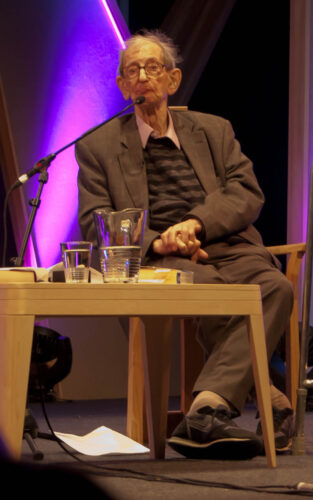
When Hobsbawm published the concluding volume of his tetralogy on the history of the long nineteenth and short twentieth centuries with Michael Joseph in London in 1994, he was in his mid-seventies. In 1936 he had joined the Communist Party of Great Britain as a student at Cambridge; in 1991, when the party came to an end, he allowed his membership to lapse half-heartedly. Three years later the book appeared, whose final chapter contains an assessment of ‘actually existing socialism’. Niall Ferguson, whose political position is far removed from Hobsbawm’s, has described the tetralogy as the best introduction to modern world history in the English language — a tribute that demonstrates how far the work’s readership has long since transcended its disciplinary and ideological boundaries.
The architecture of the book is rigorous. An introductory overview chapter is followed by three parts: ‘The Age of Catastrophe’ for the years 1914 to 1950, ‘The Golden Age’ for the years 1950 to 1973, and ‘The Landslide’ for the period from 1973 to 1991. The nineteen chapters are largely self-contained and address total war, the Russian Revolution, the Great Depression, the decline of liberalism and the rise of dictatorships, the anti-fascist alliance, decolonization, the Golden Age, the crisis of the 1970s, and the end of ‘actually existing socialism’. Dedicated chapters on art, culture, and the natural sciences extend the scope beyond political and economic history.
Hobsbawm does not write event-driven history. Rather, he seeks to explain three major transformations of his lifetime: the decline of European predominance, the transformation of the world into a ‘single operational unit’ through the revolution in communication and transport, and the disintegration of earlier patterns of social relations. From this triad there develops a global narrative in which the crisis from the early 1970s onwards appears not merely as an economic phenomenon, but as a convulsion of the institutional and ideological foundations of all regimes. In the final chapter, Hobsbawm diagnoses a loss of the state’s capacity for governance. In doing so, he does not announce the triumph of democratic capitalism that contemporary commentators proclaimed after 1989, but rather a looming anarchy. In his analysis of the Russian Revolution, he argues pointedly that capitalism proved easier to overcome at its peripheries than in its heartlands — a tension that defines the work’s central position: the acknowledgement of capitalism’s stability precisely where Hobsbawm the Marxist would most have wished to see it transcended.
It is precisely here that the controversy begins which has accompanied the book to this day. Lawrence Freedman, in his review, praised Hobsbawm’s comprehensive analysis and sweeping scope, declaring the volume a benchmark for accounts of the twentieth century. At the same time, he found Hobsbawm’s view of capitalism as an ungovernable and intrinsically extremist force, and his concern about a triumphant anarchy, unconvincing. The labels of the periodization also met with reservations in critical reception: describing the period after 1973 as a ‘Landslide’, as though things had been steadily going downhill ever since, struck several critics as hardly persuasive — it was no coincidence that Tony Judt titled his review ‘Downhill All the Way’. The consistently unsympathetic treatment of the United States, Freedman argued, leads to an inadequate understanding of the global appeal of the ‘American way’. A further line of criticism concerns the source base: the book relies almost exclusively on secondary literature, whose limitations occasionally become apparent, and the space Hobsbawm devotes to socialism reveals his own predispositions. From the left, meanwhile, the Internationalist Communist Review read the book as an expression of Hobsbawm’s transformation from a Stalinist into a defender of ‘democratic values’ — a charge levelled from the opposite direction.
Despite these reservations, the book’s central proposition has entered the vocabulary of global history. With the ‘short twentieth century’, as a counterpart to the ‘long nineteenth century’, Hobsbawm established a periodization that remains influential to this day. The tripartite division into Catastrophe, Golden Age, and Landslide structures the narrative of the epoch far beyond his own work. Anyone who wishes to tell the history of the West no longer from within itself, but through the uneven surges of capitalism and class formation and the force of nationalism, can scarcely move beyond this framework.
At one point the book remains curiously thin: migration. Hobsbawm registers the transformation of the world into a ‘single operational unit’ without treating the movements of people — expulsions, labor migrations, flights, displaced persons of the postwar period — as an independent strand of his narrative. With Wyman’s DPs, the first title on refugee history on our list, what remains structurally underexposed in Hobsbawm becomes visible: that the production of migration regimes was not a peripheral phenomenon of the short twentieth century, but one of its core processes.
What remains is a periodization that bears its own date: 1991 as an endpoint, written by a historian who had himself experienced that endpoint as a caesura in his own political biography.
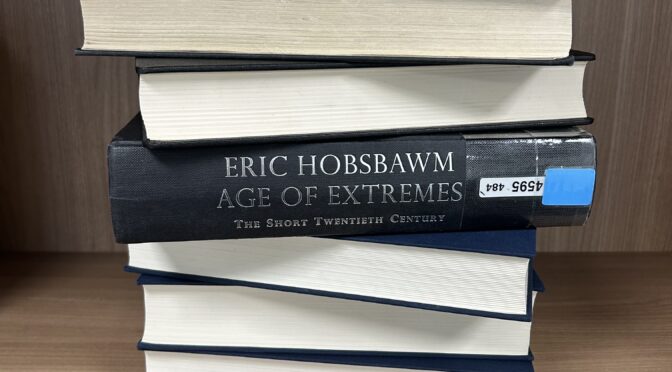
Students at Osnabrück University will find Hobsbawm’s The Age of Extremes in the B open-stack magazine under the shelf mark 4595-484 9 (OPAC).
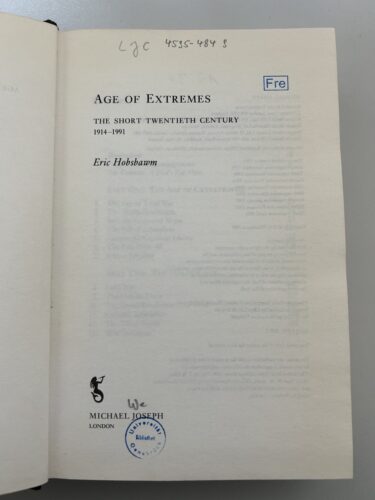
Eric J. Hobsbawm (1917–2012), The Age of Extremes: The Short Twentieth Century, 1914–1991, London: Michael Joseph 1994.
This post is part of the NGHM Reads series, in which the 65 titles on the NGHM reading list are presented. The list can be explored as a knowledge graph.