Report | Sixth Tiny Desk Colloquium: Displaced Persons, Urban Migration Policy, and the Historiography of the Refugee Regime

This post was automatically translated from the German original at
Bericht | Sechstes Tiny Desk Kolloquium: Displaced Persons, städtische Migrationspolitik und die Historiographie des Flüchtlingsregimes.
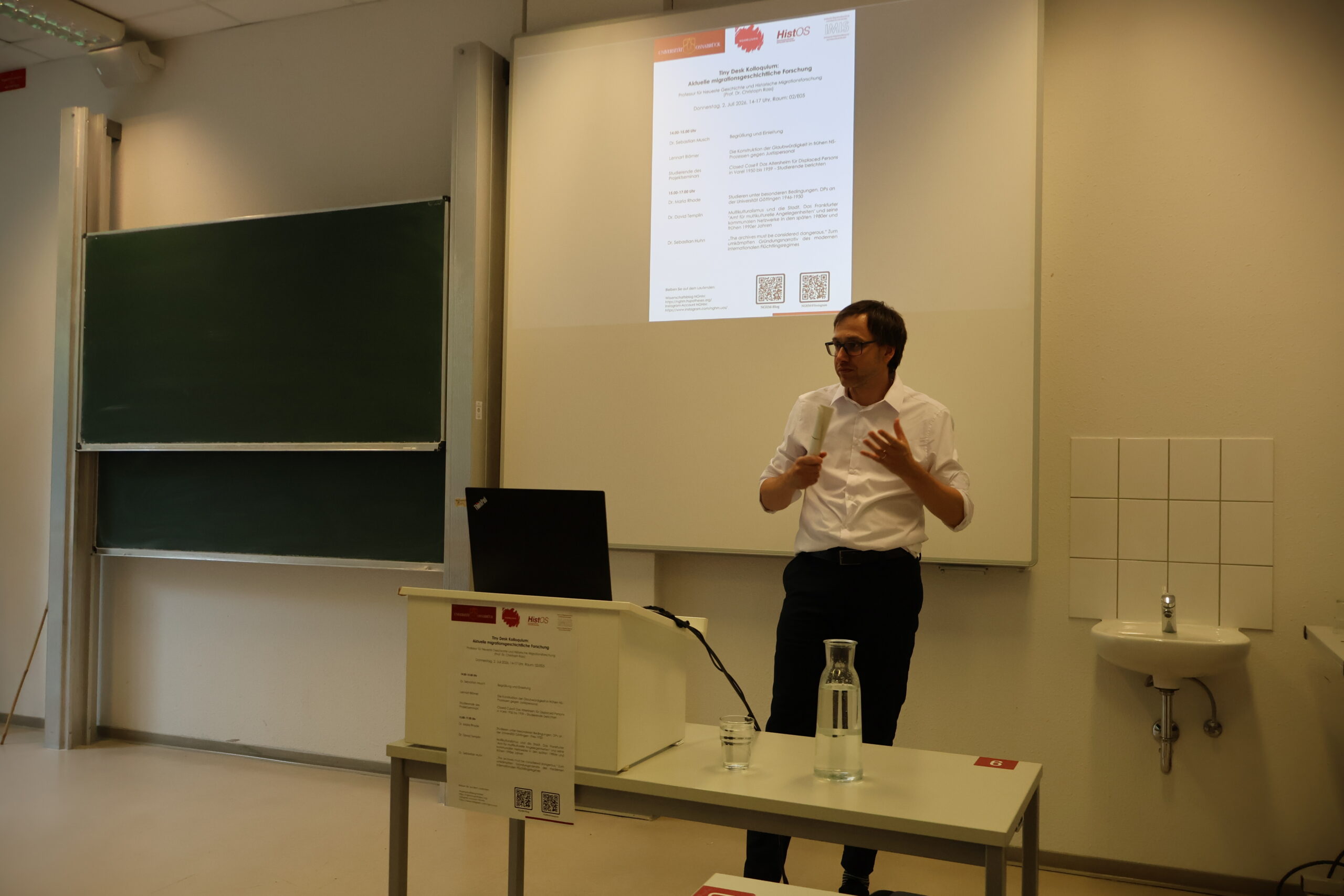
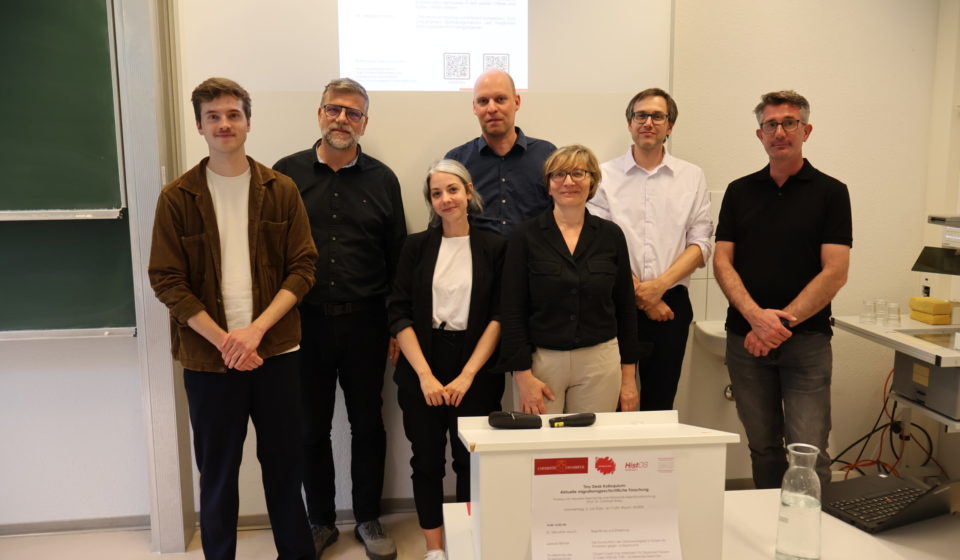
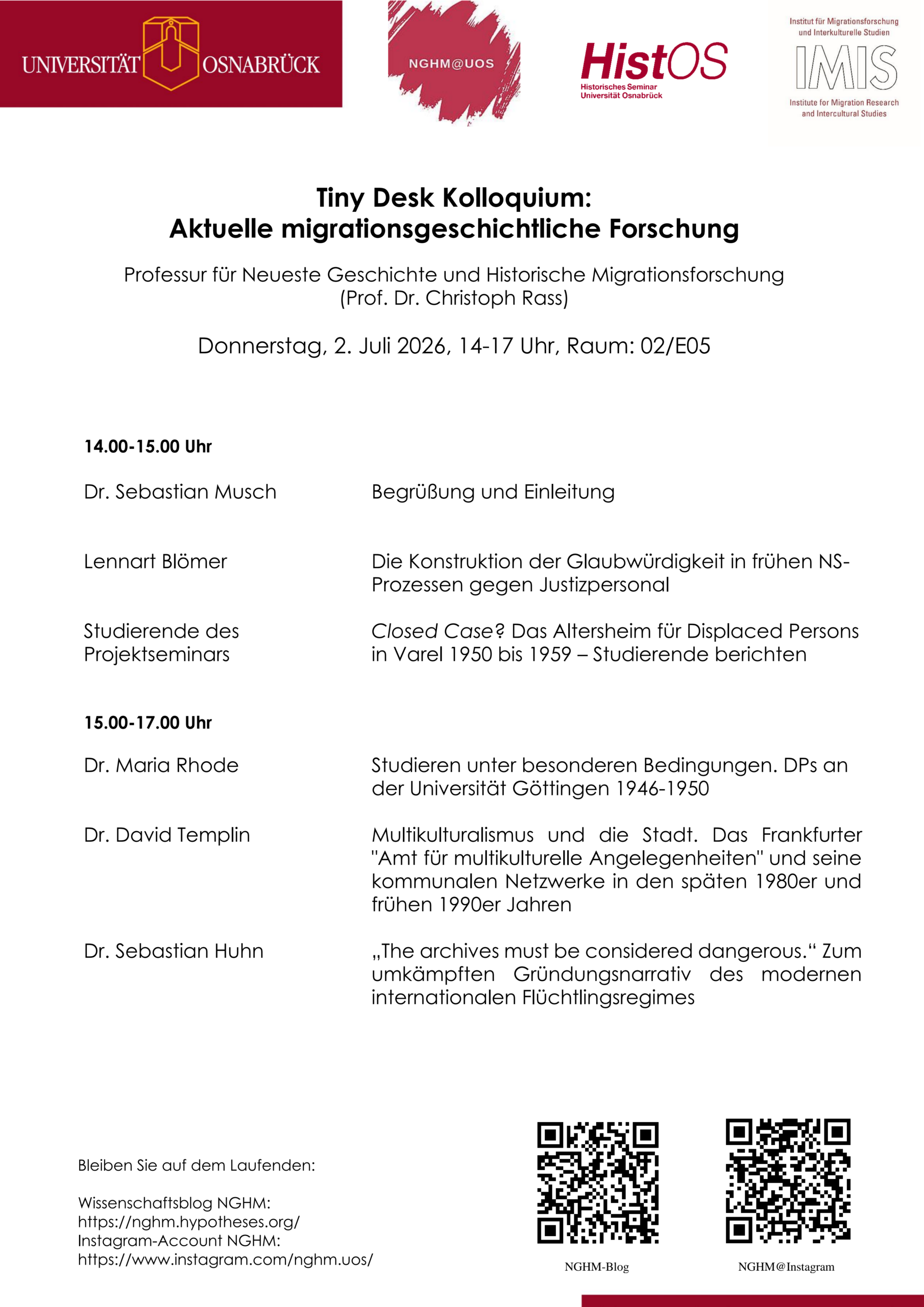
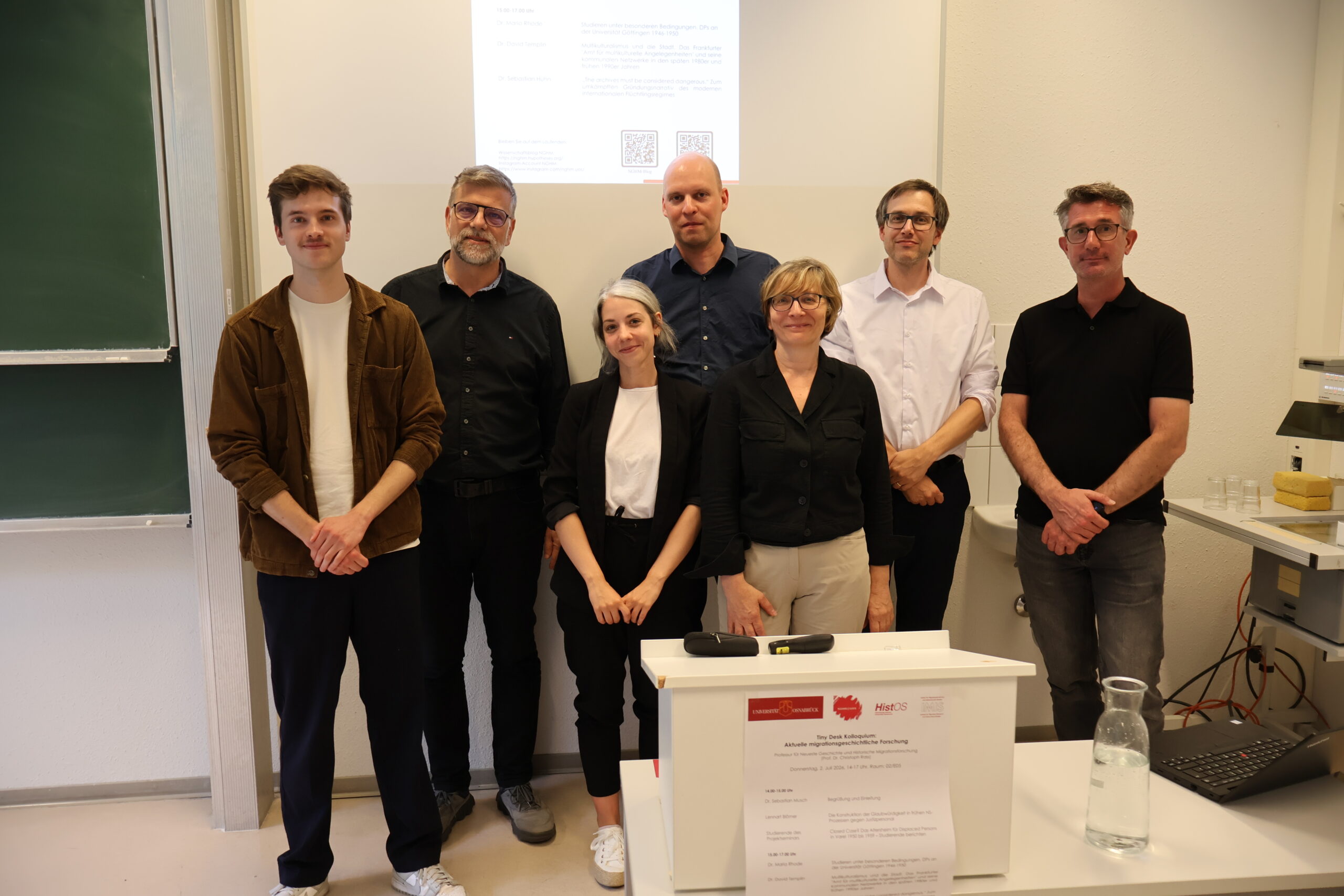
The most recent Tiny Desk Colloquium of the Chair of Contemporary History and Historical Migration Research brought together five contributions under the direction of Dr. Sebastian Musch, ranging from West German post-war justice to digital public history and the politics of history in international organizations. Despite their thematic heterogeneity, the contributions shared a common interest: the question of how categories, narratives, and attributions are historically constructed.
Once each semester, the Chair of Contemporary History and Historical Migration Research uses this format to provide an opportunity to present and discuss theses, research perspectives, and projects. The TDK format brings together five to six presenters for 15-minute short talks with a brief question-and-answer session; the entire event lasts less than three hours.
Credibility and the Category of “Criminal” in Nazi Trials
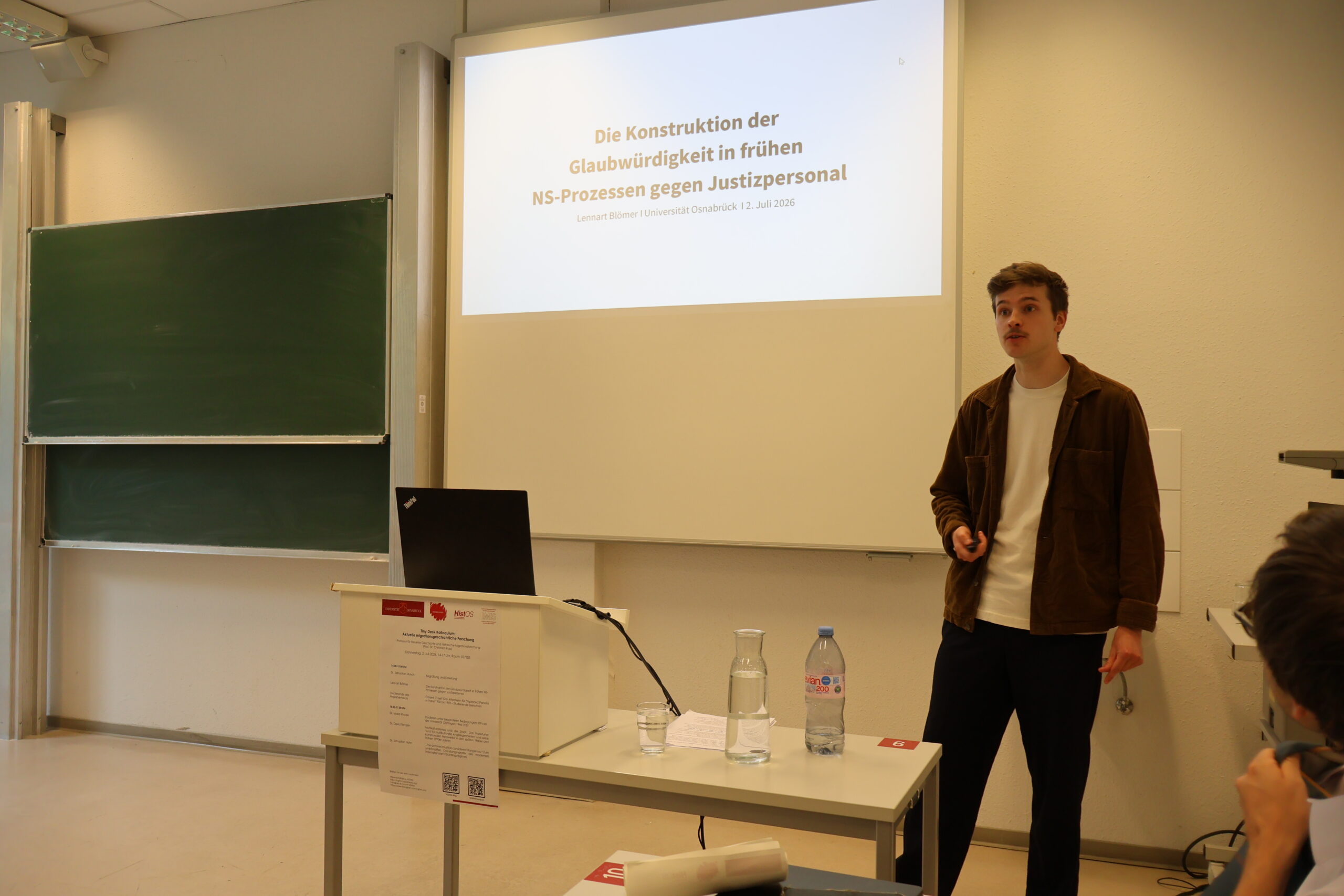
In the first presentation, Lennart Blömer presented findings from his bachelor’s thesis, in which he examined a case from West German post-war justice concerning the administration of criminal punishment under National Socialism. He placed the procedural construction of credibility at the center of his analysis: credibility, as the findings showed, was systematically attributed to those whose testimony supported the desired narrative. The case fits into the structural problem of the “wild verdicts” [arbitrary or legally dubious rulings] of the early Federal Republic, without this allowing for any general conclusions about the strategic use of witness testimony in Nazi trials. The study also elaborated how strongly the attribution of “criminal” depended on different legal and temporal contexts—such as the category of the “habitual criminal” under the Law against Dangerous Habitual Criminals of 1934 [Gewohnheitsverbrechergesetz]—and pointed to further proceedings concerning the Celle penitentiary as a potential avenue for future research.
The discussion deepened the differentiation of the concept of criminality, as well as the question of class and social stigmatization; it became clear that those imprisoned under the Law against Dangerous Habitual Criminals have to this day not been recognized as victims of National Socialism.
The Digital Exhibition on the Varel “Old People’s Home” for Displaced Persons
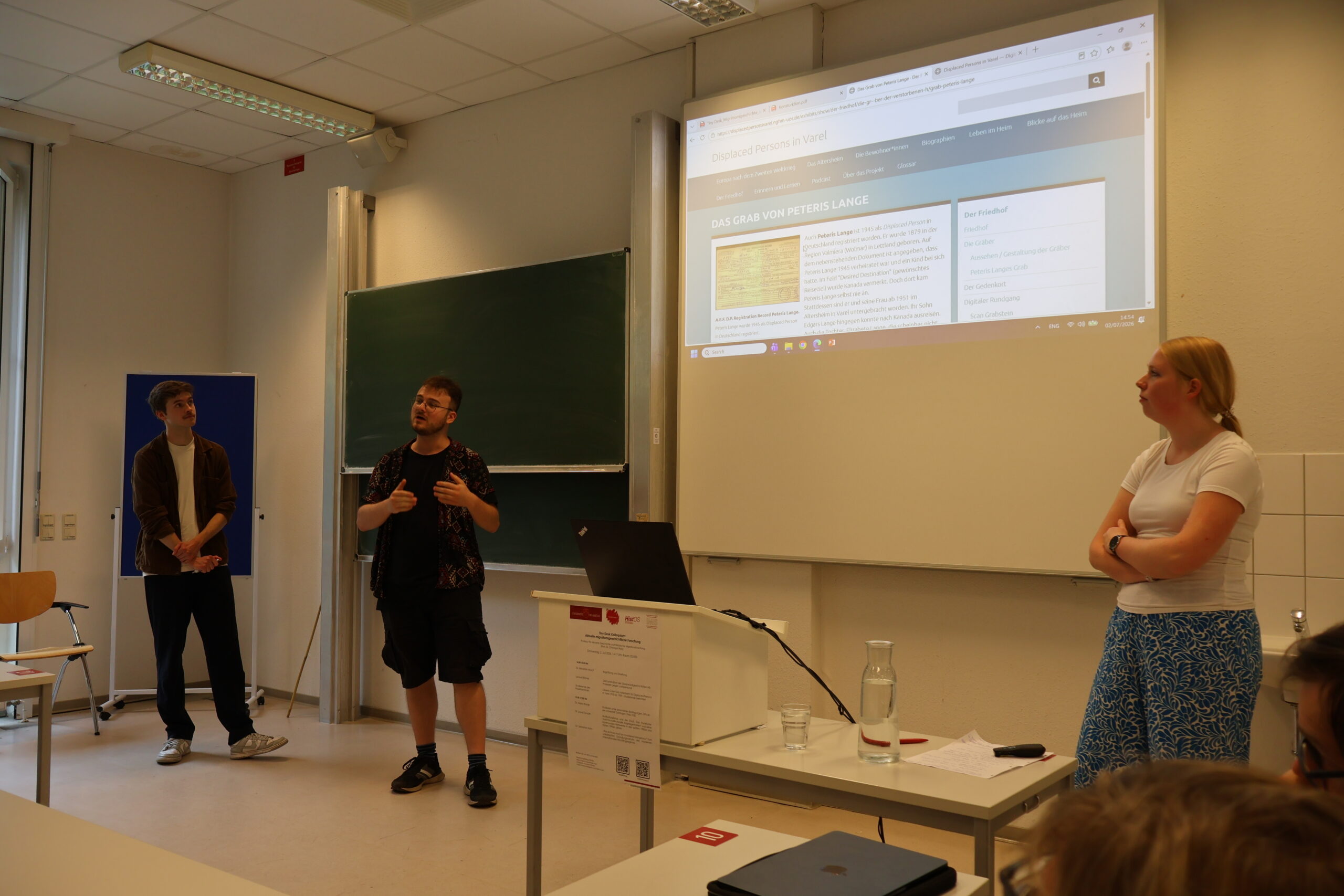
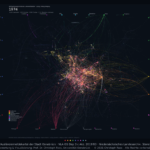
On behalf of a group of students from the University of Osnabrück, Lea Horstmann and Jannik Singer presented the digital exhibition—opened in April—on the largest European “old people’s home” for Displaced Persons, which existed between 1950 and 1959 on the grounds of a former military barracks in Varel. The exhibition emerged from a project seminar spanning several semesters, led by Dr. Sebastian Huhn in cooperation with the Lothar-Meyer-Gymnasium in Varel. The focus was less on the content of the exhibition than on the “making of”: the systematic digitization and analysis of the registration card index held in the archive of the local history association, comprising more than 1,450 individuals; the editorial consolidation of highly heterogeneous texts produced by university students and school pupils; and the possibilities that the digital format offers compared to a conventional exhibition—low costs, the ability to make permanent corrections, and expandability. Also presented was a web app, developed in the context of a digital history course, which visualizes the birthplaces and migration routes of the residents on an animated map, thereby making the underlying data accessible.
The exhibition produced as part of the project has been accessible since April at displacedpersonsvarel.nghm-uos.de.
The discussion revolved around the fine line between source-faithful accuracy and engaging presentation—particularly with regard to the map visualization, which necessarily simplifies the intermediate stages of persecution—as well as questions of data protection, which had been partly pre-determined by the publication of names in the Arolsen Archives.
Displaced Persons as Students at the University of Göttingen
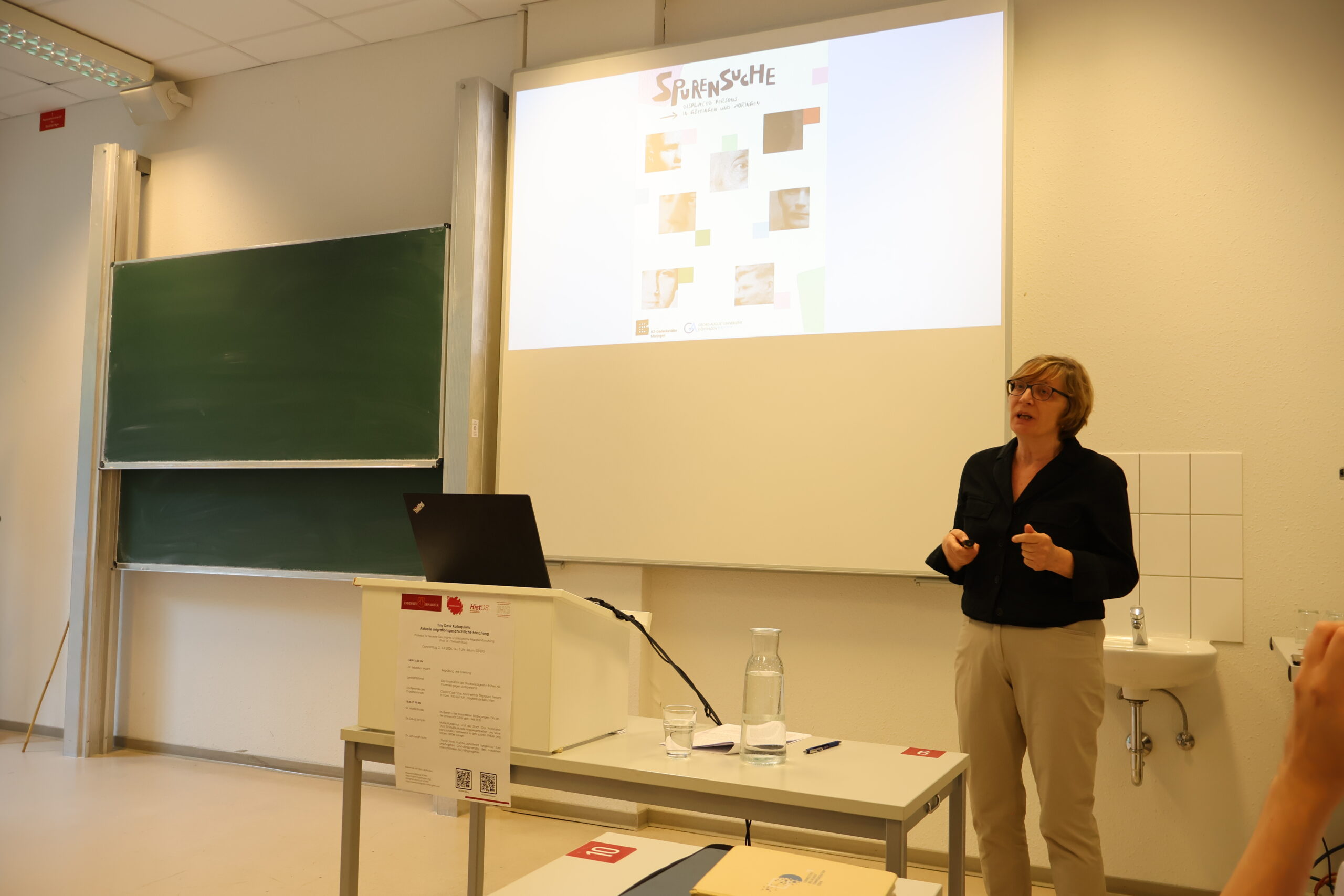
Dr. Maria Rhode (University of Göttingen) presented, in the first scholarly talk, under the title “Under Special Circumstances” [“Unter besonderen Bedingungen”], findings from an exhibition project on Displaced Persons who studied in Göttingen from 1945 onwards. The particular source base is formed by the university’s Questur [bursar’s office], which recorded DP students separately from the summer semester of 1946, making it possible to reconstruct approximately 460 students with DP status, whose national composition, choice of subjects, and housing situation Rhode traced in differentiated detail. She emphasized the semantic distinction between the empathetically charged German “expulsion history” [Vertreibungsgeschichte] and the long-marginalized history of Displaced Persons, and argued in favor of making gaps in the historical record explicit rather than passing over them.
In the discussion, attention was drawn to the correspondence between the national distribution and the patterns identified by Henning Borggräfe for the IRO, as well as to complementary holdings such as the Review Board Files, which render visible those persons at the margins of DP status.
The Frankfurt Office for Multicultural Affairs
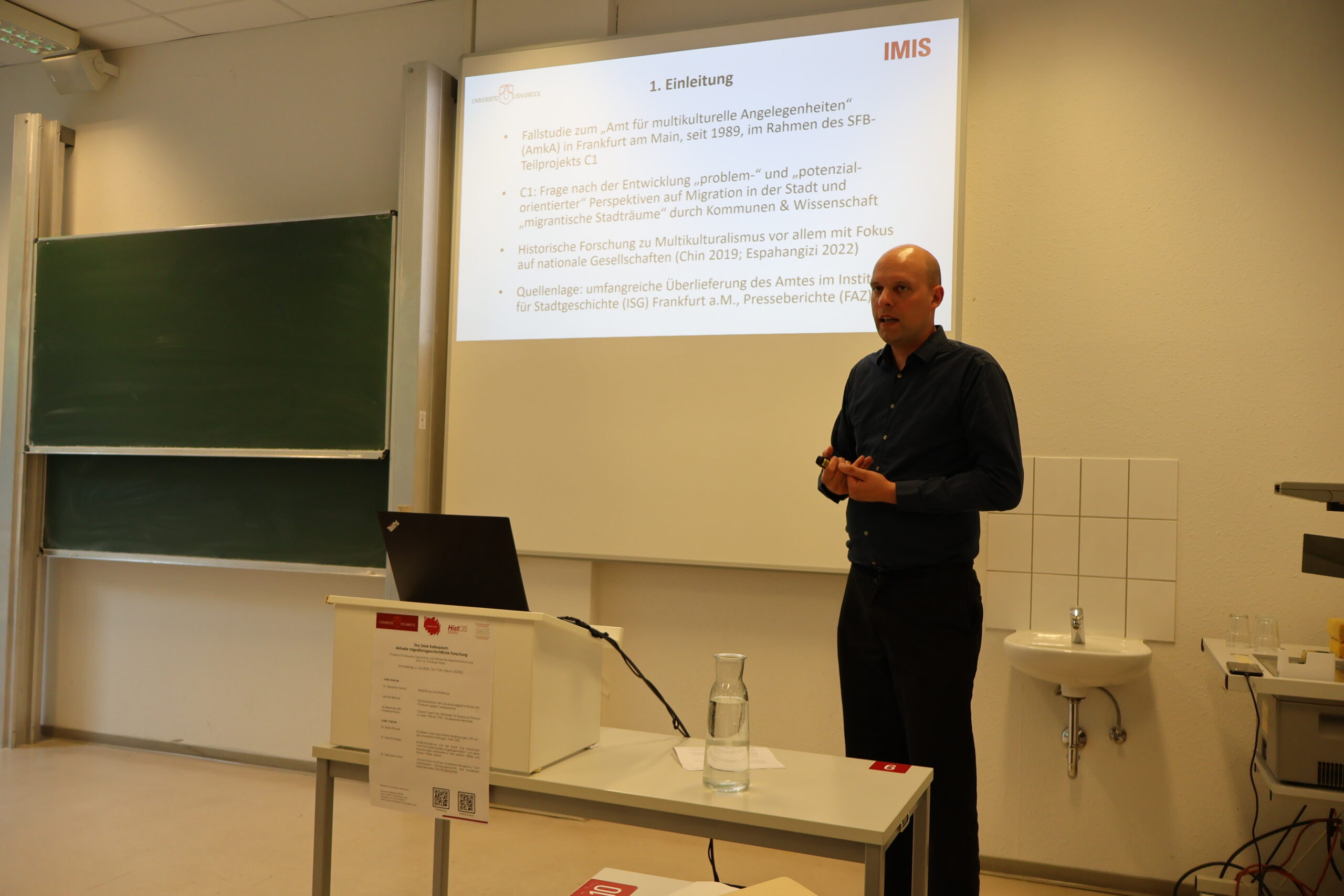
Dr. David Templin (SFB 1604, Subproject C1) shifted the focus to the late twentieth century, presenting a case study of the Frankfurt Office for Multicultural Affairs (AMkA), founded in 1989, situated within the broader question of the significance of the municipal level for the development of local migration and integration policies. Templin outlined the “peculiarly broad coalition” of the multiculturalism debate, positioned the AMkA between politics of recognition, culturalization, and symbolic politics, and demonstrated through the source material how the office sought to counterbalance restrictive federal policy through bilateral contacts, nationwide networking with commissioners for foreign nationals, and a European conference held in 1991, while its competencies in municipal practice proved to be limited.
The discussion raised questions about the semantics of the designation as “Amt” [office] as opposed to “Zentrum” [centre], about the relationship between scholarship and activism in the coining of terminology, and about the left-wing critique of multiculturalism, which targeted above all its culturalizing suppression of structural inequality.
The “Dangerous Archive”: The Suppressed History of the IRO
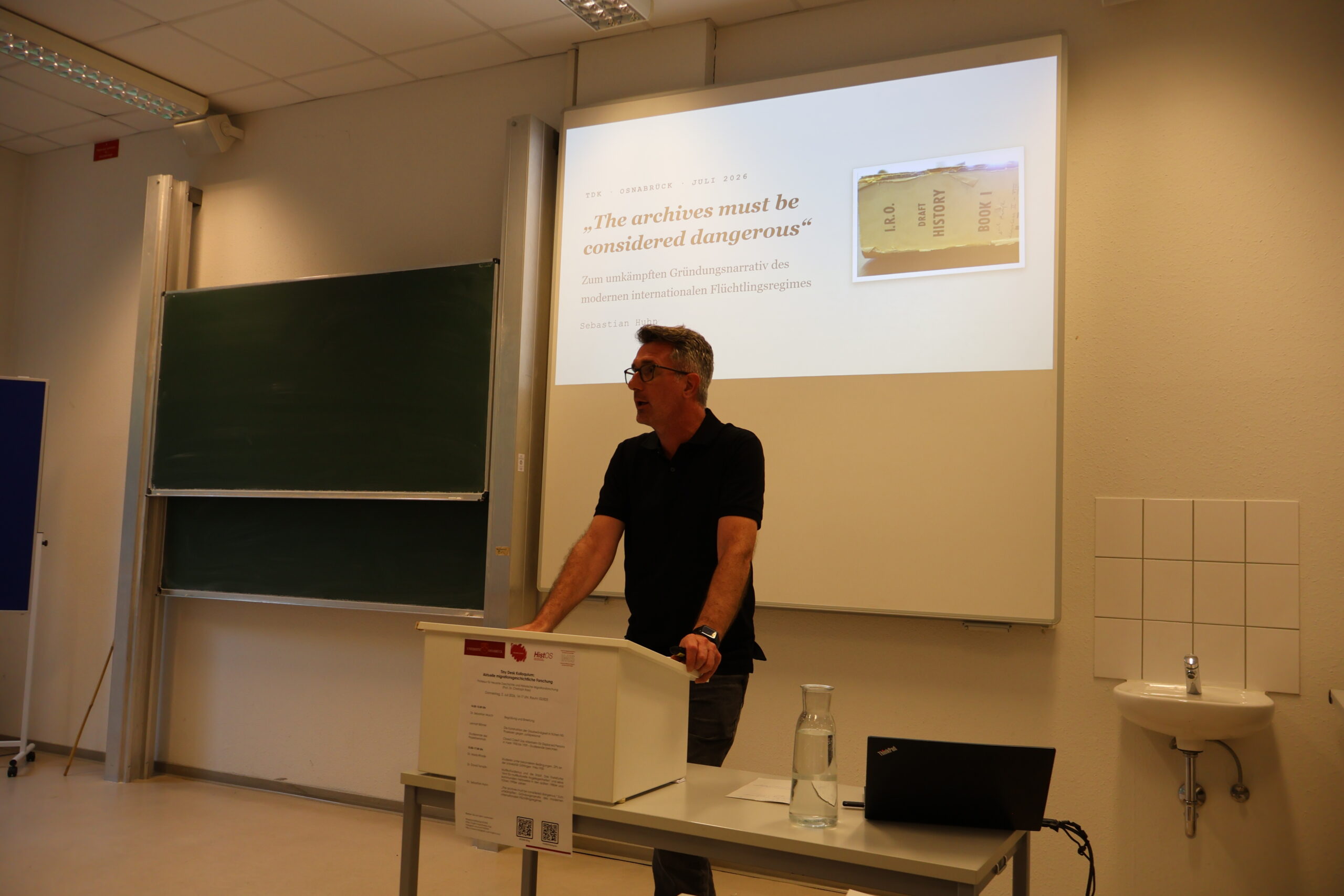
Dr. Sebastian Huhn concluded by presenting a project outline developed jointly with Christoph Rass on the founding narrative of the modern international refugee regime. The starting point is a remarkable finding from the IRO holdings of the Archives nationales in Paris: the official three-volume history of the IRO, initially prepared by the History Unit and already accepted for publication by Oxford University Press, was halted in 1953 following objections from the United States, the team was dismissed, and the task was transferred to Louise Holborn, whose work published in 1956 has since served as an unquestioned reference. Drawing on Michel-Rolph Trouillot, Huhn interpreted this process as a textbook case of the “Silencing of the Past” and emphasized that the unpublished Hacking manuscript constitutes a suppressed counter-narrative available for source-critical comparison.
The discussion connected this to corpus-linguistic methods of textual comparison, by means of which continuations, reinterpretations, and omissions between the versions can be systematically identified, and turned attention to the still open question of Warren’s actual motives, as well as to the striking semantics of the book titles, poised between scholarly historical claim and accountability report.
We invite you to the next edition of the Tiny Desk Colloquium at the end of the winter semester 2026/2027!