Digital Public History Workshop “The ‘Emsland Camps’ as a Conflict Landscape in Transformation

This post was automatically translated from the German original at
Digital Public History-Workshop “Die ‘Emslandlager’ als Konfliktlandschaft in Transformation”.
On 5 June 2025, a workshop took place at the Esterwegen Memorial with students from years 11 and 12 of Georgianum Lingen. The event was conducted as part of the project “The ‘Emsland Camps’ as a Conflict Landscape in Transformation. Research-based Learning at the Intersection of University Teacher Education, Memorial Site Pedagogy and Participatory Digital Public History” by the Chair of Contemporary History and Historical Migration Research (University of Osnabrück) and the Esterwegen Memorial.
The workshop offered participating students the opportunity to engage intensively with the history of the ‘Emsland Camps’ – a complex of 15 former concentration, prisoner, and prisoner-of-war camps in the Emsland region. The focus was on the transformation of these sites from their original use to the present day. The various locations today serve as agricultural land, commercial areas, residential settlements, or correctional facilities, among other uses. Since 2011, a central memorial site has existed at the Esterwegen location, commemorating the history of the 15 camps. The project’s aim is to make these complex sites accessible through digital media and enable a multi-perspective engagement.
A particular emphasis was placed on testing a newly developed digital offering that emerged from the project. This consists of 360° virtual tours of the sites of the 15 former ‘Emsland Camps’ as well as the nine camp cemeteries. The students were able to expand the digital offering through their own projects and thus actively participate in shaping digital historical and memorial culture.
Following an introduction by Jacqueline Meurisch (Esterwegen Memorial) and Imke Selle (NGHM, University of Osnabrück), the day began with a tour of the memorial’s outdoor grounds, led by Lea Horstmann (NGHM, University of Osnabrück & Esterwegen Memorial), who provided students with fundamental information about the design of the memorial site and pointed out historical remains. Subsequently, the students themselves took action and digitised the historical remains using 3D scans and re-photography techniques.
Afterwards, the students were able to view the already created 360° virtual tours on their own devices or provided VR headsets, as well as the 3D scans they had created. In working groups, they then researched various topics in the permanent exhibition of the Esterwegen Memorial and developed information texts that were integrated into the digital tours.
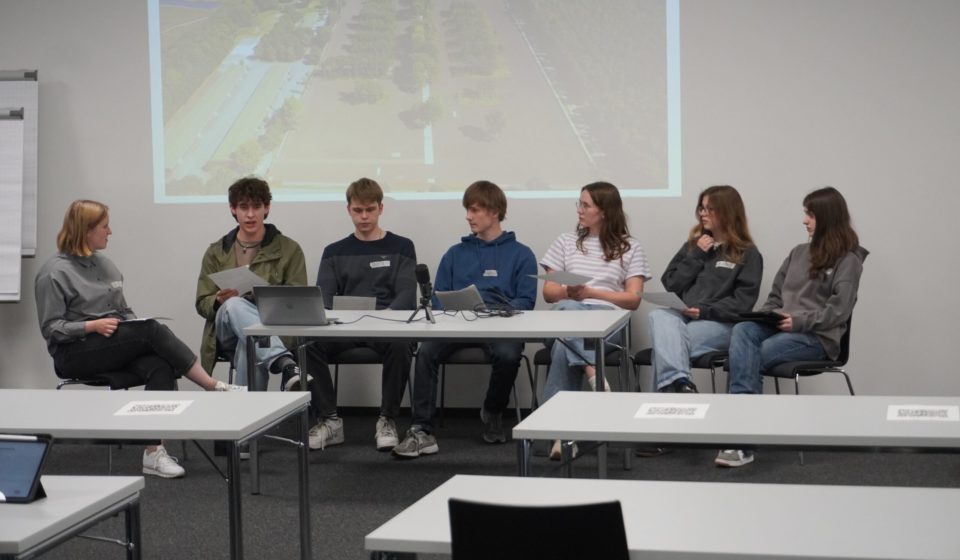
Finally, the students reflected in a panel discussion on the opportunities and challenges of digital formats for history education. The students emphasised that on one hand, the 360° virtual tours helped them better visualise how many concentration, prisoner, and prisoner-of-war camps had existed in the Emsland region. On the other hand, they noted that digital tours cannot replace memorial site visits and the educational and outreach programmes offered at the historical location.
This workshop served as an important pilot phase to evaluate the digital offering with regard to its usability for teaching and memorial site pedagogy. We thank all participating students for their valuable feedback!